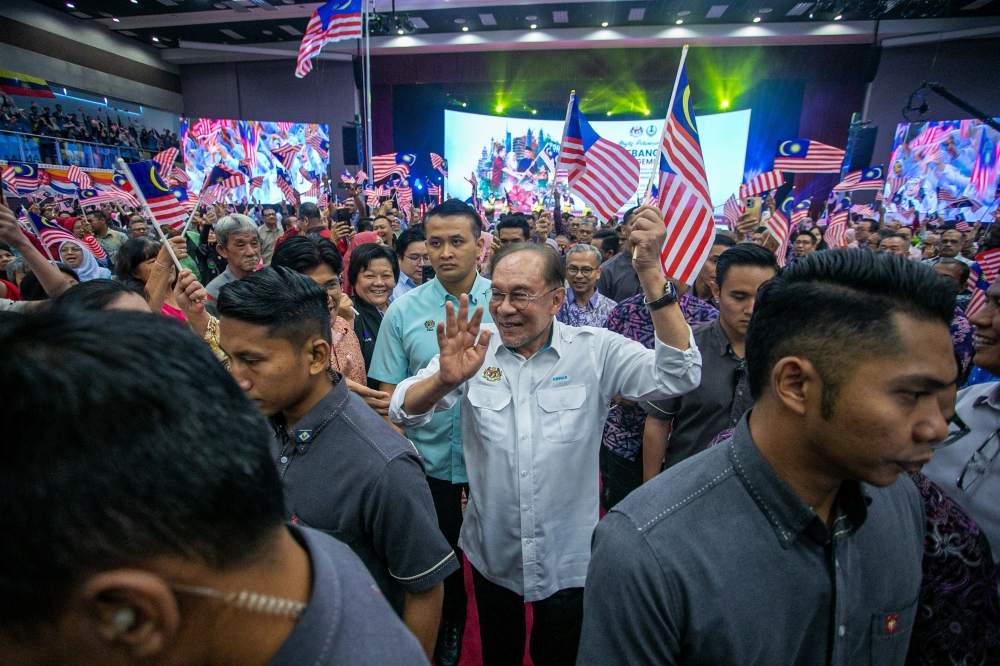
Prime Minister Datuk Seri Anwar Ibrahim has issued a measured directive to government officials, permitting them to participate actively in political campaigning whilst simultaneously emphasising that such activities must remain within defined legal and constitutional parameters. Speaking in Ipoh on July 19, Anwar struck a balance between allowing officials to support their parties and maintaining governmental neutrality, a distinction that carries particular weight in Malaysia's federal system where party politics and state machinery intersect regularly.
The Prime Minister's statement reflects an ongoing tension within Malaysian governance: the reality that cabinet members and senior civil servants inevitably harbour political affiliations, yet their official positions demand impartiality. Anwar's framework attempts to acknowledge this duality by clarifying that participation in campaign activities need not be prohibited entirely, provided that such involvement remains separate from the exercise of government authority and state resources. This approach differs markedly from stricter interpretations that would entirely restrict officials from partisan activities.
What constitutes "crossing the line" in Anwar's formulation centres on the inappropriate deployment of government machinery, resources, or official status for political advantage. Government vehicles, civil service personnel, state facilities, and public funds must not be mobilised to advance partisan causes. This principle, while seemingly straightforward, presents considerable practical challenges given the deep institutional integration of political and administrative hierarchies in Malaysian governance structures. Officials frequently occupy dual roles that blur the distinction between legitimate government functions and party-political activity.
Anwar's intervention addresses cumulative concerns about the misuse of state apparatus during election cycles and political transitions. Opposition figures and civil society observers have periodically raised allegations that government resources and officials are deployed strategically to benefit ruling coalition parties. By articulating boundaries explicitly, the Prime Minister seeks to establish clear expectations whilst acknowledging that total prohibition of political participation among government personnel would be unrealistic and potentially undemocratic. The warning signals that breaches will not be tolerated, even as it permits baseline political engagement.
The timing of Anwar's statement carries contextual significance within Malaysia's current political landscape, where several state-level elections and potential federal electoral cycles loom ahead. Government officials at federal and state levels will face repeated situations testing the boundaries the Prime Minister has outlined. Whether these guidelines will be uniformly applied across all agencies and political levels remains uncertain, as enforcement mechanisms and oversight structures require clarification. The absence of specific penalties or enforcement procedures potentially undermines the directive's effectiveness.
Malaysian administrative culture has historically struggled with establishing clear firewalls between political activity and government function. Civil servants frequently manage this tension by treating campaigning as a personal activity conducted outside official working hours, yet the symbolic weight of a uniformed or titled official supporting particular candidates inevitably associates governmental authority with partisan causes. Anwar's statement implicitly acknowledges these grey zones whilst pushing officials toward greater circumspection and transparency about their activities.
For Southeast Asian observers, Malaysia's experience demonstrates the governance challenges facing democracies where ruling coalitions regularly interact with state institutions. Thailand, Indonesia, and the Philippines have all grappled with similar questions about permissible political conduct by government officials. Malaysia's approach—permitting participation whilst prohibiting resource misuse—represents a middle path between authoritarian restriction and laissez-faire neglect. Whether this framework proves sustainable depends largely on institutional commitment to consistent enforcement.
The statement carries particular relevance for civil service morale and integrity. If government employees perceive that senior officials escape accountability for campaign-related violations, confidence in institutional impartiality erodes across the entire administrative apparatus. Conversely, if enforcement appears selective or politically motivated, accusations of weaponising anti-corruption mechanisms against disfavoured officials gain traction. Anwar's clarification aims to establish shared understanding, though translating principles into consistent practice remains challenging across Malaysia's complex federal and state bureaucracies.
International observers and democratic governance analysts will scrutinise how these guidelines operate in practice, particularly during electoral periods when political temptations intensify. The credibility of Anwar's administration may depend substantially on demonstrated adherence to the boundaries articulated in Ipoh. Transparency mechanisms, such as declaring campaign activities or establishing oversight bodies to investigate allegations of resource misuse, would strengthen implementation. Without such structural supports, the Prime Minister's words risk becoming aspirational rhetoric disconnected from institutional reality.
For ordinary Malaysians, these guidelines theoretically protect the principle that government services remain neutral and accessible regardless of political affiliation. When official authority becomes intertwined with campaign activity, citizens from opposition areas or those supporting competing parties may experience subtle or overt discrimination in accessing government services. Anwar's emphasis on maintaining boundaries thus serves not merely administrative efficiency but fundamental democratic principles regarding equal citizenship and state neutrality.
Moving forward, specific guidance documents, training programmes, and accountability mechanisms will determine whether Anwar's statement produces substantive change or remains a high-level exhortation without teeth. Departments such as the Public Service Department could develop detailed protocols clarifying permitted and prohibited activities. Establishing independent complaint mechanisms for alleged violations would signal serious commitment. Without such institutional reinforcement, even well-intentioned guidelines struggle to overcome entrenched patterns of political-administrative fusion characteristic of Malaysian governance.

