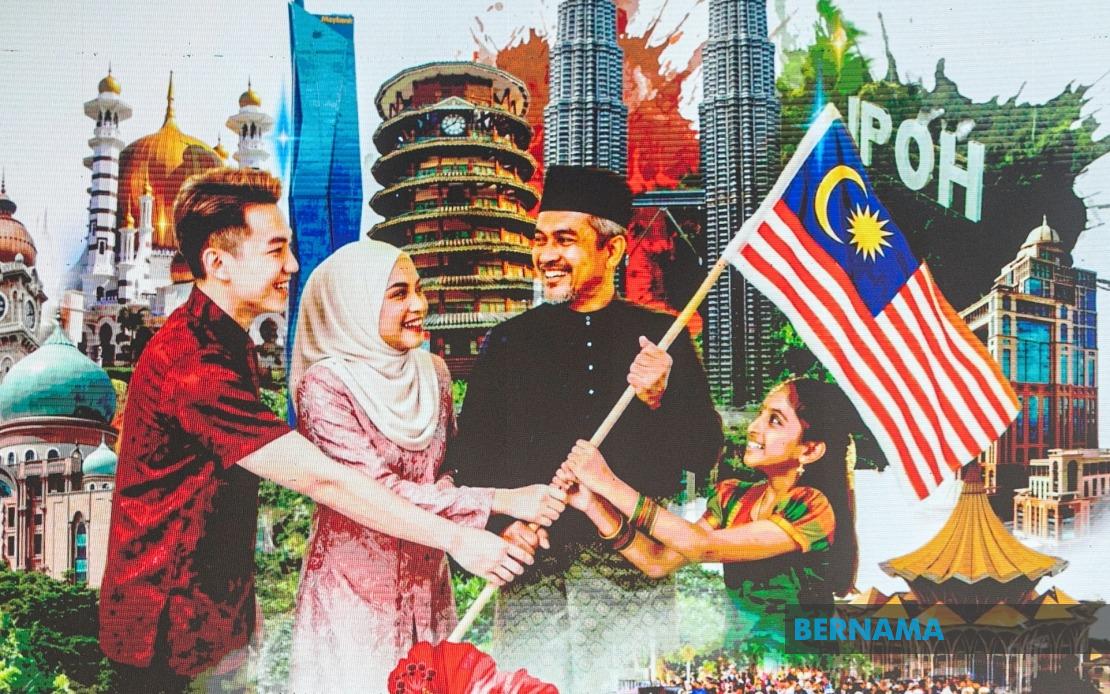
Communications Minister Datuk Seri Fahmi Fadzil has issued a timely advisory to content creators and the broader public to exercise vigilance when deploying artificial intelligence tools to generate imagery of the Jalur Gemilang, Malaysia's national flag. The warning comes amid rapid proliferation of AI-generated content across digital platforms and coincides with the launch of the 2026 National Month campaign preparations, held in Ipoh on July 19 at the Sultan Azlan Shah Ministry of Health Training Institute in Tanjung Rambutan.
The minister's concern centres on a specific vulnerability in AI systems: their propensity to introduce errors when rendering the flag's defining characteristics, most critically the 14 horizontal stripes that form a foundational element of the Jalur Gemilang's design. While artificial intelligence has become increasingly sophisticated at generating visual content, these systems occasionally struggle with precise reproduction of symbolic imagery, particularly when specific numerical or geometric details must be maintained with absolute accuracy. The omission or misrepresentation of even a single stripe could undermine the flag's integrity and diminish its symbolic power during national celebrations.
Fahmi emphasised that content creators should take personal responsibility for verifying any AI-generated flag imagery before disseminating it across social media platforms, websites, or other public channels. Rather than treating AI outputs as automatically accurate, creators must adopt a quality-assurance mindset, manually reviewing generated images to confirm that all design elements match official specifications. This human-in-the-loop approach recognises both the utility of AI tools and their current limitations when dealing with culturally significant and precisely-defined symbols.
The ministry has outlined a graduated enforcement strategy that prioritises education over punitive measures. Fahmi indicated that when errors are discovered, officials will initially contact the parties responsible and request voluntary correction of the content. Only if these advisory overtures prove unsuccessful, or if violations appear deliberate, would authorities consider invoking existing legislation that governs misrepresentation of national symbols. This measured approach acknowledges the novelty of AI-generated content problems while demonstrating resolve to protect national imagery from distortion.
To address this emerging challenge systematically, the Communications Ministry plans to collaborate with the Malaysian Press Institute and the Malaysian Media Council, mobilising media organisations across the country to uphold flagging standards throughout the National Month period. By enlisting industry partners who understand content production workflows, the government aims to create a collaborative ecosystem where accurate flag representation becomes embedded in professional norms rather than enforced through legal threats. This partnership model leverages existing institutional relationships to spread awareness and encourage compliance among content creators who regularly engage with media councils.
The Fly the Jalur Gemilang campaign, launched during an official event attended by Prime Minister Datuk Seri Anwar Ibrahim, National Unity Minister Datuk Aaron Ago Dagang, and Perak Menteri Besar Datuk Seri Saarani Mohamad, encourages Malaysians to display the national flag from mid-July through September 16. The campaign extends beyond mere patriotic display; it incorporates educational components about proper flag etiquette and specifications. Citizens are urged to invest time in learning correct flag protocols, transforming what might otherwise be a mechanical participation into a more meaningful engagement with national symbols and their proper treatment.
Fahmi called upon Malaysians to fly the Jalur Gemilang throughout their residential areas, villages, and at government premises as part of this broader initiative to reinvigorate patriotic sentiment. The sustained display of the flag across diverse community spaces—from urban neighbourhoods to rural settlements—creates a visual landscape of national unity whilst simultaneously normalising the sight of accurately-rendered flag imagery. When residents see consistently correct flag representations in their immediate environment, they internalise proper design standards and become better equipped to identify and question inaccurate versions elsewhere.
The 2026 National Month and Malaysia Day celebrations will adopt a distributed hosting model, with the main National Day festivities taking place in Putrajaya whilst Malaysia Day celebrations shift to Sarawak. This geographical division reflects Malaysia's federal structure and the constitutional significance of Sarawak as one of the nations founding territories. The exact venues in Sarawak remain under discussion, though organisers are expected to select locations that carry historical resonance and logistical feasibility for managing large-scale commemorative events.
This warning about AI-generated flag content arrives as governments globally grapple with emerging challenges posed by generative artificial intelligence. The Jalur Gemilang case illustrates how even well-intentioned technological tools can inadvertently produce culturally problematic outputs when applied to symbols imbued with profound national meaning. Malaysia's preemptive approach—establishing guidelines before widespread problems occur—positions the country ahead of the curve in addressing this category of AI-related governance challenges. By framing the issue as one requiring collaborative education rather than adversarial regulation, Fahmi's ministry demonstrates nuanced understanding of how technology adoption intersects with cultural protection.
For content creators and digital media professionals across Southeast Asia observing Malaysia's response, the episode underscores the importance of maintaining human oversight in AI workflows, particularly when cultural symbols are involved. As artificial intelligence capabilities expand, the interplay between automated systems and human judgment becomes increasingly critical. Malaysia's emphasis on accuracy, coupled with its willingness to work with media institutions to establish voluntary standards, offers a template that other countries might adapt when confronting similar challenges with their own national imagery.
The broader implications extend beyond flag representation to encompass how digital societies navigate rapid technological change whilst preserving cultural integrity. As AI tools become standard components of content creation pipelines, establishing protocols for protecting symbolic imagery serves as a foundational safeguard. The Communications Ministry's collaborative approach, combining technological literacy with patriotic education, suggests that defending national symbols in the age of artificial intelligence requires not prohibition but rather informed participation—ensuring that the tools serve cultural preservation rather than inadvertently undermining it.

