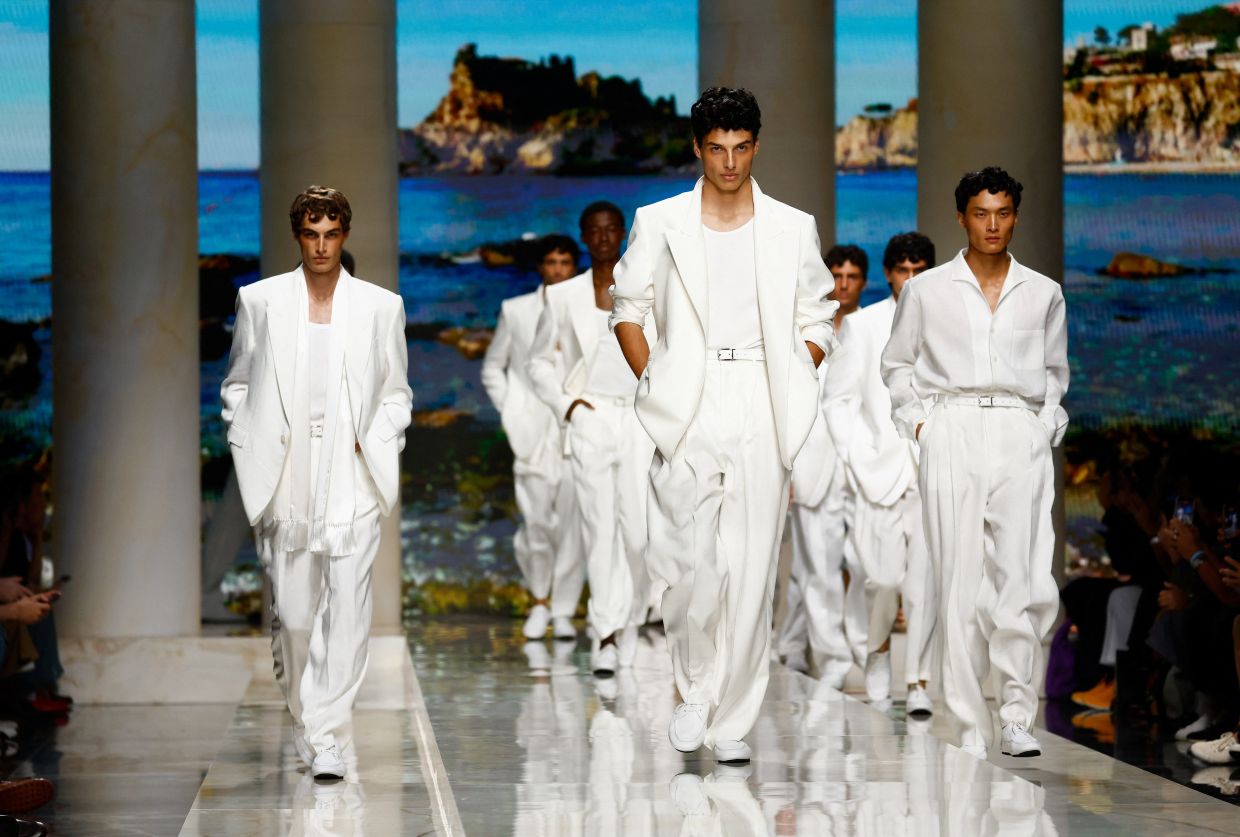
Milan's menswear designers have chosen a moment of profound global instability to advocate for the opposite: restraint, clarity, and the elegant power of doing less. Closing on Monday, Milan Fashion Week showcased collections for Spring/Summer 2027 that, in the face of economic anxiety, geopolitical turbulence, and the punishing heat of a Milan summer, moved deliberately away from excess. The result is a fashion season defined less by what designers added than by what they chose to remove, reimagining the fundamentals of men's dressing through the twin lenses of proportion and material innovation.
Prada's dual leadership of Miuccia Prada and Raf Simons set the philosophical tone early, championing a vision rooted in simplicity and the deliberate reinterpretation of clothing archetypes. This wasn't minimalism for its own sake, but rather a strategic refocus on how familiar garments could be reinvented through subtle shifts in construction and textile choice. That philosophy rippled across the Milanese schedule, creating an unusual consensus among designers who might otherwise pursue divergent aesthetics. The mood felt almost utilitarian in its sensibility, a marked departure from the oversized silhouettes and theatrical excess that have defined menswear for much of the past decade.
Yet this embrace of simplicity created an unexpected tension on Milan's runways. Despite the philosophical commitment to restraint, the practical reality of dressing for summer proved far more complicated than mere reduction. Designers filled their collections with substantial materials—leather, knits, and structured fabrics—that seem fundamentally at odds with the season they're designed for. The paradox suggests that Milan's design elite may require creative solutions to render their visions wearable: industrial-strength climate control, strategic mountain retreats, or perhaps a migration toward cooler latitudes. This friction between aesthetic vision and climatic reality underscores a broader challenge facing contemporary fashion: how to maintain sophistication and material richness without sacrificing functionality.
The persistence of leather throughout the collections emerged as perhaps the season's most intriguing surprise. Prada approached the material with conceptual clarity, drawing inspiration from the democratic universality of denim to create leather pieces that echoed casual utility in elevated form. Slim five-pocket trousers paired with cropped, flat-pocketed jackets that functioned simultaneously as structured shirts demonstrated how a single material could be reimagined through proportion and silhouette. Beyond Prada, other designers pursued technical innovation, employing woven and perforated techniques that increase breathability while maintaining leather's inherent luxury and visual weight. This represents a crucial distinction for luxury brands grappling with sustainability and practicality: material integrity needn't mean sacrificing comfort or climate-appropriateness.
After years in which oversized, voluminous silhouettes dominated men's fashion, Milan signalled a decisive return to body-conscious tailoring. Designers demonstrated broad agreement on a fundamental principle: a properly dressed man still wears a suit. The innovation lay not in rejecting this convention but in engineering how suits might survive rising temperatures. Ventilation became the operative strategy, manifested through unbuttoned dress shirts, transparent fabrics, and in some instances, the elimination of shirts entirely. Long trousers maintained their dominance, but the relationship between fabric and body tightened considerably. Dolce & Gabbana pursued this logic most aggressively with microshorts that deliberately exposed muscular definition, while several other houses unveiled designs featuring bare torsos beneath layered outerwear. This recalibration represents a generational shift in menswear philosophy, acknowledging that contemporary masculinity can encompass both formal structure and physical visibility.
Tailoring itself underwent subtle but significant transformation. Rather than abandoning construction's discipline, designers softened its expression, opening necklines, experimenting with innovative fabric combinations, and reconceiving structural techniques to maximize airflow without sacrificing silhouette. The result was a category of tailored clothing engineered explicitly for climate change—formal wear that acknowledges rising global temperatures without resorting to casualness or aesthetic compromise. US designer Thom Browne, now operating under Zegna's ownership, marked his Milan return after a fifteen-year absence with collections built from layered suiting in summer-friendly seersucker and the pleated skirts that have long anchored his brand identity. His reappearance symbolized both a design house's evolution and the broader maturation of menswear as a category capable of substantial intellectual and material sophistication.
Not every designer cleaved to Milan's philosophy of reduction. Philipp Plein presented crystal-encrusted denim ensembles requiring days of meticulous handcraft to complete, while Dolce & Gabbana indulged in elaborate embellishment featuring beaded accents evocative of coral formations. These declarations of maximalism and unapologetic glamour formed a deliberate counterpoint to Prada's reductionist vision, suggesting that the fashion industry remains capacious enough to accommodate fundamentally different philosophical approaches. This coexistence of restraint and excess, practicality and spectacle, reflects fashion's enduring capacity to serve multiple cultural functions simultaneously—from identity expression through minimalist clarity to status signaling through elaborate ornamentation.
A lighter Milan calendar this season created unexpected opportunity for emerging and mid-tier designers to command attention alongside the industry's most established houses. Martin Quad made his Milan debut introducing unconventional tailoring techniques developed in his native Copenhagen, securing critical recognition in a venue typically reserved for established names. Domenico Orefice explored the possibilities of leather and richly textured woven materials within a co-ed collection framework, suggesting how luxury materials might transcend traditional gender categories. Japanese designer Shinya Kozuka's label Shinyakozuka produced one of the season's most memorably summery collections, epitomized by a bare-chested model draped in a billowing sheer coat of teal—a vision simultaneously ethereal and confident, pairing delicate transparency with voluminous proportion and the stability of oversized white trousers.
For Malaysian and Southeast Asian menswear enthusiasts, Milan's Spring/Summer 2027 direction carries particular relevance. The region's tropical climate creates its own pressures on fashion expression, often pushing local consumers toward casualness or imported European aesthetics incompletely adapted to equatorial conditions. Milan's emphasis on breathable luxury, technically innovative materials, and tailoring engineered for warmth suggests a middle path—the possibility that formal dress need not be abandoned in hot climates, but rather reimagined through intelligent material selection and construction innovation. As the region's middle class continues to expand and aspirations toward sophisticated menswear grow, Milan's message that simplicity and functionality can coexist with luxury and formal structure offers a blueprint particularly suited to local conditions and aspirations.
The overarching narrative emerging from Milan is one of maturation rather than revolution. In uncertain times, designers gravitated toward clothes of genuine utility, garments that acknowledge both the body and the climate while maintaining formal integrity. The suit, that most enduring masculine uniform, survives—but transformed, ventilated, reconceived for contemporary realities. This represents fashion's mature response to global instability: not escapism or frivolous elaboration, but rather a deepening of craft and a recommitment to the principle that beautiful clothes should also be wearable ones.