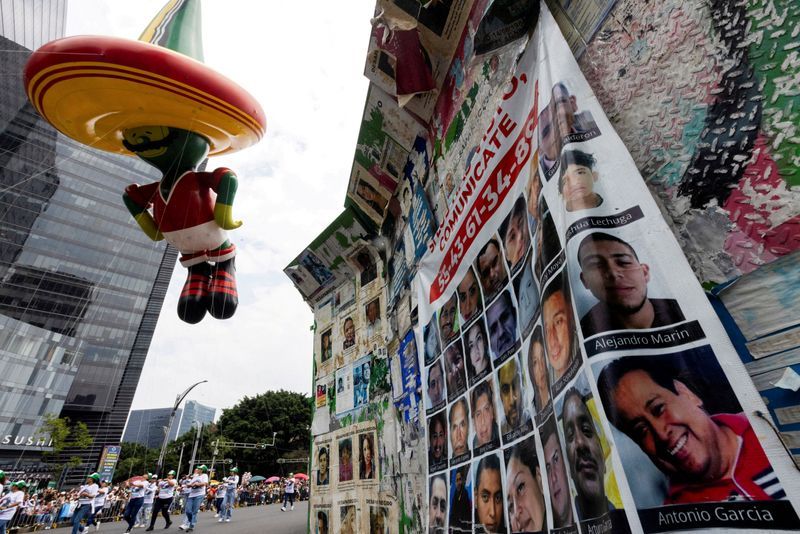
Mexico's passage to the World Cup knockout stage has ignited celebrations across the nation, yet the backdrop to this sporting triumph reveals a country wrestling with profound social divisions. The Paseo de Reforma in Mexico City, adorned with massive screens broadcasting the team's undefeated group-stage performance, simultaneously displays posters of the country's 135,000 missing persons—a haunting reminder that national joy and individual tragedy coexist in contemporary Mexican life. This juxtaposition encapsulates the peculiar challenge facing millions of Mexicans who must navigate the emotional release of supporting their national team whilst confronting the reality of systemic violence, economic hardship, and governance failures that continue unabated.
The scale of Mexico's missing persons crisis has reached unprecedented proportions since former President Felipe Calderón initiated his military-led war on drug cartels in 2006. What began as a targeted counter-narcotics strategy has instead generated decades of bloodshed, displacement, and disappearances that now number in the hundreds of thousands. Families across the country have become ensnared in an endless cycle of searching for loved ones, attending forums, and petitioning authorities for answers that rarely materialise. The placement of these missing persons posters alongside World Cup promotional materials creates an uncomfortable visual testimony to the failure of the state to protect its citizens, a stark contrast that many Mexicans find impossible to ignore regardless of sporting success.
Beyond the missing persons crisis, Mexico's economy presents another source of anxiety for ordinary households. Although inflation demonstrated signs of moderation in early June, the Bank of Mexico's core inflation rate remained elevated above its 3 percent target, continuing to compress household purchasing power and limit consumption. For low and middle-income families, the cost of living crisis has become a daily reality that transcends the temporary psychological relief offered by World Cup victories. This economic squeeze has been particularly acute regarding access to the tournament itself, as ticket prices have reached levels that place stadium attendance beyond the reach of most Mexican fans—a troubling democratisation of privilege that fundamentally changes the nature of national sporting experience.
Commentator Carlos Mendoza articulated a widely shared observation about how the World Cup functions as a national sedative, enabling Mexicans to temporarily suspend engagement with uncomfortable political realities. He identified a specific parallel concern: allegations of collusion between Morena party politicians and drug trafficking organisations, a charge that strikes at the heart of government credibility and institutional integrity. Yet Mendoza cautioned that this escapism is temporary, that the underlying dysfunction will persist regardless of how far the national team progresses. This analysis resonates deeply with the Mexican experience, where sporting nationalism has historically served as a pressure valve allowing governments to defer confronting systemic problems that demand immediate attention and substantial resource allocation.
Protest has remained a constant presence throughout the tournament, with Reforma repeatedly blocked not only by celebrants but by organised groups demanding government accountability. The CNTE teachers' union established encampments along central thoroughfares, their tents creating physical obstacles that symbolised the ongoing struggle for labour rights and pension reform. These activists are pressing the government to repeal a 2007 law that restructured public-sector pension and social security provisions, demands accompanied by calls for salary increases commensurate with inflation. The collision between World Cup euphoria and labour unrest highlights how major sporting events can paradoxically intensify awareness of institutional inequality by creating temporal contrasts between national celebration and persistent grievance.
The cost of celebration itself has emerged as a troubling issue. Mexico's dominant victory over Ecuador in the round of 32—the nation's first knockout-stage World Cup win in four decades—was accompanied by tragedy when four people died during post-match festivities around Reforma. These deaths represent not merely unfortunate accidents but symptomatic failures of crowd management, emergency services coordination, and urban planning that extend far beyond the scope of any single sporting event. They underscore how national celebration in Mexico remains entangled with risks that disproportionately affect lower-income communities with limited access to safe public space and emergency medical care.
Local political leaders have attempted to articulate a more nuanced understanding of Mexican citizenship that acknowledges the capacity for simultaneous emotions. Rodrigo Cordera, speaking through social media, reminded constituents that patriotic enthusiasm for ninety minutes of football need not preclude anger at FIFA, frustration with the Mexico City government, or concern about national direction. This articulation of emotional complexity reflects an emerging recognition that mature democratic engagement requires holding contradictory sentiments rather than surrendering critical faculties to the intoxication of sporting success. The statement implicitly critiques simplified narratives suggesting Mexicans must choose between national pride and political accountability, positioning these as compatible rather than mutually exclusive orientations.
President Claudia Sheinbaum's domestic political standing appears comparatively robust, with approval ratings recorded at 69 percent in El Financiero polling, reversing earlier declines that began in March. The government has publicly committed to locating missing persons as a national priority, though implementation mechanisms and resource commitments remain contested. Sheinbaum's capacity to maintain approval even amid economic and security challenges suggests that Mexican public opinion operates across multiple registers, evaluating leaders on distinct dimensions rather than applying uniform standards. The World Cup has provided a backdrop that has potentially assisted the government in managing perceptions, though it remains unclear whether this tournament-induced benevolence will translate into durable political capital once football competition concludes.
Mexican resident Alejandra Gonzalez offered a perspective that captures the sophisticated understanding many citizens possess regarding the World Cup's role in national life. She acknowledged that the tournament functions to reprioritise rather than resolve troubles, creating psychological space that governments can exploit to postpone difficult decisions. Yet she simultaneously expressed hope that celebration might catalyse positive collective sentiment, conditional upon maintaining critical consciousness regarding inequality and institutional inconsistency. This formulation suggests that the most engaged Mexican citizens reject false binaries between enjoyment and critique, instead seeking approaches that permit celebration whilst sustaining vigilance about governance quality and social equity.
The anti-World Cup graffiti adorning walls across Mexico City and surrounding the Azteca Stadium bears witness to those who have declined to participate in tournament enthusiasm, viewing the event as emblematic of misplaced priorities. These messages represent not mere spoilsports but articulate dissent regarding how national resources and attention are allocated. For these critics, the massive infrastructure investment, security apparatus, and international attention directed toward football stands in stark contrast to the underfunded systems addressing disappeared persons, inadequate healthcare delivery, and educational inequality. The persistence of these voices throughout the tournament has ensured that no Mexican can experience World Cup celebration without encountering organised reminders of alternative interpretations of national interest.
As Mexico's World Cup journey continues, the fundamental tension between national sporting achievement and domestic institutional failure remains unresolved. The tournament offers temporary psychological relief from persistent anxieties, yet this relief cannot substitute for substantive policy changes addressing inflation, security, labour rights, and governance transparency. Mexican citizens have demonstrated considerable sophistication in navigating this paradox, many refusing to choose between patriotic engagement and critical consciousness. Whether sustained engagement with these underlying issues will outlast the World Cup's conclusion, however, remains the central question confronting Mexican political leadership and civil society alike.

