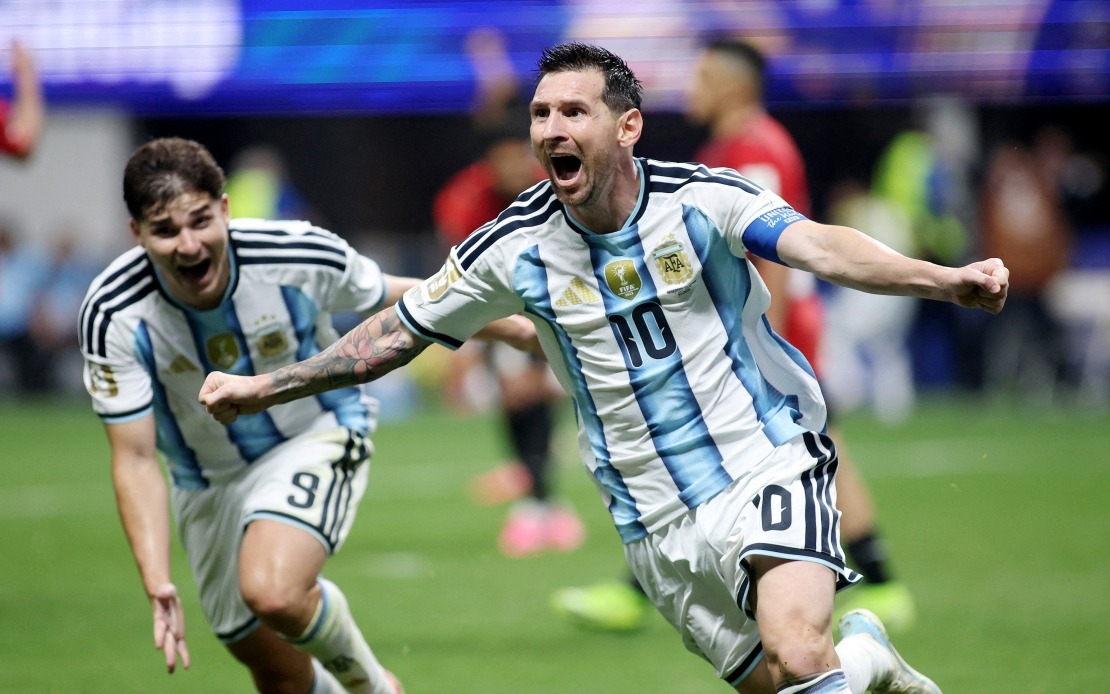
The football world is witnessing an extraordinary display of longevity as 39-year-old Lionel Messi pursues another World Cup title, having already etched his name across the record books this summer with a series of historic milestones. Argentina's captain will lead his team against England on Wednesday in Atlanta, seeking to add yet another chapter to his legendary international career that defies the typical trajectory of athletes entering their final years.
Messi's journey to the quarter-finals has been marked by an eight-goal haul that places him level with France's Kylian Mbappé at the top of the tournament's scoring charts. This positions the two stars as the overwhelming favourites to claim the Golden Boot award, though the competitive dynamics between them remain intriguingly balanced. Beyond raw goal-scoring numbers, Mbappé currently holds the advantage in secondary metrics, having provided more assists and used fewer minutes than his Argentine counterpart, giving the French sensation the edge on the traditional tiebreaker criteria. Behind these two titans, England's Harry Kane and emerging talent Jude Bellingham occupy the next tier with six goals each, though their mathematical prospects of claiming the award have dimmed considerably as the tournament progresses into knockout stages.
The Golden Boot represents one of the few major individual accolades absent from Messi's extraordinary personal collection, a gap that traces back to Qatar 2022 when Mbappé's hat-trick in the final proved decisive despite his team's loss to Argentina. That tournament saw Messi net seven goals, including the crucial second-half strikes that carried Argentina through the penalty shootout against France. The psychological weight of capturing this particular honour, long held by others, could provide additional motivation as he approaches what many expect to be his final World Cup campaign. Unlike some players who decline invitations or lose interest, Messi's return to international football nearly four years after the 2022 triumph demonstrates an appetite for competition that shows no signs of diminishing.
Messi has fundamentally altered the World Cup's all-time scoring landscape during this tournament. His accumulated tally of 21 World Cup goals places him within striking distance of the record books, yet Mbappé's relentless pursuit suggests the younger player will eventually claim long-term ownership of this metric. The pair have decisively surpassed Miroslav Klose's previous benchmark of 16 goals, a record that stood for over a decade and underscores just how exceptional the current generation of attackers has become. Even Harry Kane, who has climbed to 14 career World Cup goals, finds himself substantially outpaced by this new standard of excellence that reflects both improved attacking systems and the durability of elite players across multiple tournament cycles.
Beyond individual scoring records, Messi and Cristiano Ronaldo have jointly shattered fundamental longevity standards in World Cup football. Both men have now appeared in six different World Cup tournaments, becoming the first male players to achieve this milestone in the competition's 75-year history. This achievement holds particular resonance for the global football community, as it challenges long-standing assumptions about athletic decline and the finite window for peak performance at international level. Messi's remarkable consistency across nearly two decades of World Cup participation reflects not merely physical capability but an exceptional capacity for adaptation and mental resilience.
Messi's appearance count provides further perspective on his unparalleled World Cup resume. He is poised to register his 33rd appearance on Wednesday, extending his lead over Ronaldo's 27 appearances by a margin that illustrates the Argentine's additional involvement in recent tournaments. This statistic carries significance beyond mere numerology, as it demonstrates Messi's continued selection and utilisation by Argentina's coaching staff, a testament to his ongoing value despite being well into what would normally be considered the twilight of a footballer's career. His journey began in 2006 when he scored once on debut, though the 2010 tournament saw him contribute no goals before he exploded onto the World Cup stage with four goals in 2014 at Brazil.
The 2018 tournament yielded one goal before Messi's epochal 2022 campaign transformed expectations about what a 35-year-old could accomplish. That Qatar tournament represented a watershed moment, with Messi netting more goals than he had managed across the previous four World Cups combined, a stunning concentration of performance that redefined late-career possibility in elite football. His contribution proved decisive in Argentina's march to the trophy, with particular impact in knockout matches where clinical finishing determined outcomes. The emotional resonance of that victory cannot be separated from its sporting achievement—a nation had invested considerable hope in a final opportunity for its greatest player to win the ultimate team prize.
Penalty conversion, however, reveals a more complex narrative within Messi's World Cup legacy. While his shootout record stands perfect with three successful conversions from three attempts in knockout scenarios, his open-play penalty statistics paint a less decorated picture. He has converted only four of eight penalties across World Cup tournaments, a surprisingly modest return that contradicts his reputation for reliability from the spot. This summer has brought two additional misses, including one dispatched wide against Austria and another saved by Egyptian goalkeeper Mostafa Shobeir in the round of 16, resurfacing a vulnerability that has periodically undermined his personal performance metrics despite its minimal impact on team results.
The statistical contrast between Messi's penalty shootout success and open-play penalty record creates an intriguing subplot to his tournament narrative. His perfect record in shootouts—against the Netherlands in both 2014 and 2022, and France in the 2022 final—demonstrates his capacity to deliver under extreme pressure when tournament survival hangs in balance. Yet his below-average conversion rate from open play suggests a distinction between clinical execution under shootout conditions and the different psychological terrain of in-game penalties. This dichotomy has not fundamentally altered Argentina's prospects, as the team has progressed despite Messi's recent misses, but it remains a tangible area where elite consistency has proved occasionally elusive.
Messi's England appointment represents a crucial test in determining whether his record-breaking summer can extend into a second World Cup title before what appears an inevitable retirement from international football. The quarter-final format eliminates margin for error, transforming statistical performances into binary outcomes that either extend or conclude tournament dreams. Argentina arrives as defending champions with a squad that has demonstrated cohesion and tactical discipline throughout their campaign, while England enters as consistent contenders seeking their first World Cup triumph since 1966. For Messi personally, the opportunity to add another championship to his legacy while simultaneously competing for the Golden Boot and setting additional longevity records encapsulates the remarkable convergence of individual excellence and team success that has defined his World Cup career.
The broader significance of Messi's continued presence in elite football extends beyond Argentina's fortunes or individual award calculations. His performances challenge prevailing assumptions about athletic decline and the supposed inevitable diminishment of skills with advancing age. For global football and particularly for Southeast Asian audiences following the sport's evolution, Messi's trajectory offers instructive lessons about longevity, adaptation, and the primacy of mental resilience in sustaining excellence. Whether he departs after this tournament or continues beyond remains uncertain, but his current performances suggest that farewell narratives written prematurely may require substantial revision.

