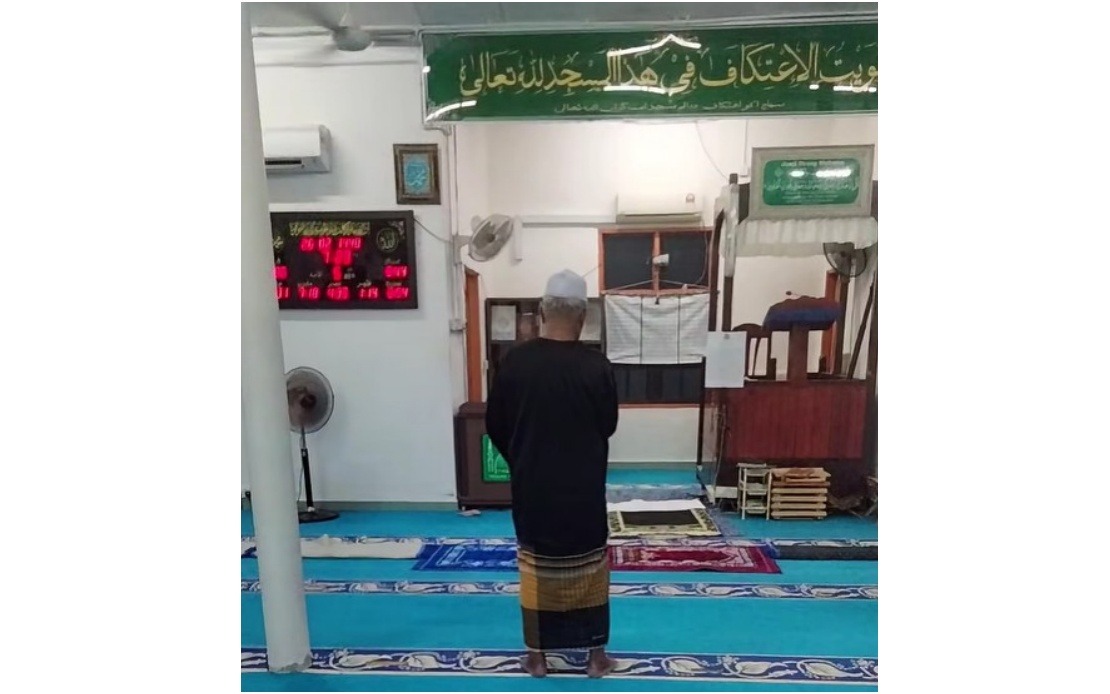
A video clip circulating across Facebook and WhatsApp has drawn attention to Masjid Tanjung Resang in Mersing, after footage showed a single worshipper conducting prayers while simultaneously fulfilling the roles of imam and bilal. The 15-second recording, which sparked concerns about the mosque's management and vitality, has prompted local leaders to explain the circumstances surrounding the small congregation and defend the facility's ongoing religious programming.
Mersing Member of Parliament Muhammad Islahuddin Abas, who resides in the village, acknowledged the unusual appearance captured in the video but contextualised it within broader demographic realities affecting rural communities across Malaysia. He explained that whilst the settlement contains numerous residences, the permanent population has contracted significantly due to economic migration, with many residents commuting to urban centres for employment or permanently relocating elsewhere. This pattern reflects a wider trend in smaller Malaysian towns where younger and working-age populations have shifted away, leaving behind ageing or part-time residents.
Despite the demographic challenges, Muhammad Islahuddin emphasised that the mosque sustains its regular schedule of religious activities without interruption. The weekly programme encompasses organised religious discourses, educational lectures, and Yasin recitation sessions—traditional Quranic readings that form part of Islamic communal practice. These initiatives demonstrate that the mosque continues to function as an active religious institution, though perhaps with congregation sizes that fluctuate based on who remains present in the locality at any given time.
The MP recounted his own surprise upon receiving a screenshot of the viral content, shared by an acquaintance in Kuala Lumpur via WhatsApp, indicating how quickly the clip had travelled beyond the immediate Mersing district. However, Muhammad Islahuddin adopted a constructive perspective on the controversy, viewing the unexpected publicity as an inadvertent marketing opportunity. He suggested that the incident had effectively introduced Masjid Tanjung Resang to audiences well beyond the surrounding region, potentially raising its profile among those unfamiliar with rural Johor religious facilities.
A significant factor contributing to the mosque's relative obscurity, according to Muhammad Islahuddin, is its positioning off the main thoroughfare. The structure's tucked-away location means that even district-level residents and local authorities have sometimes remained unaware of its existence. This geographical isolation exemplifies a challenge faced by many small-town Malaysian institutions that lack prominent visibility along primary transportation corridors, limiting walk-in foot traffic and awareness among passing travellers.
Beyond its core function as a prayer venue, the mosque serves a broader community purpose that extends across denominational lines. Muhammad Islahuddin characterised the facility as welcoming to non-Muslim visitors and positioned it as a convenient waystation for hikers ascending Gunung Arong, a local mountain attraction. The provision of facilities for recreational users who are not primarily visiting for worship underscores how rural mosques often function as multi-purpose community anchors in areas with limited alternative infrastructure.
Masjid Tanjung Resang's chairman, Abdul Syamil Abdul Fadzil, confirmed that representatives from the Johor Islamic Religious Affairs Department (JAINJ) had contacted him regarding the viral footage. He utilised this engagement to clarify the actual operational context, explaining that the individual filmed was performing a voluntary prayer session in his capacity as the mosque's assistant, rather than depicting a typical congregational gathering. This distinction carries significance in Islamic practice, where individual voluntary prayers conducted at mosques represent legitimate religious observance distinct from mandatory congregational worship.
Abdul Syamil stressed that the snapshot captured in the video failed to represent the mosque's genuine operational rhythm. He reiterated that diverse religious programmes continue unfolding on a regular schedule, maintaining the institution's role as an active centre for Islamic learning and devotion. The chairman's statements indicate that JAINJ has been apprised of the situation and appears satisfied with the mosque's explanations and continued functionality, suggesting no administrative intervention was deemed necessary following the viral incident.
The controversy surrounding Masjid Tanjung Resang illuminates broader questions about how rural religious institutions adapt to demographic transition in contemporary Malaysia. As urbanisation continues accelerating and economic opportunities concentrate in metropolitan areas, smaller towns struggle to maintain institutional vitality when resident populations decline. Mosques in these settings must balance expectations of active congregation sizes with demographic realities, often pioneering creative approaches such as expanded community functions or tourism-oriented hospitality to justify their continued operation and relevance.
The incident also reflects how social media circulation can distort perception of localised religious practice. A single moment—perhaps during off-peak hours or when a majority of the community was engaged in other activities—becomes magnified into a broader narrative about institutional decline. For Islamic institutions particularly, where congregational worship holds theological significance, such misrepresentation carries added weight in public understanding and religious legitimacy.
Moving forward, the Masjid Tanjung Resang episode may prompt other rural Malaysian mosques to become more intentional about documenting and publicising their activities, countering potential negative narratives with concrete evidence of ongoing programmes. The incident demonstrates how religious institutions now operate within an information ecosystem where isolated moments can shape public perception rapidly and at scale, requiring proactive communication strategies to contextualise their work.

