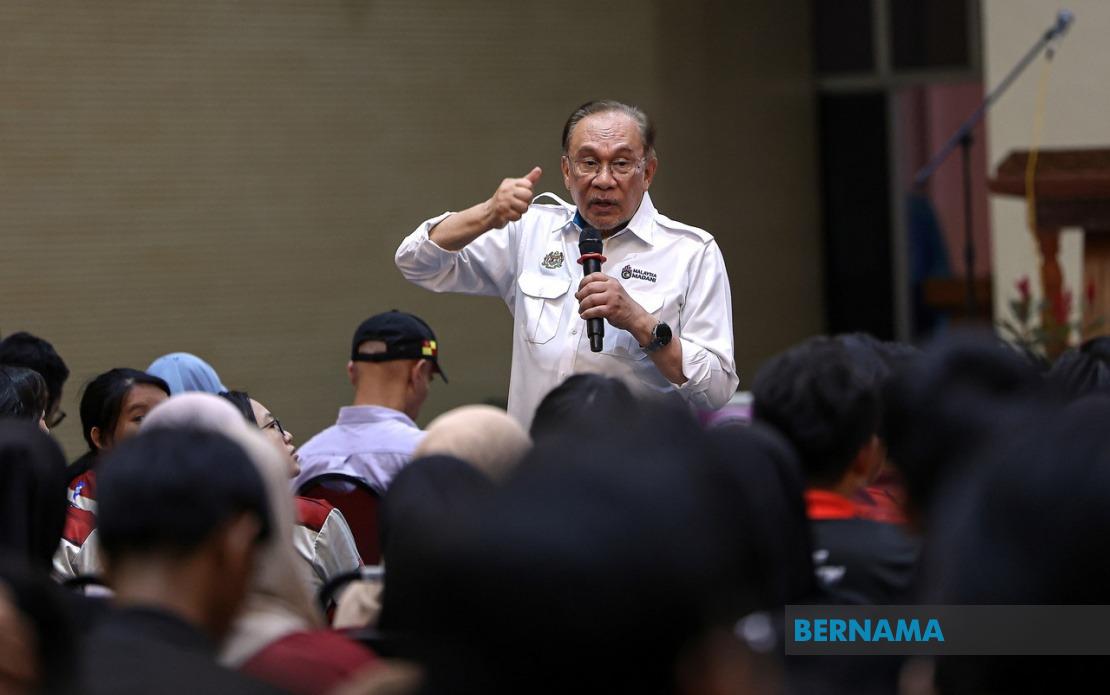
Prime Minister Datuk Seri Anwar Ibrahim has outlined a dual-track approach to matriculation admissions that seeks to recognise academic excellence while simultaneously addressing educational inequities faced by disadvantaged communities across Malaysia. Speaking at the Youth and Sports Complex in Paroi, Seremban during the "Jelajah Rakan Muda" programme, Anwar emphasised that the government's intake framework operates on two complementary principles designed to broaden access to higher education pathways without compromising meritocratic standards.
The first pillar of this strategy centres on pure academic achievement. Students who attain the pinnacle of performance in their Sijil Pelajaran Malaysia (SPM) examinations by securing 10As will receive guaranteed admission to matriculation programmes entirely on the strength of their results. This threshold-based merit system deliberately ignores racial or ethnic considerations, signalling that excellence—when demonstrated at the highest level—transcends demographic categories and opens pathways regardless of a student's background. Anwar explicitly highlighted this inclusivity, noting that admission would be guaranteed to Chinese, Indian, and Malay students alike who meet this demanding academic benchmark.
Parallel to this merit-driven mechanism operates a second framework rooted in demographic equity and regional development concerns. The government maintains the Bumiputera quota system within matriculation intake, a policy that Anwar characterised not merely as preferential treatment but as a deliberate tool addressing specific structural disadvantages. This quota acknowledges that Bumiputera students—particularly those originating from rural and interior regions, including the Malaysian territories of Sabah and Sarawak—often labour under distinct socioeconomic and infrastructural handicaps that pure merit-based assessment alone cannot adequately address. The quota therefore functions as a corrective mechanism ensuring that geographic isolation, limited access to quality schooling, and economic constraints do not permanently foreclose higher education opportunities for entire communities.
This policy articulation carries particular significance for Southeast Asia's wider development conversation. Malaysia, as a nation navigating the complexities of rapid urbanisation and persistent regional inequality, confronts the universal tension between meritocratic principles and equity objectives. The matriculation framework Anwar describes attempts to resolve this tension not through compromise but through simultaneous pursuit of both objectives via different pathways. Students demonstrating exceptional academic capacity gain unmediated access; simultaneously, communities facing structural barriers receive targeted support designed to identify and nurture talent that might otherwise remain latent due to circumstantial disadvantage rather than incapacity.
The maintenance of Bumiputera quotas within this framework reflects deeper recognition of Malaysia's demographic and constitutional realities. These protections derive from foundational constitutional agreements and address real disparities in educational infrastructure and resource distribution between urban centres and rural peripheries. Sabah and Sarawak, despite their vast territorial expanse and natural resources, continue to experience educational provision gaps relative to Peninsular Malaysia. Rural Bumiputera communities frequently encounter constrained access to pre-university preparation facilities, experienced tutoring, and the information networks that facilitate successful matriculation applications. The quota system acknowledges these structural inequalities as legitimate grounds for differentiated admission criteria.
Youth and Sports Minister Dr Mohammed Taufiq Johari's presence at the announcement underscores the cross-ministry coordination required to implement such balanced policies. Education access intersects directly with youth employment prospects, socioeconomic mobility, and regional development—concerns within the minister's purview. The "Jelajah Rakan Muda" programme itself functions as a public engagement exercise, directly communicating policy frameworks to younger citizens who represent both beneficiaries of matriculation pathways and future stakeholders in whether such policies prove effective and equitable.
For Malaysian students and families, particularly those from economically marginalised backgrounds, the dual-track system offers clarity regarding pathways to tertiary education. The 10As automatic admission threshold, while demanding, establishes an unambiguous meritocratic standard that cannot be dismissed as subject to quotas or preference systems. Simultaneously, the Bumiputera quota protection provides reassurance that geographic or economic disadvantage alone will not preclude access for students demonstrating capability within their particular educational contexts. This architecture attempts to satisfy both those concerned that standards remain rigorous and those concerned that opportunity remains genuinely accessible.
Regionally, Malaysia's approach may serve as a model for other Southeast Asian nations grappling with balancing excellence and inclusion in higher education systems. Countries with significant rural-urban divides and ethnic or regional diversity—characteristics many ASEAN members share—confront similar dilemmas regarding university admission frameworks. Malaysia's explicit articulation of how merit and equity can coexist provides a template that neighbouring governments contemplating education policy reform might examine constructively. The specificity of Anwar's public statement, naming both the academic threshold and the equity concerns simultaneously, suggests a government confident in defending both dimensions rather than treating them as opposed.
The timing of this policy clarification matters in Malaysia's broader political context. Education access has historically been subject to intense public scrutiny and considerable partisan debate. By explicitly committing to both meritocratic transparency and equity protection, the government seeks to establish ground accepted across demographic and ideological divides. This rhetorical positioning attempts to remove matriculation intake from the realm of zero-sum ethnic politics where one community's advancement appears zero-sum relative to others. Instead, Anwar frames the policy as simultaneously honouring national principles of meritocracy and constitutional commitments to specific communities.
The practical implementation of this framework will ultimately determine its effectiveness. Monitoring whether 10As students from all ethnic backgrounds actually gain the promised automatic admission, and whether Bumiputera quota beneficiaries subsequently complete matriculation and transition successfully to degree-level study, remains essential. The policy's credibility depends on transparent administration that demonstrates both merit thresholds function genuinely and quota provisions actually reach intended beneficiary communities rather than accruing disproportionately to relatively privileged members of quota-eligible groups.

