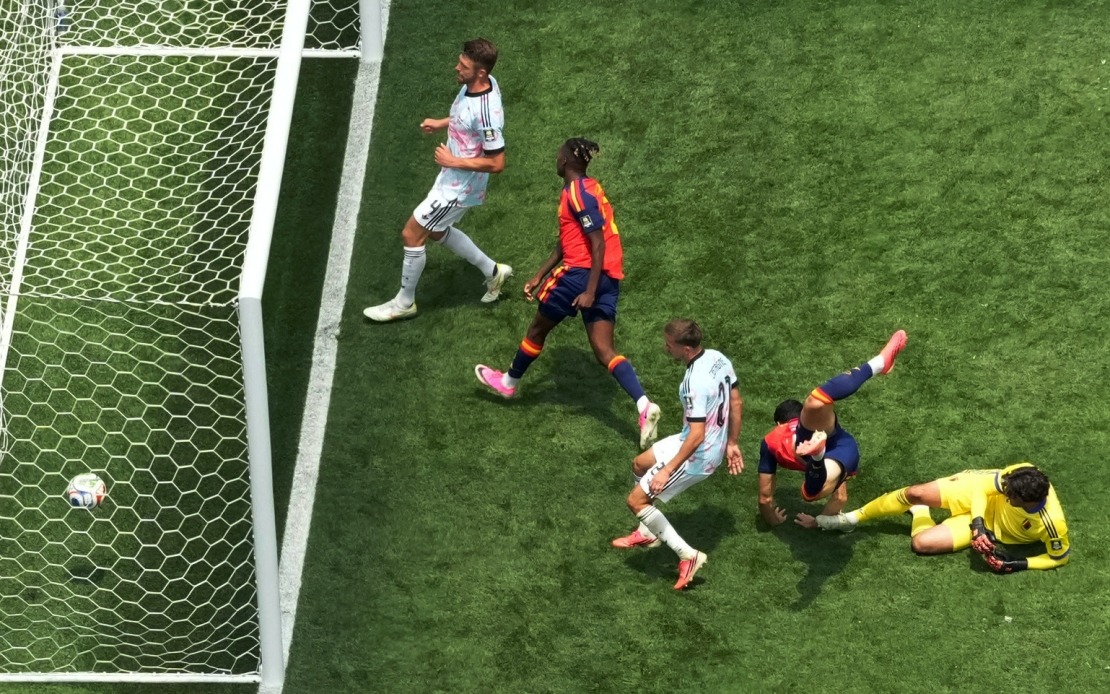
Spain advanced to the semi-finals of the FIFA World Cup 2026 with a 2-1 quarter-final victory over Belgium at Los Angeles Stadium on Friday, with substitute Mikel Merino delivering the decisive strike in the 88th minute. The result marks a significant milestone for La Roja, representing their first appearance in the tournament's final four since 2010, when they claimed their sole World Cup title.
Merino has emerged as Spain's unlikely hero throughout this competition, following his match-winning contribution against Portugal in the round-of-16 just days earlier. The midfielder's clinical finishing in crucial moments has underscored his value to Luis de la Fuente's squad, demonstrating how tactical flexibility and squad depth remain pivotal in modern tournament football. His ability to make an immediate impact from the bench has proven instrumental in Spain's progression, a testament to both his technical proficiency and mental composure under pressure.
Spain's path to victory began promisingly, with the team controlling possession and creating early chances. Eighteen-year-old sensation Lamine Yamal announced his presence on the world stage in the 21st minute with an ambitious effort that curled just past the left post, signalling intent from the Spanish side. The young winger's confident play throughout the match demonstrated why European clubs are circling for his signature, as he proved capable of operating at the highest level despite his tender age.
Fabian Ruiz broke the deadlock for Spain in the 30th minute after Belgian goalkeeper Thibaut Courtois was forced into an exceptional save to deny Dani Olmo. The veteran goalkeeper's involvement proved crucial to keeping Belgium competitive throughout; his low dive in the 35th minute to repel Yamal's free-kick destined for the bottom corner showcased his enduring quality at age 34. However, the Belgian defensive frailties were exposed when Timothy Castagne's cross from the right wing found Charles De Ketelaere, whose powerful downward header restored parity in the 41st minute, levelling proceedings before the interval.
Belgium, under French coach Rudi Garcia, appeared primed to exploit Spanish vulnerabilities in the second half. Maxim De Cuyper's effort just after the hour mark tested Spain's resilience, striking the side netting rather than finding the target. Courtois remained Belgium's barrier against Spanish waves of attack, producing back-to-back saves within a minute to deny both Yamal and Mikel Oyarzabal before ultimately succumbing to injury. His departure in the 71st minute shifted momentum decisively toward Spain, as replacement Manchester United goalkeeper Senne Lammens struggled with the intensity of Spanish pressure.
The goalkeeper's critical error proved determinative. Lammens spilled centre-back Pau Cubarsi's long-range effort, presenting the simplest of opportunities for Merino to convert with a poacher's finish. That moment encapsulated the match's trajectory: Spain's superior depth, fitness, and tactical discipline ultimately overwhelming Belgian resistance despite earlier anxieties about their defensive solidity.
Spain's reward is a mouth-watering semi-final clash against France in Dallas on July 15. The two-time World Cup champions reached the last four after dismantling Morocco 2-0 in their quarter-final, establishing themselves as tournament favourites. This fixture represents a genuine test of Spain's credentials, pitting two footballing powerhouses against each other with contrasting approaches to the modern game.
The expanded FIFA World Cup 2026 format, jointly hosted by Canada, Mexico and the United States, encompasses 48 teams, making it the largest tournament in the competition's 96-year history since Uruguay 1930. The expanded structure has been designed to provide more nations with genuine opportunity, though it has also extended the tournament schedule. The competition began on June 11 and continues until July 19, with Spain now firmly entrenched in its concluding stages.
For Malaysian and Southeast Asian football enthusiasts, Spain's advancement highlights the tournament's unpredictability and the sustained excellence of traditional European powerhouses. The semi-final berth also represents vindication for De la Fuente's team management philosophy, particularly his willingness to deploy impact substitutes strategically rather than adhering rigidly to established lineups. This approach offers valuable lessons for emerging football nations, demonstrating how tactical intelligence and squad rotation can determine knockout competition outcomes.

