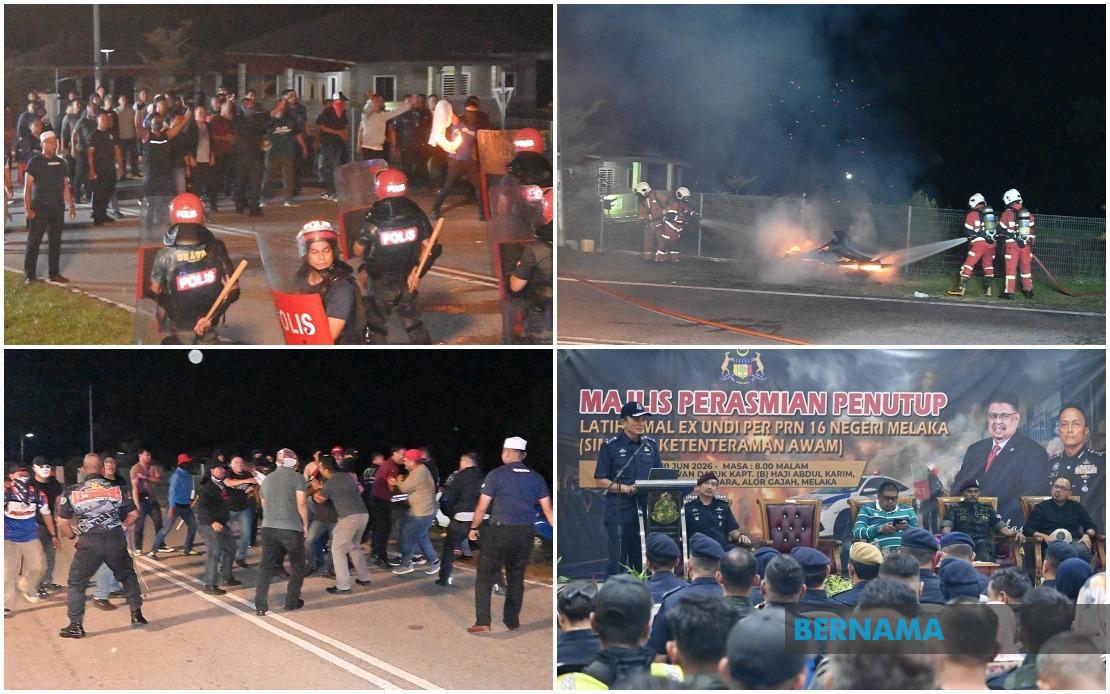
Melaka's Chief Minister Datuk Seri Ab Rauf Yusoh has issued a clear warning that the 16th state election should not become a vehicle for provocative acts that could threaten public peace, reaffirming the government's commitment to maintaining order during the democratic process expected to take place this September. Speaking at the closing ceremony of a major security simulation exercise held in Alor Gajah, Ab Rauf stressed that while electoral contests naturally generate competing political interests and differing viewpoints among voters, these differences must never overshadow the fundamental priority of safeguarding community welfare and regional stability.
The Chief Minister's remarks come amid intensive preparations by state authorities to ensure a secure voting environment across Melaka. In his address, he drew a deliberate distinction between the legitimate platform that elections provide for democratic participation and the weaponisation of the electoral process through incitement. He underscored that although Melaka's citizens enjoy the constitutional right to support their preferred political parties and express diverse ideological positions, such freedoms exist within the overarching framework of maintaining peace and protecting the state's security apparatus.
The simulation exercise itself represents a watershed moment for Melaka's security infrastructure. Acknowledged by Ab Rauf as the first comprehensive security drill of this scale conducted in the state, the two-day operation demonstrated the integrated capacity of law enforcement and allied agencies to respond to multiple crisis scenarios that could potentially emerge during the election cycle. The drill encompassed 395 officers and personnel drawn from a cross-section of government institutions, including the National Security Council, the Elections Commission, the Fire and Rescue Department, the Civil Defence Force, and the Health Ministry, reflecting the whole-of-government approach being adopted to ensure electoral stability.
Melaka Police Chief Datuk Dzulkhairi Mukhtar provided detailed insights into the scope and intensity of the exercise, revealing that it tested the security machinery's readiness across a spectrum of operational challenges. These encompassed not only logistical functions such as ballot box escorting and voter flow management at polling stations, but also rapid-response protocols for managing confrontational situations, containing civil unrest through crowd dispersal techniques, addressing fire emergencies, and deploying riot control units when necessary. The comprehensiveness of the simulation underscores official recognition that election periods, by their very nature, create environments where tensions can escalate rapidly if not properly managed through advance planning and institutional coordination.
Intelligence assessments shared by Dzulkhairi paint a reassuring picture of the current security environment across Melaka. Although law enforcement agencies have identified pockets of potential provocation—a standard expectation during any high-stakes election—overall assessments indicate that the state remains stable and under control. This measured perspective acknowledges realistic risks without exaggerating threat levels, suggesting that authorities are neither complacent nor alarmist in their approach to maintaining electoral security. The police chief noted that while the state does not anticipate outbreak of full-scale riots, the mere possibility has prompted thorough preventive preparations and the refinement of standing operational protocols.
The logistics of the September election in Melaka will be substantial. Some 685,455 registered voters across the state will be required to cast ballots at 264 designated polling centres distributed throughout the region, with these venues accommodating 1,198 separate voting streams to facilitate efficient processing. This scale of electoral activity necessitates corresponding deployment of security personnel and resources. Melaka police have committed to stationing over 3,300 officers and other security members across all polling sites, supplemented by specialist units including the Public Order Riot Unit and Federal Reserve Unit contingents. Additionally, the police contingent will activate four dedicated operations rooms positioned at both contingent headquarters and district levels, creating a hierarchical command structure capable of responding to incidents with appropriate speed and coordination.
The positioning of this election within Malaysia's broader political context adds further significance to Ab Rauf's warnings. State elections, while locally focused, often attract attention and engagement from national political actors and their supporters, potentially amplifying tensions that might otherwise remain localised. For Melaka specifically, a state with a history of closely contested electoral results and shifting political coalitions, the management of post-election dynamics—regardless of which coalition emerges victorious—will be as important as maintaining order on polling day itself. The Chief Minister's emphasis on transcending partisan divisions in service of stability reflects an awareness that electoral legitimacy ultimately depends on public perception that results were obtained through fair, secure, and peaceful processes.
Melaka's approach also carries implications extending beyond the state's borders. As one of Malaysia's smaller states but with historical and cultural significance, how Melaka's election unfolds will be observed by observers across the Southeast Asian region as an indicator of Malaysia's democratic maturity. Successful conduct of the polls without major security incidents would reinforce international perceptions of Malaysia's institutional capacity to manage competitive elections. Conversely, any significant disruptions could generate negative narratives about democratic governance in the country, potentially affecting Malaysia's standing in regional forums and bilateral relationships. This broader reputational dimension adds weight to Ab Rauf's message that electoral conduct transcends narrow partisan advantage.
The involvement of Bukit Aman's Internal Security and Public Order Department, represented at the ceremony by Deputy Director DCP Datuk M.V Srikumar, indicates that federal-level security apparatus are directly engaged in Melaka's electoral preparations. This vertical integration between federal and state authorities ensures consistency in security doctrine and facilitates resource-sharing and intelligence coordination across administrative boundaries. The presence of senior federal police officials signals that electoral security in Melaka is being treated as a matter of national security significance rather than a purely localised administrative concern, a positioning that likely reflects lessons learned from previous state elections elsewhere in Malaysia.
Dzulkhairi's commitment to addressing identified weaknesses through post-exercise analysis and protocol refinement demonstrates institutional learning capacity. Rather than treating the simulation as a box-ticking compliance exercise, authorities are leveraging it as a genuine diagnostic tool to identify operational gaps and resource constraints. This iterative approach—drill, analyse, adjust—represents best practice in security planning and suggests that Melaka's law enforcement agencies are employing contemporary crisis management methodology rather than relying on historical precedents alone. The gap between September's election date and the current planning period provides adequate time for implementation of improvements identified during the exercise.
For Malaysian voters and observers monitoring Melaka's electoral process, the messaging from Ab Rauf and security chiefs can be interpreted on multiple levels. On one level, it represents reassurance that authorities take the fundamental responsibility of protecting public order during elections seriously and have invested substantial resources in preparation. On another level, the repeated emphasis on preventing provocation implicitly acknowledges that some actors may be tempted to exploit the election period to advance goals beyond legitimate political competition. This dual messaging—confidence in security arrangements coupled with explicit warnings against troublemaking—is a calibrated communication strategy designed to deter problematic behaviour while reassuring law-abiding citizens that their electoral participation will occur in a secure environment.

