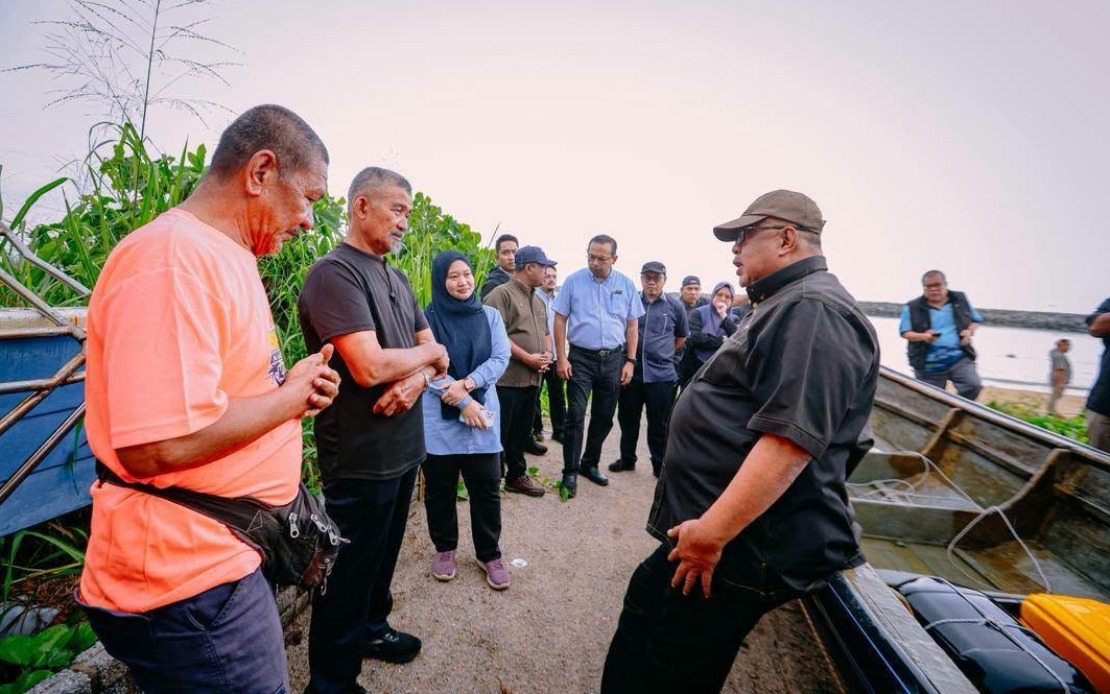
Melaka Chief Minister Datuk Seri Ab Rauf Yusoh has issued directives to several state agencies to urgently resolve difficulties confronting the fishing community in Pasir Gembur, Tanjung Bidara, following a visit to assess progress on a proposed fishermen's complex and gather concerns directly from residents.
The decision emerged from a comprehensive inspection during which Ab Rauf engaged with local fishermen and community members to understand the specific challenges they face. Rather than adopting a top-down approach, the Chief Minister chose to listen firsthand to grievances before coordinating a government response, reflecting a strategy of grounding policy decisions in ground-level realities affecting ordinary Malaysians.
Among the immediate actions ordered, the Drainage and Irrigation Department (DID) must conduct a feasibility assessment for deepening the channel that facilitates fishing boat movement between Pasir Gembur and Batu Tenggek. This initiative addresses practical maritime constraints that restrict local fishermen's operational capacity. The Public Works Department (JKR) faces a parallel mandate: identifying and preparing a more geographically suitable location for the proposed fishermen's complex that minimises exposure to seawater intrusion and tidal flooding—critical concerns for a facility designed to serve a maritime economy vulnerable to coastal environmental hazards.
The Melaka administration has also moved to regulate development patterns within designated coastal zones. A blanket prohibition on additional private construction within the coastal wave-breaker area takes effect immediately, establishing clearer boundaries for urban expansion near sensitive fishing grounds. This regulatory tightening aims to prevent ad-hoc encroachment that could further constrain fishing operations or compromise environmental conditions.
Further, all existing structures and future developments within the coastal reserve must now secure a Temporary Occupation Licence (TOL) from the Land Administrator and demonstrate technical approval from relevant departments. This formalisation of the permitting process creates an administrative framework that balances development pressures with environmental stewardship and community livelihood protection. For a coastal state like Melaka, where fishing remains culturally and economically significant despite broader economic diversification, such governance measures reflect an acknowledgment that uncontrolled coastal development poses real risks to traditional maritime communities.
Ab Rauf characterised the site visit and subsequent coordination meeting with the Alor Gajah Municipal Council and other relevant bodies as evidence of substantive governmental commitment rather than symbolic engagement. He emphasised that the initiative forms part of a broader state narrative positioning Melaka as genuinely responsive to constituent needs. By formalising these commitments through documented agency directives and regulatory changes, the government creates measurable accountability benchmarks against which future performance can be evaluated.
The constellation of measures—channel deepening feasibility studies, site relocation for the complex, coastal zoning restrictions, and licensing formalisations—collectively represent a systematic approach to environmental management and community economic support. Rather than isolating these as separate bureaucratic tasks, they function as interconnected interventions addressing seawater intrusion, flooding vulnerability, access constraints, and uncontrolled development simultaneously.
For the broader Malaysian context, this case illuminates persistent tensions between modernisation aspirations and the protection of traditional livelihoods in coastal communities. Fishing communities across Southeast Asia increasingly confront pressures from industrial aquaculture, tourism development, and environmental degradation. State-level initiatives that explicitly centre fishing communities' operational needs within development planning frameworks thus carry significance beyond Melaka's borders, potentially influencing how other regional governments approach similar tensions.
The emphasis on direct consultation with affected communities also marks a deliberate governance choice. By prioritising firsthand engagement over predetermined administrative solutions, the Melaka government signals recognition that technical expertise alone cannot adequately address complex community challenges. Fishermen understand their operational environment, environmental constraints, and economic vulnerabilities intimately, and this knowledge should shape official interventions.
Looking ahead, the practical success of these directives will depend on inter-agency coordination execution and resource allocation. DID's feasibility study and JKR's site evaluation require technical rigour and timely completion to translate political commitment into concrete infrastructure improvements. Monitoring implementation timelines and assessing whether the fishing community perceives genuine benefit will ultimately determine whether these measures represent substantive policy shift or administrative rhetoric.
The broader implication reflects an emerging recognition that sustainable state development requires balancing multiple constituencies and economic sectors. While manufacturing and tourism drive aggregate economic growth, preserving spaces for fishing communities acknowledges their historical importance, cultural significance, and ongoing economic contribution. This perspective suggests evolution toward more inclusive developmental models that do not merely extract resources from traditional communities but instead integrate their concerns into governance frameworks.

