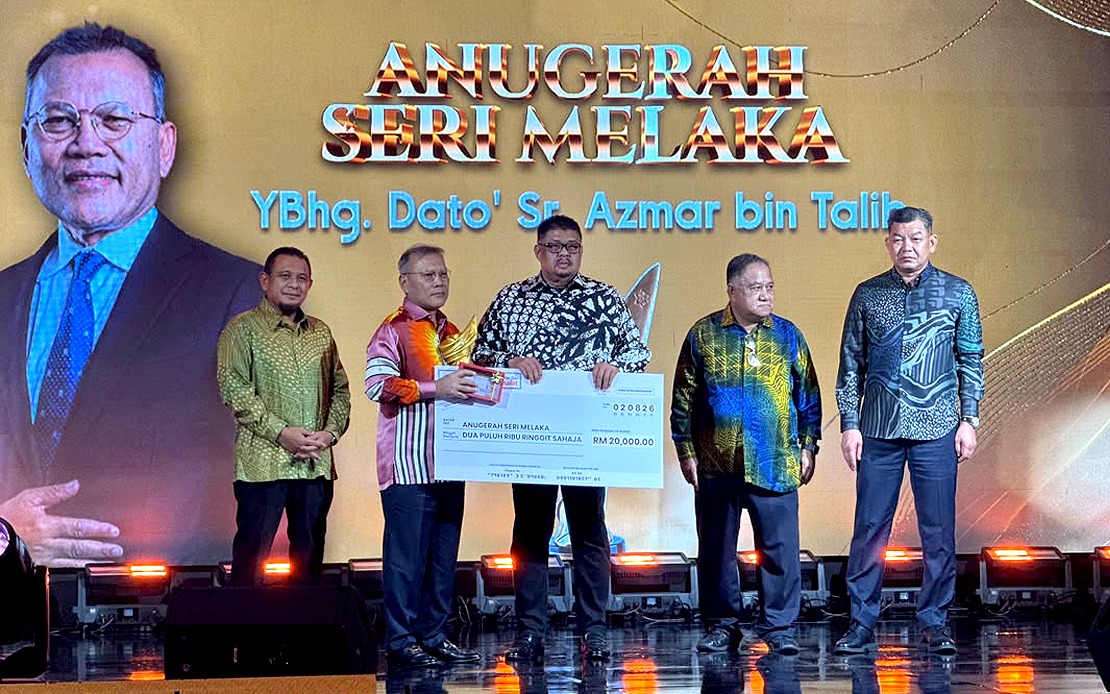
Melaka's Chief Minister Datuk Seri Ab Rauf Yusoh has issued an appeal to accomplished professionals and entrepreneurs from the state to transition from personal success into broader mentorship roles that benefit the wider community. Speaking at the Anugerah Seri Melaka gala ceremony held at the Melaka International Trade Centre in Ayer Keroh, Ab Rauf framed this call as part of a larger vision to transform individual achievement into collective advancement for the state's younger generation.
The appeal forms a cornerstone of the Melaka Sayang Rakyat initiative, a state-level programme designed to document and celebrate the accomplishments of Melaka-born achievers across multiple sectors. Rather than allowing these success stories to remain isolated personal narratives, the state government seeks to weaponise them as inspiration and practical knowledge for aspiring professionals throughout Melaka. This approach recognises that talent cultivation requires not just policy frameworks but active engagement from those who have already navigated their respective fields successfully.
Ab Rauf's emphasis on "strategic partnerships" signals a departure from traditional top-down governance in favour of collaborative models that harness the social and professional networks built by successful individuals. The Chief Minister specifically highlighted the value of experience, expertise, and connections as transformative assets that can unlock opportunities for others. This language suggests the state views its high achievers not merely as role models but as bridge-builders capable of creating tangible pathways for younger Malaysians seeking advancement in business, sports, arts, or public service.
The framework underpinning this initiative encompasses four distinct categories: Public Service, Corporate, Sports, and Arts and Culture. This breadth reflects recognition that excellence and leadership extend across diverse domains, and that Melaka's reputation depends on strength across multiple sectors rather than concentrated achievement. The state received more than 200 nominations for the awards, indicating substantial participation and a deep pool of talent worthy of recognition and potentially available for mentorship roles.
The five award recipients announced at the ceremony represent these diverse fields. Datuk Azmar Talib, chief executive officer of TRX City Sdn Bhd, claimed the Corporate category honour, whilst national badminton player Aaron Chia secured the Sports distinction. The Arts and Culture category was won by performing arts director Lokman Abd Ghani, and Datuk Zamri Misman, director-general of the Legal Affairs Division at the Prime Minister's Department, received recognition in the Public Service category. Dr Saiful Anuar Singar, an international medical science researcher, was awarded the Special Category honour, reflecting the government's acknowledgment that some achievements transcend traditional classifications.
Financial recognition accompanies these accolades. Special Category winners receive RM20,000 in cash along with a trophy, whilst category winners secure RM10,000 and corresponding trophies. This monetary component moves beyond symbolic recognition, potentially enabling award recipients to invest in mentorship programmes, research initiatives, or educational ventures that directly benefit their communities. The prize structure also signals genuine commitment from the state government rather than merely ceremonial acknowledgment.
Each nomination submitted for consideration reflects decades of accumulated effort, according to the Chief Minister's framing. The candidates' journeys have been constructed through persistent hard work, personal sacrifice, and sustained perseverance—qualities the government wishes to document and communicate as achievable within Melaka's environment. This narrative construction serves multiple purposes: it validates individual success as products of character and effort rather than circumstance alone, whilst simultaneously positioning Melaka as a state capable of nurturing world-class professionals.
For Malaysia and the broader Southeast Asian region, this model of leveraging accomplished citizens as development catalysts holds broader implications. As countries compete for talent and seek to build knowledge-driven economies, mechanisms that create formal connections between successful professionals and emerging talent become increasingly valuable. Melaka's approach potentially offers a template for other Malaysian states seeking to combat brain drain whilst creating retention mechanisms that benefit local communities.
The emphasis on legacy-building through mentorship also addresses a demographic consideration relevant across Southeast Asia. Younger generations in the region often seek tangible pathways and relatable examples of success rather than abstract opportunities. By connecting aspiring professionals directly with individuals who have achieved prominence in their fields, Melaka creates credibility and practical guidance that formal education and government programmes alone cannot provide. This peer-to-peer transmission of knowledge and networks represents a powerful yet often overlooked tool for sustainable development.
From an economic perspective, the initiative recognises that human capital development requires more than educational investment. Networks, industry relationships, and tacit knowledge accumulated through experience represent economic assets as valuable as formal qualifications. By institutionalising mechanisms to share these assets, the state government positions itself as a facilitator of knowledge transfer rather than a primary provider. This approach distributes responsibility for talent development across multiple stakeholders whilst reducing direct fiscal burden on the state.
The timing of this initiative also reflects evolving governance philosophy within Malaysia. Rather than centralised control or top-down implementation, contemporary development increasingly relies on multi-stakeholder collaboration. By framing successful Melaka residents as strategic partners rather than passive exemplars, the state government acknowledges their agency and capacity to drive change independently. This empowerment model potentially generates more sustained commitment than traditional corporate social responsibility approaches.
Moving forward, the success of this initiative will depend on translating the honour of recognition into structured mentorship opportunities. Award recipients must be provided with platforms, resources, and clear pathways through which they can engage younger generations. Without such institutional support, even enthusiastic awardees may struggle to convert goodwill into meaningful impact. The state government's challenge lies in creating ecosystems where professional networks can flourish organically whilst providing sufficient scaffolding to ensure productive connections materialise.

