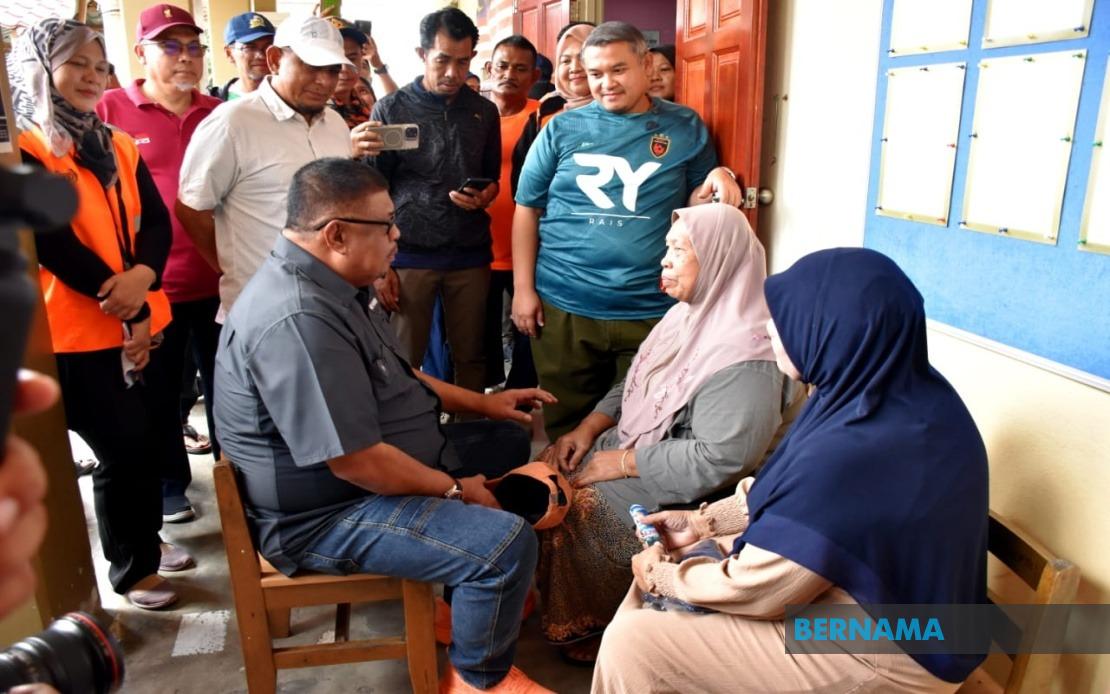
Melaka Chief Minister Datuk Seri Ab Rauf Yusoh has made a firm commitment to finally tackle the persistent flooding crisis that has burdened residents of Tanjung Minyak for more than three decades, a problem that has taken on fresh urgency following this month's severe weather events. The pledge came during an official visit to evacuees sheltering at relief centres, where the chief minister acknowledged the long-standing nature of the issue and signalled the state government's determination to pursue lasting solutions rather than temporary measures.
The flooding that struck the area in early July represented a watershed moment of sorts, with meteorological data indicating that rainfall levels exceeded those recorded during Tropical Storm Senyar late last year, marking the heaviest precipitation in over two decades for the affected districts. The Melaka Irrigation and Drainage Department recorded cumulative rainfall surpassing 100 millimetres in both Melaka Tengah and Alor Gajah districts by mid-afternoon, overwhelming the existing water management infrastructure designed for earlier climate patterns. This failure of conventional drainage systems to cope with contemporary weather patterns underscores a broader challenge facing Malaysian municipalities adapting to changing environmental conditions.
The scale of displacement resulting from this particular flooding episode illustrates the vulnerability of the region's population. More than 900 residents from approximately 300 households required evacuation and shelter in multiple relief centres across the state, placing considerable strain on disaster management resources and highlighting how a single rainfall event can rapidly escalate into a humanitarian response situation. The concentration of affected families in a relatively confined area suggests structural issues with both drainage infrastructure and possibly settlement patterns in flood-prone zones.
Ab Rauf's statement outlined a methodical approach involving comprehensive review of existing proposals and recommendations from technical agencies, indicating that various solutions have been proposed over the years but perhaps not systematically evaluated or prioritised. This suggests the possibility of bureaucratic fragmentation, where individual agencies have developed plans independently without coordinated implementation strategy. The chief minister's commitment to identify "long-term solutions" reflects acknowledgment that previous interventions have fallen short of their intended impact, whether due to insufficient investment, inadequate design specifications, or changing hydrological conditions that render older infrastructure obsolete.
The involvement of senior state officials including the Housing, Local Government, Drainage, Climate Change and Disaster Management Committee chairman Datuk Rais Yasin during the site visit signals elevated political attention to the issue. The explicit inclusion of climate change in the committee's remit reflects growing recognition within Malaysian governance structures that flood management cannot rely solely on traditional civil engineering approaches but must account for shifting precipitation patterns and intensifying weather events. This institutional framing suggests the state government understands that solutions must address both immediate drainage capacity and longer-term climate adaptation.
The immediate humanitarian response appears well-coordinated, with the District Office and state government working through established channels to distribute aid to displaced residents. However, the number of households requiring emergency shelter raises questions about the adequacy of pre-disaster preparedness planning for a location with such a lengthy history of recurring inundation. Communities facing repeated flooding over three decades might reasonably expect enhanced early warning systems, maintained evacuation routes, and pre-positioned relief supplies to minimise disruption and displacement.
The technical problem underlying Tanjung Minyak's vulnerability appears multifaceted. Water retention systems designed to handle normal rainfall proved insufficient when precipitation levels exceeded historical thresholds, causing overflow into adjacent residential areas. This suggests the drainage infrastructure operates with limited safety margins and may not incorporate sufficient redundancy or capacity buffers. Upgrading such systems typically requires substantial capital investment and may involve complex hydraulic engineering solutions, particularly if the area's topography constrains conventional drainage approaches.
For residents of Tanjung Minyak, Ab Rauf's commitment to resolve their flooding problem carries both promise and uncertainty. Three decades of unresolved issues suggests the challenge involves factors more complex than simple political will, potentially including geographic constraints, competing resource allocation priorities across multiple state constituencies, and technical complexities in redesigning drainage systems for a settled area. The chief minister's assurance that welfare will remain a priority until conditions normalise provides immediate relief but does not address the fundamental question of whether permanent solutions will materialise or whether future generations will face the same seasonal inundation.
The flooding incident also carries implications for other Malaysian communities facing similar chronic drainage problems. As climate patterns shift and rainfall intensifies, municipalities nationwide must grapple with infrastructure designed for earlier meteorological conditions. Tanjung Minyak's experience demonstrates both the human cost of delayed intervention and the urgency of systematic review and upgrade of water management systems in flood-prone areas throughout the country. State governments confronting comparable situations might observe how Melaka addresses this long-standing challenge as a potential model—positive or negative—for their own interventions.
Moving forward, meaningful progress will require translating political commitment into technical action plans with specified timelines, allocated budgets, and measurable performance benchmarks. Residents will be watching closely to determine whether this represents a genuine turning point after three decades of false starts, or another cycle of promises that dissolve once immediate crisis conditions recede and media attention shifts elsewhere.

