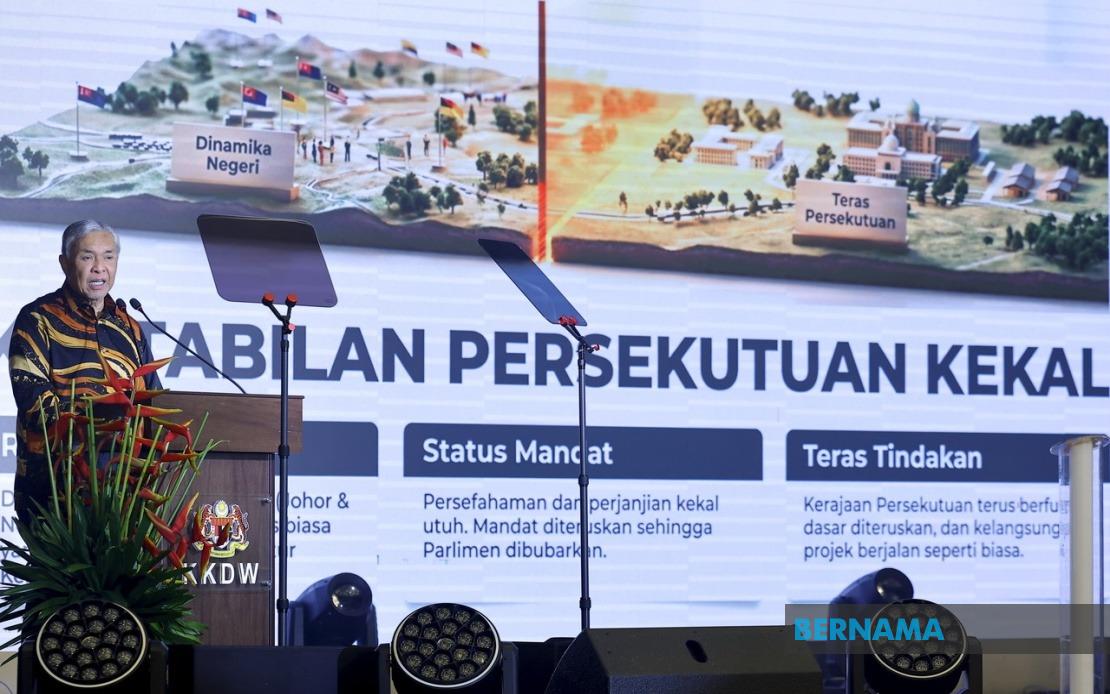
Barisan Nasional's Melaka chapter is preparing for a decisive defence of its legislative stronghold, with party leadership committing to contest all 21 state assembly seats in the upcoming election. The coalition's ambitious retention strategy reflects optimism about its electoral prospects in the peninsular state, where it has maintained continuous governmental control. Ahmad Zahid Hamidi, who leads the national BN coalition, disclosed this stance while addressing reporters following a ministry function in Putrajaya, underscoring the organisation's determination to preserve its dominant position in the southern state.
Melaka Chief Minister Ab Rauf Yusoh, who concurrently oversees BN's state machinery, has personally championed this comprehensive electoral approach, according to Ahmad Zahid's remarks. The chief minister's conviction reflects his assessment of ground conditions and grassroots sentiment across the 21 constituencies, suggesting internal party confidence that incumbency advantages and developmental achievements can sustain support among voters. This full-slate strategy contrasts with the more selective fielding approaches that opposition coalitions sometimes adopt, indicating BN's intent to contest territory systematically rather than concentrate resources on marginal seats.
However, the coalition's hierarchical decision-making structure introduces a layer of complexity to these preliminary announcements. Ahmad Zahid explicitly referenced that BN's central leadership retains final authority over electoral arrangements, suggesting that the Melaka chapter's ambitions remain subject to approval from party headquarters. This distinction between state-level aspirations and national-level endorsement reflects the tension within Malaysian coalition politics, where local chapters must balance autonomous decision-making with allegiance to central party machinery. The qualification carries practical significance, particularly if negotiations with potential alliance partners at the national level necessitate compromises in specific constituencies.
The BN leadership's openness to pre-electoral understandings with other political organisations adds another dimension to Melaka's electoral calculus. Ahmad Zahid emphasised that despite the target of defending all 21 seats, the coalition remains amenable to discussions with outside parties, conditional upon acceptance by the national BN hierarchy. This diplomatic positioning reflects broader coalition trends where smaller parties or independent candidates sometimes negotiate non-contest agreements in exchange for BN support or resource allocation. Melaka's specific political configuration, shaped by its history of stable BN governance and demographic composition, may create opportunities for such arrangements to enhance overall electoral performance.
For Malaysian political observers, Melaka represents a crucial testing ground for coalition stability and electoral mechanics. The state has historically served as a relatively stable stronghold for BN, with the coalition maintaining legislative control through most of the post-independence period. However, the 2018 general election demonstrated that even traditionally secure states could experience electoral volatility when national sentiment shifted decisively. Melaka's subsequent political fluctuations, including leadership transitions and internal party dynamics, have rendered it a more competitive environment than its historical record might suggest.
The timing of this announcement carries significance within Malaysia's broader electoral calendar. With the 16th Melaka state election anticipated in coming months, political parties are entering the phase where strategic positioning and candidate selection become increasingly concrete. BN's declaration of comprehensive electoral intent signals to party members, potential coalition partners, and the electorate that the organisation views the contest as a priority engagement requiring full organisational commitment. This messaging functions both internally, to energise BN machinery and demonstrate leadership confidence, and externally, to establish negotiating parameters with potential allies.
Regional implications extend beyond Melaka's state boundaries, as electoral outcomes in individual states influence broader perceptions of coalition strength and viability. Southeast Asia's coalition-based political systems depend substantially on the ability of multi-party arrangements to maintain stability and deliver electoral success. Melaka's status as a relatively compact, politically sophisticated state makes it a barometer for assessing whether traditional coalition frameworks retain explanatory power in an increasingly fragmented Malaysian political landscape. Strong BN performance would reinforce arguments for coalition continuation; conversely, setbacks would prompt reconsiderations of partnership arrangements.
The economic dimension of Melaka's political competition warrants attention, given the state's strategic importance as a maritime trading hub and increasingly significant commercial centre. Developmental projects, infrastructure investments, and economic management records typically feature prominently in state-level electoral campaigns. BN's lengthy tenure provides a substantial record of state governance to defend or critique, depending on voters' assessment of administrative performance. Opposition parties will likely challenge the coalition's economic stewardship, particularly concerning wealth distribution, employment opportunities, and business development for marginalised communities.
Demographic shifts and generational change present subtle challenges to BN's electoral calculations in Melaka. Younger voters, who constitute an expanding proportion of the electorate, may respond differently to traditional coalition messaging than their parents' generation. Urban constituencies within Melaka have demonstrated increasing electoral unpredictability in recent cycles, with metropolitan voters showing greater receptiveness to alternative political narratives. BN's comprehensive defence strategy must account for these shifting preferences while mobilising traditional support bases in more rural and semi-urban areas where the coalition has traditionally performed strongly.
The coalition's willingness to negotiate with other parties, while maintaining its full-seat defence aspiration, reflects sophisticated political pragmatism. Rather than adopting rigid positions, BN leadership recognises that electoral success sometimes requires flexibility regarding seat allocation, candidate selection, and resource distribution among allied organisations. This approach acknowledges that governance viability depends not merely on contesting all positions but on securing effective legislative majorities. Negotiations with potential partners might yield arrangements where mutual support in specific constituencies enhances overall coalition prospects more effectively than competing independently.
Moving forward, the Melaka chapter's stated objectives will be tested against the practical realities of candidate recruitment, campaign financing, and competitive intensity. Ahmad Zahid's acknowledgment of these aspirations signals BN's confidence, yet electoral outcomes depend on numerous factors extending beyond leadership announcements. The coalition's ability to translate this defensive posture into concrete electoral success will significantly influence perceptions of BN's institutional health and capacity to govern in post-pandemic Malaysia, where political volatility remains elevated and voter preferences increasingly fluid across demographic and geographic lines.

