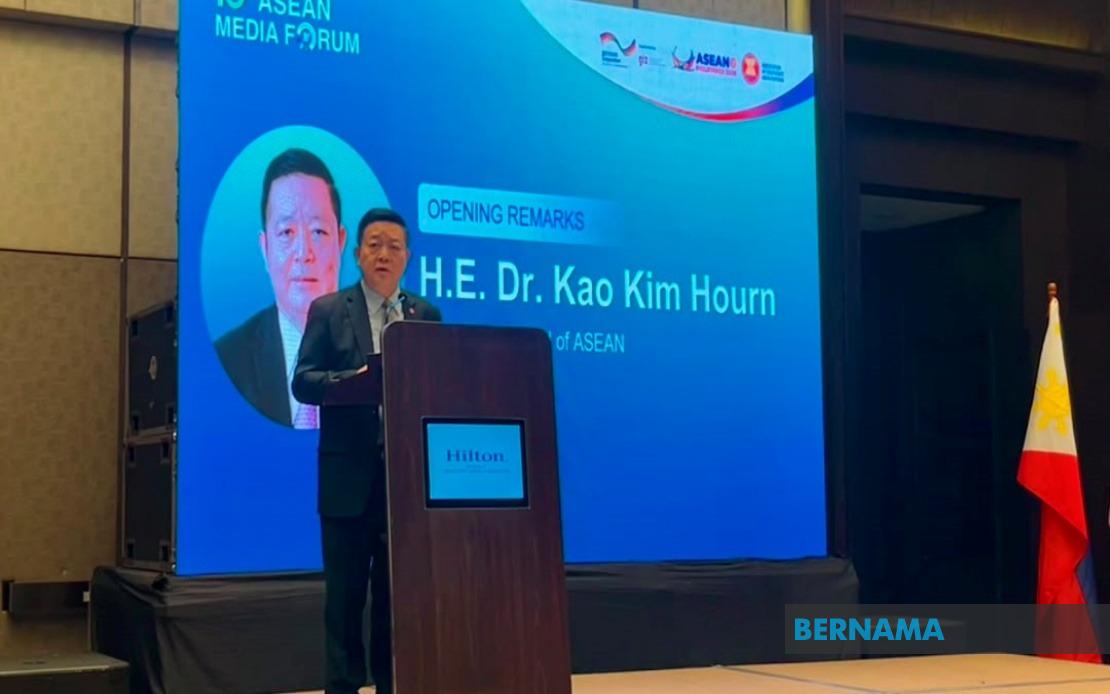
The media stands at the intersection of ASEAN's future and public understanding, according to ASEAN Secretary-General Dr Kao Kim Hourn, who delivered this message at the 10th ASEAN Media Forum in Manila this week. Speaking to an assembly of journalists, editors and media leaders, Kao outlined how news organisations across the region must evolve to meet the bloc's ambitious Community Vision 2045 targets, which require sustained engagement between ASEAN institutions and the citizens they serve. The forum, held on Wednesday, brought together key stakeholders to examine how journalism can deepen understanding of ASEAN's work and strengthen the sense of shared regional purpose that underpins the organisation's strategic direction.
The information landscape has transformed dramatically over the past decade, Kao acknowledged, driven by the proliferation of digital platforms, social media networks and increasingly sophisticated artificial intelligence systems. These technological shifts have fundamentally altered the mechanisms through which news and information reach audiences. Content creation, dissemination and consumption patterns bear little resemblance to those of ten years ago, with real-time global connectivity now enabling instantaneous information sharing across borders and time zones. Yet this same technological revolution that democratises information access has simultaneously created new vulnerabilities in the information ecosystem.
The downside of this connectivity is equally pronounced. Misinformation, disinformation and deliberately manipulated content now spread across borders with alarming speed, often outpacing efforts by fact-checkers and credible news organisations to contain false narratives. The borderless nature of digital platforms means that false or misleading information originating in one country can rapidly influence public opinion and policy debates thousands of kilometres away. For a geographically dispersed region like ASEAN, where ten diverse nations contend with varying levels of media literacy and digital infrastructure, this challenge becomes magnified. The ability to distinguish reliable reporting from deliberately crafted falsehoods has become a fundamental public health and democratic concern.
As ASEAN progresses towards its 2045 vision, these shifts in the information environment carry profound implications for regional cohesion and communication. Kao emphasised that building a stronger sense of regional identity and shared purpose cannot be accomplished through policy documents and institutional frameworks alone. Instead, it requires sustained, meaningful engagement that connects ASEAN's work to the daily lives of ordinary citizens across the region. This is where journalism performs an irreplaceable function. Beyond simply chronicling events and reporting developments, media organisations can serve as interpreters and explainers, translating complex regional policies into language and context that resonates with diverse audiences. They can illuminate how ASEAN decisions affect employment, trade, security and quality of life in local communities.
Generative artificial intelligence presents both extraordinary opportunity and genuine peril for newsrooms across Southeast Asia. On one hand, AI systems can dramatically enhance newsroom efficiency, enabling journalists to process vast amounts of data more rapidly and to produce reporting in multiple languages simultaneously. This technological capability could theoretically allow smaller newsrooms in less-resourced markets to expand their coverage and reach. Conversely, AI raises serious concerns about editorial accountability, the authenticity of information sources, copyright protection and the emerging threat of deepfakes and synthetic media. The potential for malicious actors to create convincing but fabricated audio and video content designed to deceive audiences represents a genuinely novel threat to public discourse.
These technological challenges place unprecedented emphasis on the foundations of professional journalism: rigorous verification, contextual understanding and unwavering ethical standards. Kao stressed that public trust, once eroded, proves extraordinarily difficult to reconstruct. Credibility represents the media's most valuable asset, yet it remains profoundly vulnerable to erosion through sloppy practices, sensationalism or complicity with propagandists. For ASEAN nations, many of which continue developing their democratic institutions and civil society cultures, the stakes are particularly high. Reliable journalism serves not only to inform the public but also to provide a counterweight to government power and to hold institutions accountable.
The Philippines, holding the ASEAN chair this year, has placed particular emphasis on journalism's role in realising the ASEAN Community Vision 2045. Undersecretary for Foreign Affairs Leo M. Herrera-Lim articulated this vision by noting that journalism touches every pillar of ASEAN's strategic framework—the Political-Security dimension, the Economic agenda and the Socio-Cultural sphere. Rather than serving merely as chroniclers documenting ASEAN's evolution, media organisations function as active partners in shaping the region's trajectory. The through-line connecting these pillars, Herrera-Lim suggested, is ASEAN's commitment to communicating with the same deliberation that it applies to decision-making.
The regional security environment currently facing ASEAN—marked by geopolitical tensions, maritime disputes and great power competition—underscores why credible and responsible journalism has never been more essential. When journalists fail in their duty to report accurately and contextually on security matters, the consequences can include misunderstanding between nations, whipped-up public anxiety and the erosion of evidence-based policymaking. Conversely, when media outlets provide clear, factual reporting on complex geopolitical issues, they enable both policymakers and publics to respond more intelligently to regional challenges. This responsibility falls particularly heavily on editors and publishers in major news organisations who shape the narrative around sensitive topics.
The ASEAN Media Forum itself has evolved into a significant institution since its inaugural gathering in Manila in August 2017, when it commemorated ASEAN's 50th anniversary. Over the intervening years, the forum has developed into a vital regional platform where journalists, media executives and policymakers convene to exchange ideas, identify collaborative opportunities and collectively advance public understanding of ASEAN. The forum's structure and reach reflect recognition among ASEAN governments that investing in media capacity and fostering dialogue between the journalism community and policymakers serves broader regional interests. The forum is jointly organised by the ASEAN Secretariat with support from the German government through GIZ, demonstrating international backing for strengthening ASEAN's information environment.
For Malaysian news organisations and journalists, the implications are clear and substantial. As a founding ASEAN member with significant regional influence, Malaysia's media community carries particular responsibility for interpreting ASEAN developments for domestic audiences and for contributing to regional discourse. Malaysian journalists and editors have opportunities to deepen engagement with counterparts across the region, to share best practices in verification and ethical reporting, and to collaborate on cross-border investigative projects that illuminate regional issues. The professional standards that Malaysian newsrooms uphold—or fail to uphold—influence not only domestic public understanding but also broader regional information quality.
The challenges identified by Secretary-General Kao regarding misinformation and AI-driven content manipulation are not abstract concerns for Southeast Asia. The region has already experienced significant incidents where false information spread rapidly online, influencing public opinion on sensitive communal and political issues. Building institutional capacity to respond to these threats requires coordination across national borders and collaboration between journalists, platforms, regulators and civil society organisations. ASEAN's geographically distributed nature and linguistic diversity mean that no single national approach can adequately address these region-wide challenges.
Moving forward, the media's role in ASEAN's journey towards 2045 depends on several factors: sustained investment in professional journalism capacity, particularly in smaller and more economically constrained markets; clear commitment to editorial standards and ethical practices even when economically pressured; willingness to collaborate regionally on issues affecting multiple nations; and public advocacy for press freedom and editorial independence. These elements collectively determine whether ASEAN's media landscape will strengthen public understanding of regional integration or instead fragment further into competing national narratives and ideologically-driven outlets. The stakes, as Kao and Herrera-Lim suggested, extend far beyond journalism's institutional interests to shape ASEAN's political, economic and social future.

