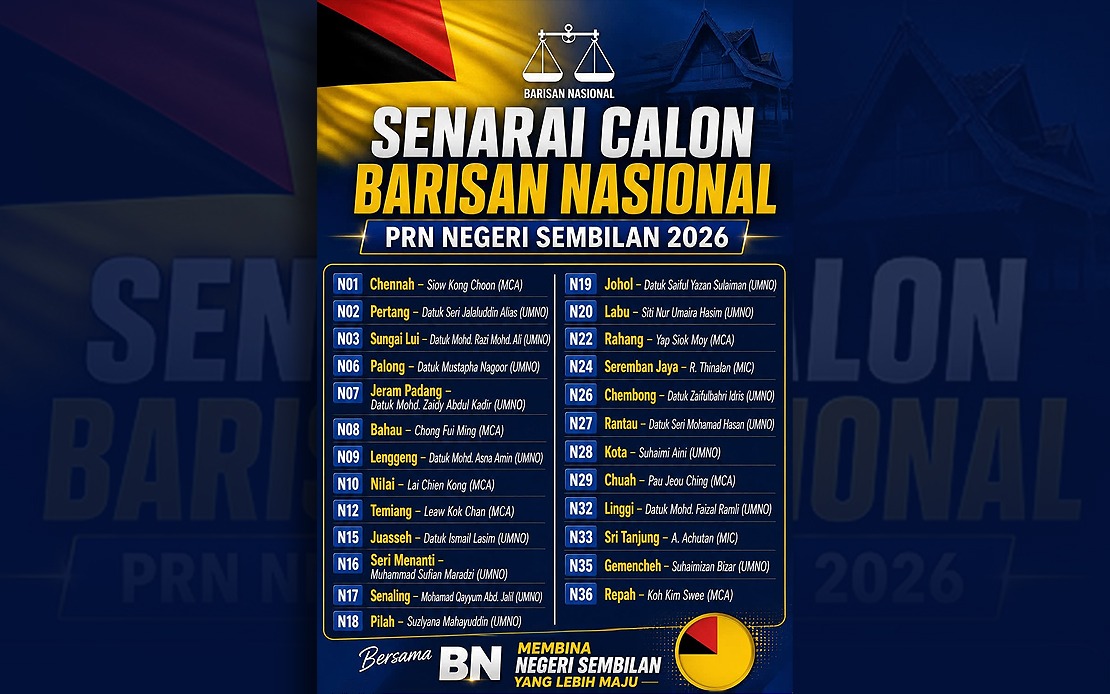
Barisan Nasional will field MCA candidates in seven constituencies and MIC representatives in four seats for the 16th Negeri Sembilan state election, according to a statement by coalition chairman and Deputy Prime Minister Datuk Seri Dr Ahmad Zahid Hamidi. The seat allocation marks the final distribution of campaign territories among BN's component parties ahead of what is expected to be a closely contested state assembly contest.
Ahmad Zahid explained that the distribution formula relied on systematic evaluation of electoral viability rather than arbitrary party preferences. The determination of which candidates would contest which seats reflected a careful assessment of their capacity to secure victories in their respective constituencies, he noted during remarks made to journalists at Wisma UMNO Negeri Sembilan. This methodology has become standard practice for BN across state-level and federal electoral contests, ensuring resources and candidate placement align with realistic winning prospects.
The BN chairman emphasised the importance of candidate commitment, revealing that all prospective nominees had formally signed undertakings and pledged their loyalty directly to him in his capacity as coalition leader. Such pledges represent both a procedural requirement and a symbolic reaffirmation of party discipline within the broader BN framework. The meeting held at the party's Negeri Sembilan headquarters brought together all candidates expected to carry the BN banner into the campaign, providing an opportunity to reinforce shared objectives and strategic alignment ahead of the formal nomination process.
The candidate announcement is scheduled for tonight at Stadium Tuanku Abdul Rahman Paroi, where the full roster of BN contenders will be formally unveiled to the public. This public presentation represents an important moment for the coalition to project unity and present a compelling vision to voters across the state. The event will offer an opportunity to highlight individual candidate credentials and the broader policy platform that BN intends to promote during the campaign phase.
The Election Commission has structured the electoral timeline with precision, designating July 18 as the official nomination day when all candidates must formally register their candidacy. Early voting is scheduled for July 28, allowing those unable to vote on election day to participate beforehand, while the main polling day has been set for August 1. This compressed calendar typical of state elections means the campaign period will be relatively brief, requiring parties to mobilise their machinery efficiently and communicate their messages effectively to voters.
The Negeri Sembilan contest comes against a backdrop shaped by results from the previous state assembly election held during the 15th session. In that contest, BN secured fourteen seats, representing a diminished position within the state legislature. Pakatan Harapan emerged as the dominant coalition with seventeen seats, reflecting voter preference at that time, while Perikatan Nasional captured five seats. The performance gap between BN and its principal rival suggests that reclaiming ground in Negeri Sembilan will require more than simply maintaining existing voter bases; the coalition must persuade voters who switched allegiance since the last election to return to the fold.
This upcoming election represents a significant test for BN's capacity to reverse electoral losses in a crucial state. Negeri Sembilan, located in the Klang Valley region of Peninsular Malaysia, carries political importance as a swing state with considerable bearing on federal coalition mathematics. A strong BN performance could strengthen the coalition's overall position in Parliament and demonstrate restored electoral appeal, while a poor result would raise questions about the viability of BN's electoral strategy and leadership across state and federal levels.
MCA's presence across seven seats reflects the party's enduring role as a key component within BN despite broader challenges facing the coalition. The party continues to compete for support among urban and suburban constituencies where Chinese Malaysian voters remain influential, particularly in areas with significant business and professional communities. MIC's allocation of four seats recognises the Indian Malaysian community's voting power in select constituencies, though the party has faced structural challenges in mobilising its traditional support base in recent electoral cycles.
The allocation also reflects pragmatic considerations about which parties command greatest influence in which geographic areas. Rather than distribute seats equally, BN has oriented its candidate placement toward maximising total seats won across the state. This suggests confidence among BN strategists that certain constituencies will prove more responsive to MCA and MIC representation than to UMNO candidates, even as UMNO will contest the majority of seats as the coalition's largest component party.
The election comes at a moment of broader political realignment across Malaysia, where voter preferences have become more fluid and less predictable than in earlier decades. The rise of competing coalitions and independent candidates has fragmented electoral outcomes, making traditional strongholds less certain. For Negeri Sembilan specifically, BN must contend with sustained competition from Pakatan Harapan while managing internal coalition dynamics among its own parties and persuading floating voters to return after voting for alternatives in 2022.
With the nomination process beginning within days, the real phase of electoral contestation will soon commence. Candidates will fan across the state to campaign, present their credentials to voters, and articulate the reasons why constituents should vote for their particular party. The compressed timeline means intensive campaigning across a short period, requiring efficient use of traditional and digital media as parties vie for voter attention and support. The August 1 polling day will ultimately determine whether BN can recapture momentum in a state that has proven competitive and unpredictable in recent contests.

