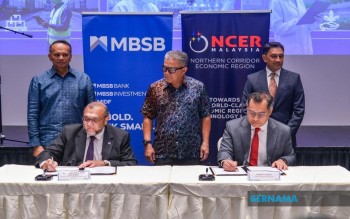
MBSB Bank Bhd and the Northern Corridor Implementation Authority sealed a significant financing partnership yesterday, committing up to RM1 billion to fuel economic expansion across Malaysia's northern states. The memorandum of understanding, formalised at a ceremony in Petaling Jaya, represents a strategic effort to channel capital towards small and medium enterprises operating within the Northern Corridor Economic Region—a four-state expanse encompassing Perlis, Kedah, Penang and Perak that has emerged as one of the country's most dynamic investment zones.
Datuk Wan Kamaruzaman Wan Ahmad, chairman of MBSB Bank, framed the collaboration as a catalyst for unlocking entrepreneurial potential across the northern territories. By broadening access to capital, the financing facility is intended to enable businesses to scale operations, integrate into sophisticated supply chains, and ultimately contribute to the region's sustained economic advancement. The RM1 billion allocation reflects confidence in the growth trajectory of enterprises in these states, particularly those seeking to expand their footprint beyond domestic markets.
The operational framework for the partnership was signed by Noor Mohamed Amin, group chief commercial banking officer at MBSB Bank, and Hasri A Hassan, chief operating officer of NCIA. This administrative alignment underscores both institutions' commitment to expediting the deployment of funds and streamlining approval processes for eligible borrowers. Such coordination is crucial in competitive financial markets where speed and clarity often determine whether businesses pursue available credit or seek alternatives elsewhere.
Rafe Haneef, group chief executive officer of MBSB Bank, highlighted the bank's strategic positioning to serve export-oriented SMEs seeking growth capital. Beyond the direct financing arrangement, MBSB Bank has cultivated a partnership with Spain-headquartered Santander Group, creating a conduit through which northern Malaysian businesses can access international market development expertise and cross-border financial services. This layering of capabilities—domestic lending capacity coupled with global market access—addresses a persistent challenge for Malaysian SMEs: knowing how to navigate international sales channels once they achieve sufficient scale.
The financing framework is explicitly aligned with Malaysia's 13th Malaysia Plan, which prioritises regional economic diversification and inclusive growth. By anchoring capital deployment in the Northern Corridor, the partnership acknowledges the strategic importance of geographically distributed economic engines rather than relying on the concentration of activity in the Klang Valley or southern Johor.
Datuk Mohamad Haris Kader Sultan, chief executive of NCIA, emphasised that the collaboration strengthens the region's competitive advantages in seven critical sectors: electrical and electronics, advanced manufacturing, agri-food production, logistics infrastructure, digital economy services, green technology, and ancillary industries. This sectoral focus is deliberate and reflects where international investment flows and Malaysia's comparative advantages intersect. The E&E sector, in particular, continues to attract semiconductor manufacturers and component suppliers relocating supply chains away from traditional Asian hubs amid geopolitical tensions.
The NCER has demonstrated resilience and attraction as an investment destination over the past decade. Unlike regions dependent on single commodities or services, the northern corridor has diversified its industrial base, capturing investments from multinational corporations in manufacturing while simultaneously nurturing digital startups and agri-tech ventures. This heterogeneity reduces vulnerability to sectoral downturns and creates multiple pathways for wealth generation and employment.
Access to affordable financing remains a persistent bottleneck for Malaysian SMEs, particularly those outside major urban centres. Traditional banks often impose stringent collateral requirements or demand established track records that younger or smaller enterprises cannot readily provide. By committing RM1 billion through a dedicated MoU, MBSB Bank signals a willingness to accept different risk profiles and business models, potentially incorporating revenue-based lending or asset-light financing structures that better suit digital-first or technology-enabled businesses.
The partnership also carries implications for regional integration within Southeast Asia. As businesses in Perlis, Kedah, Penang and Perak gain access to capital and international market expertise, cross-border trade within ASEAN—particularly with Thailand and Myanmar—stands to accelerate. Northern Malaysian ports and industrial estates are geographically positioned to serve as logistics hubs for the broader region, a role that capital availability and financial infrastructure can substantially facilitate.
For policymakers monitoring implementation of the 13th Malaysia Plan, this MoU demonstrates how public development agencies and private financial institutions can align incentives to achieve shared objectives. The absence of concessional interest rates or government guarantees in the announced terms suggests the transaction operates on commercial footing, indicating investor confidence in the underlying viability of northern corridor enterprises rather than reliance on subsidised financing.
The timing of the partnership also reflects broader efforts to rebalance Malaysia's economic geography. Post-pandemic recovery strategies have emphasised the importance of strengthening regional economies and reducing concentration of economic activity. By mobilising RM1 billion specifically for the northern states, both MBSB Bank and NCIA are making a tangible bet that this region can absorb capital productively and generate competitive returns.

