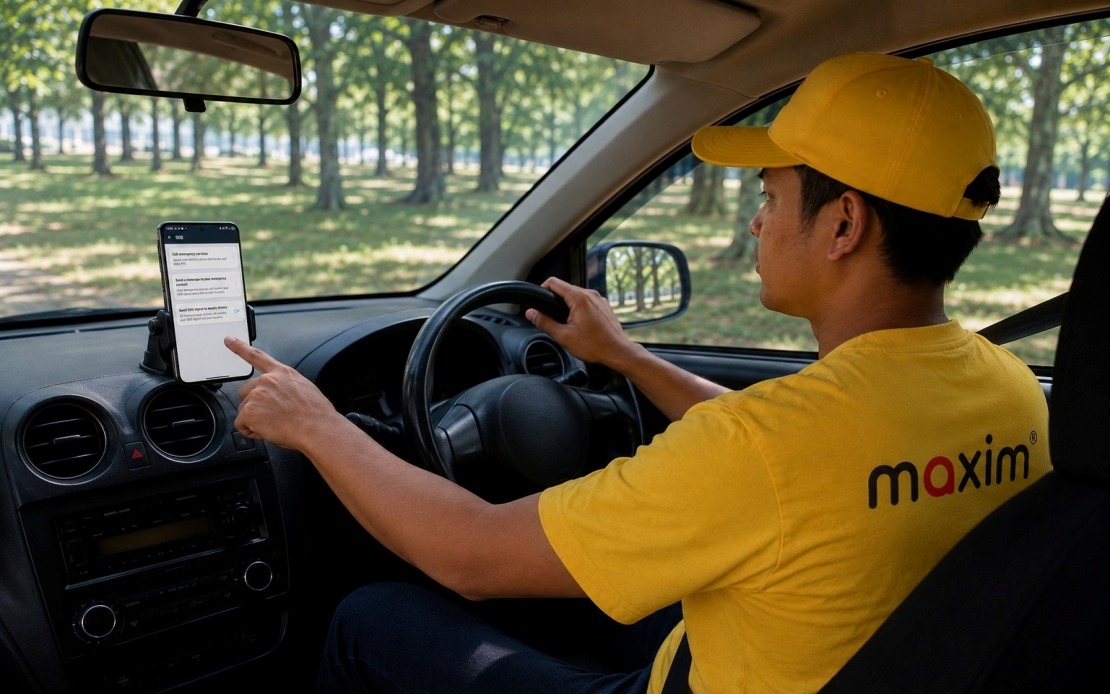
Ride-hailing platform Maxim Malaysia has rolled out a substantially revamped emergency response infrastructure designed to accelerate assistance during critical situations. The overhaul introduces a standardised SOS mechanism accessible to both passenger and driver-partner cohorts, fundamentally reshaping how the platform's community can mobilise help when facing unexpected danger or distress on Malaysian roads.
At the core of the update lies a redesigned SOS button that operates on dual pathways. Users can immediately reach the 999 emergency hotline, or simultaneously dispatch alerts to up to three pre-registered emergency contacts—typically family members or trusted associates. This dual-track approach acknowledges that emergencies vary in nature and context; sometimes professional emergency responders are needed first, whilst in other scenarios, immediate notification of loved ones takes priority. The flexibility embedded in this design reflects nuanced real-world decision-making that drivers and passengers face when incident strikes.
The technical infrastructure underpinning these alerts represents a significant leap in reliability. Dispatched messages contain the user's precise GPS coordinates alongside a live trip-tracking hyperlink, enabling recipients to monitor the situation in real time. Critically, the system functions even when internet connectivity falters—a particularly important safeguard across Malaysia's geographically diverse landscape where network coverage remains inconsistent in certain regions. Alert recipients receive SMS notifications, a medium that operates independently of data services and ensures message delivery regardless of circumstances.
For professional driver-partners operating within the Maxim ecosystem, the platform has introduced a localised Driver Alert System that transforms nearby drivers into an informal first-response network. When a driver-partner activates emergency protocols, notifications propagate to other Maxim drivers within a three-kilometre radius, detailing the emergency category and precise incident coordinates. This distributed assistance model leverages the platform's community as an immediate resource pool, potentially providing crucial support during critical minutes before formal emergency services arrive on scene.
Maxim Malaysia director Mohd Hazwan Musli framed the enhancements as embodying a philosophy that one-size-fits-all emergency protocols are insufficient for genuine safety. He underscored that contemporary emergency response demands velocity and adaptability—users require the capacity to determine swiftly which assistance channel suits their particular predicament. Whether summoning paramedics, alerting family networks, or mobilising neighbouring drivers, the system compresses decision time into seconds, a span that frequently determines outcomes in genuine emergencies. The director's comments implicitly acknowledge that Malaysian ride-hailing users operate within environments where seconds matter considerably.
Beyond emergency triggers, Maxim has fortified its broader safety architecture through complementary mechanisms. An encrypted in-app messaging system protects against fraudulent communication, whilst continuous trip monitoring aggregates journey telemetry including real-time GPS coordinates. For passengers particularly, the Trip Sharing functionality permits immediate distribution of live journey links to designated family or friends upon vehicle boarding, creating external accountability and awareness of their whereabouts.
Data protection constitutes another dimension of the enhancement. All information transmitted through the SOS apparatus, Driver Alert mechanisms, and Trip Sharing channels undergoes encryption conforming to contemporary security benchmarks. Access restrictions limit exposure to authorised security personnel and government authorities operating within prescribed procedures, theoretically preventing unauthorised surveillance whilst preserving legitimate emergency response capacity.
This upgrade arrives as regional ride-hailing services face mounting pressure to demonstrate tangible commitment to user safety—a concern that extends beyond Malaysia into broader Southeast Asian markets. Incidents involving driver-passenger confrontations, vehicle hijackings, and personal safety episodes have generated sustained consumer anxiety across the region. Platforms must simultaneously manage operational efficiency, cost containment, and genuine protective measures, creating persistent tension between competing priorities.
For Malaysian passengers and driver-partners, the practical implications involve accelerated emergency response times and expanded choice in how they mobilise assistance. The three-kilometre driver alert radius potentially transforms everyday traffic congestion into a protective factor, surrounding any driver-partner with potential helpers. Passengers gain assurance that family members can track their journey, addressing particular concerns about solitary late-night journeys common across Malaysian cities.
The enhancement also reflects evolving regulatory expectations across Malaysia's transport sector. Authorities increasingly scrutinise ride-hailing platforms' safety protocols, implicitly signalling that minimal compliance no longer suffices. Companies demonstrating proactive safety investment position themselves favourably within regulatory frameworks and consumer trust matrices. Maxim's investment suggests competitive differentiation based on safety credentials—a market signal that riders increasingly weight protection alongside price and convenience.
Looking forward, these enhancements establish a template potentially influencing competitor responses across Southeast Asia's ride-hailing landscape. As platforms compete for safety-conscious riders and positive regulatory standing, similar safety infrastructure upgrades may become table-stakes rather than differentiating features. For Malaysian consumers, this competitive dynamic ultimately generates positive pressure favouring increasingly sophisticated emergency response systems across the regional mobility ecosystem.

