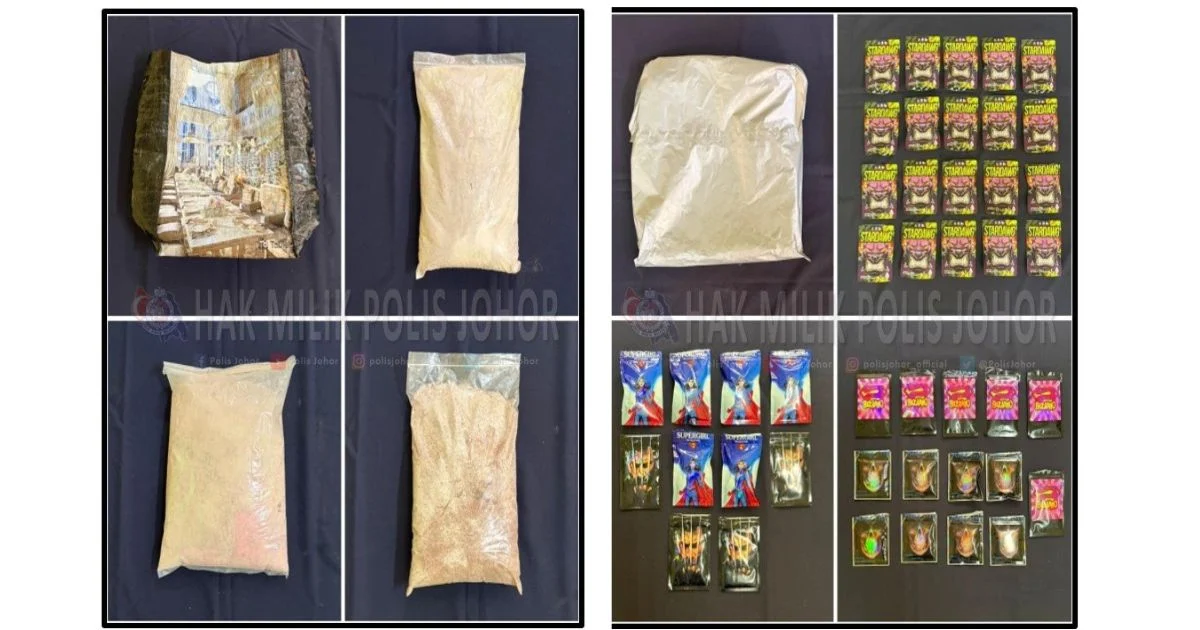
Authorities in Johor have dealt a significant blow to organised drug trafficking following a major enforcement operation in the Kulai district, where police apprehended a married couple and recovered a substantial quantity of controlled substances. The narcotics haul, valued at approximately RM3.59 million, represents a substantial seizure that underscores the ongoing battle against drug distribution networks operating across the state's manufacturing heartland.
The operation highlights the continued vulnerability of Johor's industrial zones to drug trafficking activities. Kulai, strategically positioned within Johor's industrial corridor and lying between Kuala Lumpur and Singapore, has become an area of concern for law enforcement agencies monitoring the movement of illicit substances through the region. The district's network of small and medium-sized enterprises, warehouse facilities, and residential areas provides concealment opportunities that traffickers have historically exploited.
The decision to target a family-operated drug network reflects a broader shift in enforcement strategy across Malaysian law enforcement. Organised trafficking increasingly involves spousal partnerships and extended family networks, which can complicate investigation efforts while providing operational flexibility for criminal enterprises. The arrest of both individuals simultaneously demonstrates coordination in police planning, suggesting intelligence gathering had preceded the enforcement action.
Drug syndicates operating at this scale typically maintain multiple supply chains and distribution points. The RM3.59 million valuation suggests the seized material encompassed various drug categories, likely including methamphetamine, heroin, and synthetic stimulants that dominate Malaysian street markets. The conversion to street value indicates the substances were positioned for distribution rather than simple possession, suggesting the couple's operation had reached an intermediate level within the trafficking hierarchy.
Johor continues to serve as a critical transit corridor for drug trafficking in Southeast Asia, given its proximity to Singapore—a major drug consumption market—and its role as a transshipment point between Thailand and Malaysia's peninsula. Law enforcement operations targeting source-level distributors aim to disrupt supply chains before substances penetrate deeper into Malaysian communities. Each successful interdiction reduces available inventory and temporarily elevates street prices, theoretically creating market friction that deters consumption.
The involvement of a married couple in mid-level distribution reflects economic desperation intertwined with criminality that characterises many trafficking networks. Spousal partnerships in narcotics operations often emerge from financial pressure or existing ties to criminal acquaintances, with couples rationalising the activity as a temporary income solution. The seizure value suggests monthly turnover that would have substantially exceeded legitimate employment opportunities, explaining the appeal despite recognised legal and personal risks.
Police success in Kulai illustrates improved intelligence capabilities and inter-agency coordination within Johor's law enforcement apparatus. Pinpointing specific individuals and executing precise enforcement operations requires extended surveillance, financial tracking, and often cooperation with community informants. The specificity of the RM3.59 million valuation suggests detailed quantification of seized materials, indicating professional forensic assessment and documentation protocols.
The broader implications for Johor's drug situation remain complex. While individual operations' dismantling generates important short-term victories, the underlying supply-demand dynamics persist. Singapore's wealth and relative scarcity create continuous demand transmission across the causeway, while Thailand's opium regions maintain steady supply pressure southward through Malaysia. Addressing this structural problem requires sustained enforcement combined with demand reduction strategies—rehabilitation, treatment accessibility, and employment generation in high-risk communities.
Residential enforcement operations also signal increasing police attention to house-based distribution networks, which have proliferated as street-level dealing becomes riskier. Operating from residential premises provides security benefits for traffickers, complicating detection compared to street markets. The Kulai operation suggests police have developed improved methodologies for identifying and targeting home-based operations, potentially through financial surveillance and informant networks.
For Malaysian communities, such enforcement actions provide reassurance of police commitment to drug control, though substance abuse rates across the peninsula continue rising. Johor, with its transient workforce and industrial concentration, experiences particular vulnerability. The RM3.59 million seizure represents substances that would have been distributed across retail and personal-use markets, ultimately reaching consumers throughout Johor and neighbouring states.
The couple's prosecution will proceed through Johor's courts under Malaysia's strict drug trafficking statutes, which impose mandatory sentencing including significant imprisonment terms. Conviction carries potential sentences reflecting the quantity seized and distribution intent, likely resulting in multi-year incarceration for both individuals. Such outcomes provide deterrent messaging, though effectiveness remains debated among criminologists studying trafficking behaviour.

