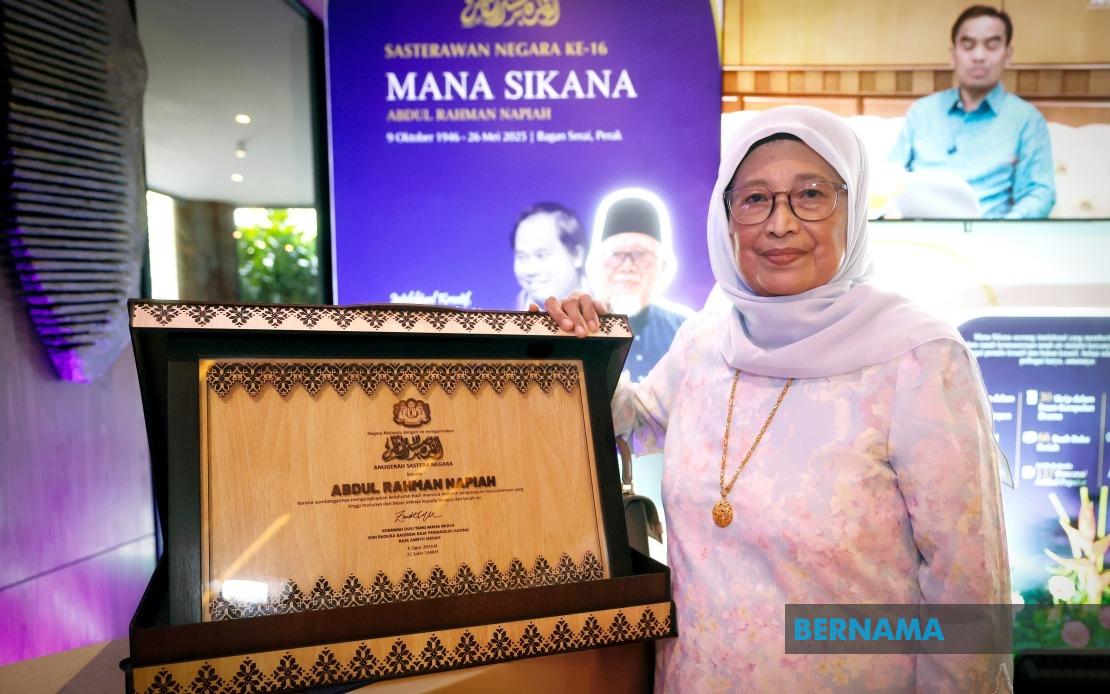
Malaysia's literary world has gained formal recognition for one of its most influential figures, though the accolade arrives posthumously. The late Dr Abdul Rahman Napiah, better known by his pen name Mana Sikana, has been conferred the title of 16th National Laureate—an honour his widow described as a long-overdue acknowledgment of his extraordinary impact on the nation's cultural landscape. The award was presented by Her Majesty Raja Zarith Sofia, Queen of Malaysia, during a ceremony in Kuala Lumpur on August 6, with Education Minister Fadhlina Sidek in attendance.
Salmah Ali, 82, accepted the prestigious award on behalf of her husband, who passed away in May of the previous year at age 80 following heart complications. Speaking to reporters with evident emotion, she reflected on how her husband had anticipated this recognition before his death. Mana Sikana had reportedly been informed of the possibility of receiving the literary award in his final months, making the timing of its conferment both poignant and bittersweet for his family. The widow expressed pride in the recognition while acknowledging the profound sadness of receiving it without him present to witness the moment he had long desired.
The trajectory of Mana Sikana's career reveals a scholar whose influence permeated multiple dimensions of Malaysia's literary and academic ecosystem. Born in Bagan Serai, Perak, on October 9, 1946, he began his professional life as a schoolteacher before transitioning into higher education, where he eventually attained the rank of professor. His academic positions spanned several prestigious institutions, including Universiti Kebangsaan Malaysia (UKM), Universiti Pendidikan Sultan Idris (UPSI), and Nanyang Technological University in Singapore, demonstrating the regional significance of his scholarly work. This multifaceted career underscores how his contributions extended beyond Malaysia's borders, establishing him as a regional intellectual figure in Southeast Asian literary circles.
Beyond his formal academic role, Mana Sikana demonstrated a remarkable commitment to creative expression through drama production. During his years in Johor Bahru, he actively produced dramatic works for both Singaporean radio and television while managing his teaching responsibilities—a dual commitment that exemplified his dedication to popularising literature beyond university walls. Malaysian television networks regularly broadcast his dramatic compositions, bringing his creative vision to audiences beyond academic circles. This willingness to engage with mass media platforms reflects a pragmatic approach to literary promotion, understanding that sustained cultural influence requires reaching diverse audiences through varied mediums.
According to Fadhlina's remarks at the ceremony, the selection of Mana Sikana as National Laureate specifically recognised his multifaceted contributions to strengthening national literature. His influence encompassed creative writing, literary theory, and critical analysis—areas that collectively form the intellectual foundations of any thriving literary culture. The Minister's emphasis on his role in academic discourse highlighted how Mana Sikana worked to elevate Malaysian letters not merely through creative output but through rigorous intellectual engagement with literary concepts and frameworks. This approach positioned him as a bridge between creative practitioners and academic theorists, a role increasingly important in contemporary literary development.
The significance of this award extends to broader questions about how Malaysian society recognises intellectual achievement and cultural contribution. The National Laureate title represents the highest honour available to those whose lifelong work has demonstrably shaped the nation's cultural trajectory. By conferring this honour on Mana Sikana, Malaysia formally acknowledged that literary development constitutes a legitimate and valued form of national service. The timing of the award—following his death—also prompts reflection on whether such recognition should ideally occur during the recipient's lifetime, allowing them to experience the validation of their life's work.
Mana Sikana's influence extended directly into his family sphere, suggesting that his literary philosophy was not confined to professional contexts. Salmah noted that he continued sharing his knowledge of writing and literature with their four children and twelve grandchildren until his final days, embedding his intellectual legacy within the family structure. This domestic transmission of literary values reflects a conception of cultural work as familial responsibility rather than purely professional obligation. His children and grandchildren thus carry forward both explicit lessons in literary technique and implicit values regarding the importance of cultural expression and intellectual engagement.
The awards and accolades Mana Sikana accumulated throughout his life—beginning from his school days—paint a portrait of consistent recognition within literary circles. Yet the National Laureate honour stands apart as the pinnacle of such recognition, reflecting institutional validation at the highest level. That his final public act involved presenting a working paper to Dewan Bahasa dan Pustaka before the health emergency that ultimately proved fatal adds a symbolic dimension to his legacy. He was literally engaged in advancing Malaysian language and literature culture when his life ended, a circumstance that seems to crystallise his fundamental priorities and commitments.
For Malaysian literary communities and academic institutions, the conferment of this honour on Mana Sikana serves multiple functions simultaneously. It validates the importance of literary scholarship and creative work within the national context. It establishes a record that Malaysian cultural achievement extends beyond economic or technological metrics. And it creates a benchmark against which future literary figures will be measured, encouraging others to pursue sustained, multifaceted contributions to the nation's intellectual and cultural development. The award therefore transcends the individual biography of one remarkable figure, instead functioning as a statement about what Malaysia values and wishes to perpetuate within its cultural inheritance.
Widow Salmah's gratitude focused on the recognition finally received for her husband's services, yet her words also carried undertones about the importance of timely acknowledgment. While National Laureate status represents undeniable prestige, its conferment after death necessarily prevents the recipient from experiencing the validation and satisfaction such recognition would have provided during his lifetime. This circumstance raises implicit questions about institutional processes for identifying and honouring national cultural figures—whether systems exist to recognise extraordinary contributions while their authors remain alive to appreciate the honour. Nevertheless, for Mana Sikana's family and for the broader Malaysian literary community, the award stands as formal, permanent recognition of a lifetime devoted to advancing the nation's cultural sophistication and intellectual depth through the medium of literature.

