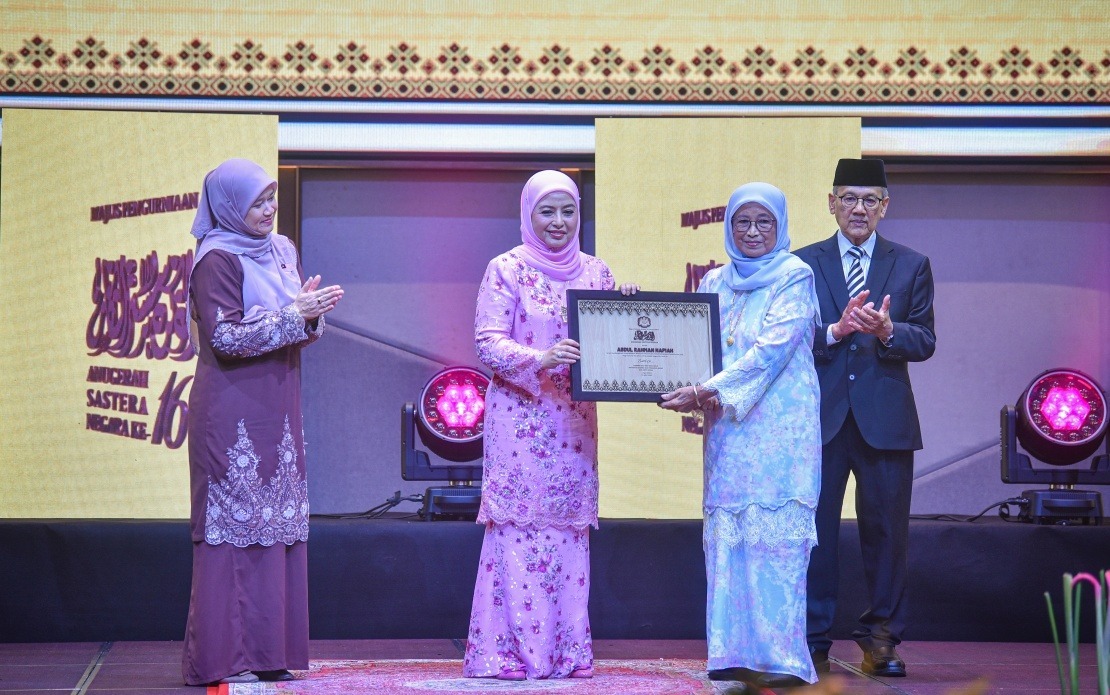
Dr Abdul Rahman Napiah, the influential literary figure known professionally as Mana Sikana, has been posthumously bestowed Malaysia's 16th National Laureate award in recognition of a career that fundamentally shaped the country's literary canon and intellectual discourse. Her Majesty Raja Zarith Sofia, Queen of Malaysia, presented the honour to the author's widow, Salmah Ali, during a ceremony in Kuala Lumpur on 6 August. The distinction represents the nation's highest formal recognition for writers whose work has demonstrated sustained excellence and made lasting contributions to Malaysian letters.
The National Laureate accolade carries substantial symbolic weight within Malaysia's cultural establishment. Beyond the ceremonial recognition, laureates receive a national letter of honour, a monetary award of RM60,000, and crucially, a publishing allocation that permits the production and distribution of up to 50,000 copies of selected works or equivalent value totalling RM500,000. This publishing component ensures that a laureate's oeuvre reaches educational institutions, public libraries, government departments and agencies throughout the country, effectively anchoring their literary legacy within Malaysia's institutional memory and educational infrastructure.
Education Minister Fadhlina Sidek, who chaired the selection panel responsible for evaluating candidates for the honour, articulated the reasoning behind the committee's decision in her address at the ceremony. Fadhlina highlighted how Mana Sikana's prolific output—comprising more than 100 works across his creative career—consistently prioritised themes of cultural awareness, interpersonal empathy, cross-cultural understanding and the moral complexities of human experience. She emphasised that his writing served as a vehicle for deepening public comprehension of Malaysia's heterogeneous society, offering readers sophisticated insights into the nation's multicultural fabric at a moment when literary reflection on national identity remained underdeveloped.
Beyond his creative output, Mana Sikana's intellectual influence extended across three interconnected dimensions of literary life that collectively transformed Malaysian letters. First, he pioneered expansions in the technical and stylistic vocabulary available to Malaysian creative writers, introducing and legitimising experimental narrative approaches that enriched the medium's expressive possibilities. Second, he championed the integration of critical rigour and theoretical sophistication within literary works themselves, elevating the intellectual ambition of Malaysian fiction and poetry. Third, and perhaps most durably, he invested substantially in institutional capacity-building—through university teaching positions, the organisation of literary seminars, and the publication of academic scholarship—thereby cultivating multiple generations of writers, literary scholars, critics and researchers who would themselves advance the field.
Mana Sikana's biographical trajectory underscores the interconnection between creative practice and intellectual institution-building that characterised his career. Born in Bagan Serai, Perak, on 9 October 1946, he initially pursued teaching before transitioning into the academy, where he held positions at several prestigious institutions. His academic appointments included tenures at Universiti Kebangsaan Malaysia (UKM), the Nanyang Technological University in Singapore, and Universiti Pendidikan Sultan Idris (UPSI). He pursued doctoral studies at UKM, embedding himself within Malaysia's premier research ecosystem. This combination of creative authorship and academic engagement typified an older model of the writer-intellectual—a figure equally comfortable producing fiction and engaging in scholarly debate, mentoring junior writers while advancing theoretical discussions about literature's social functions.
Throughout his lifetime, Mana Sikana accumulated numerous accolades that signalled his standing within Malaysian cultural circles. Recognition came through the Malaysian Literary Prize, the Malaysian Perdana Literary Prize, the Perak Laureate Award, and the Darul Ridzuan Lifetime Literary Achievement Award. These honours, cascading across different institutional frameworks and geographic jurisdictions, mapped his influence across both federal and state-level literary establishments. The National Laureate designation thus represents the culmination of a long trajectory of institutional recognition rather than a sudden elevation, affirming through formal state apparatus what literary circles had long acknowledged.
Mana Sikana's death in May 2025 at the age of 80, following complications related to heart disease, marked the conclusion of a career spanning several decades. The posthumous bestowal of the National Laureate honour situates his legacy within a permanent historical record, ensuring that subsequent generations of Malaysian readers and writers will encounter his work as part of the nation's foundational literary inheritance. This mechanism of posthumous recognition reflects broader practices within literary establishments worldwide—the conferral of highest honours sometimes occurs only after an author's death, when accumulated influence can be measured and when the totality of a creative life can be properly assessed.
For Malaysian readers and the broader Southeast Asian literary community, Mana Sikana's laureation carries implications beyond ceremonial recognition. His published work and critical writings remain available for sustained engagement, offering contemporary audiences sophisticated explorations of cultural identity, ethical complexity and the relationship between artistic form and social meaning. Universities throughout the region continue teaching his texts within literature programmes, and scholars continue analysing his contributions to literary theory and practice. The substantial publishing allocation accompanying the National Laureate honour will extend this reach further, introducing his work to students and readers who may not otherwise encounter it.
The recognition also registers within broader conversations about literary value and cultural authority in Southeast Asia. Malaysia's maintenance of a formal National Laureate designation reflects commitment to elevating literature as a significant cultural practice worthy of state recognition and investment. By honouring writers whose work demonstrably enriched national intellectual life—as opposed to recognising purely commercial or entertainment-oriented literary products—the system stakes out literature as a domain meriting serious public support and institutional attention. Mana Sikana's career, bridging creative production, academic scholarship, and pedagogical mentorship, exemplifies the multifaceted contributions that this system seeks to honour and perpetuate.

