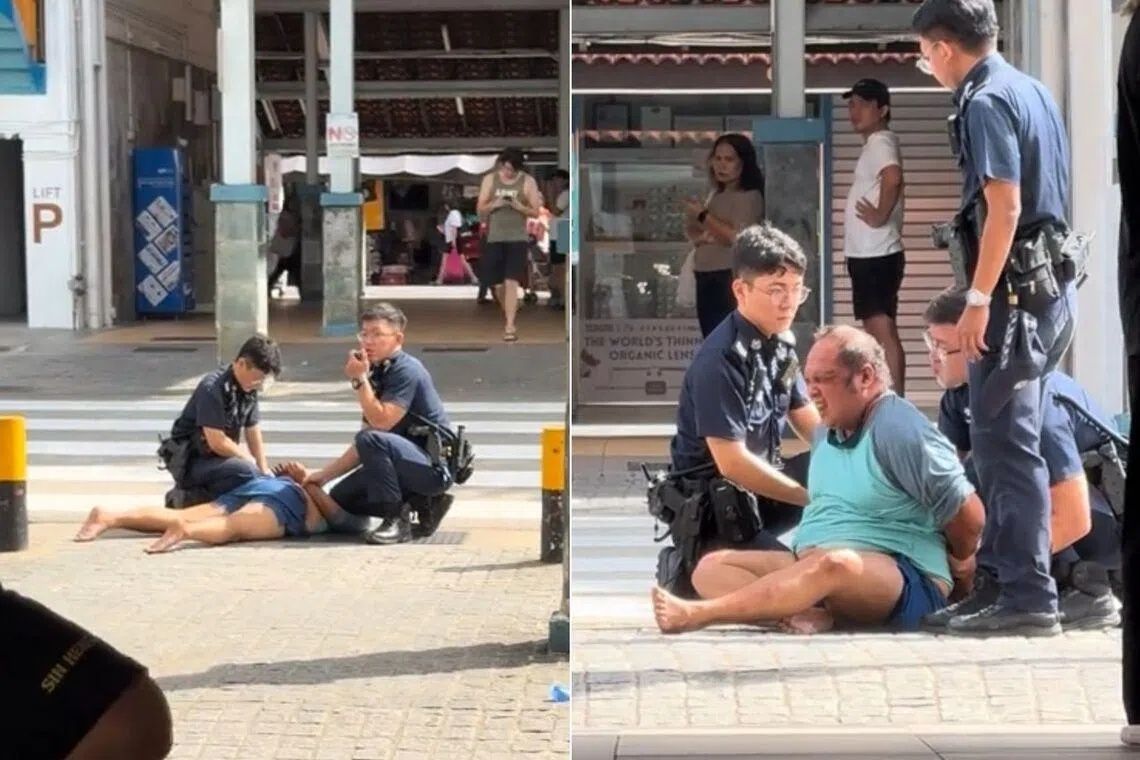
Singapore authorities have arrested a 36-year-old man following an incident in Toa Payoh on Sunday morning in which he committed an obscene act and attacked a police officer responding to a disturbance call. The arrest underscores ongoing public order challenges in the city-state's residential areas and the hazards faced by law enforcement personnel managing disruptive behaviour in public spaces.
Police received a report at approximately 9.45am requesting assistance at Block 184 Toa Payoh Central, where the man had been creating a disturbance inside a coffee shop. Officers arrived promptly to manage the situation, but the encounter escalated when the suspect resisted apprehension. During the arrest procedure, the man struck a 19-year-old police officer directly in the face, inflicting minor injuries that warranted hospital treatment. The officer was conveyed to medical facilities while conscious, suggesting the blow, though forceful, did not result in severe trauma.
Footage captured by TikTok user Kee Wee Shang and circulated online provides documentation of the arrest operation. In one video, two uniformed officers can be observed restraining the barefooted suspect on the ground as they work to secure him. A second clip from the same user shows additional police personnel present at the scene, with the now-handcuffed man being guided away by officers for transport to a police facility. The availability of such recordings reflects the prevalence of public documentation through mobile devices in modern incident reporting, offering contemporaneous accounts alongside official police narratives.
The charges lodged against the accused are substantial. He faces allegations of committing an obscene act in public, a matter that affects community standards and public decency regulations that Singapore maintains with considerable rigour. More significantly, he is charged with voluntarily causing hurt to a public servant with intent to deter that person from performing their official duties. This second charge carries particular weight within Singapore's legal framework, as assaults on law enforcement personnel are treated as serious offences that undermine police authority and public safety operations.
The incident illuminates the operational pressures encountered by Singapore's police force when responding to disturbances in crowded public areas. Coffee shops, being established social gathering points across the island, occasionally become flashpoints for behavioural incidents. The rapid escalation from a disturbance call to physical confrontation illustrates how quickly situations can deteriorate when individuals resist lawful police interventions. For the 19-year-old officer involved, the experience represents an occupational hazard that, while managed professionally by his colleagues, nonetheless underscores the physical risks inherent in policing.
Singapore's approach to public order maintenance has long emphasised swift and decisive intervention to prevent minor incidents from developing into larger disturbances. The response captured in this case—rapid deployment of multiple officers to secure the suspect—reflects established operational protocols. However, the assault on police personnel highlights the ongoing challenge of managing individuals who become confrontational during arrest procedures, a phenomenon that jurisdictions across Southeast Asia continue to grapple with.
For Malaysian observers, this incident serves as a reminder of the pressures faced by law enforcement across the region. While public order challenges manifest differently across Southeast Asian cities, the fundamental issues of managing disruptive behaviour and ensuring officer safety remain consistent priorities. Police forces throughout the region invest considerable resources in de-escalation training and tactical procedures to minimise injury while maintaining public order, yet incidents such as this demonstrate the unpredictability that officers confront in operational settings.
The investigation into the matter remains ongoing, with authorities examining the circumstances that precipitated the disturbance and the assault. Police statements indicate that inquiries continue to establish the full context of events at Block 184 Toa Payoh Central that morning. Such investigations typically encompass witness accounts, video evidence, and medical documentation, all of which contribute to building prosecutorial cases in assault matters involving public servants.
This episode also highlights broader questions surrounding mental health and substance-related incidents within public spaces. While the original police statement does not specify contributing factors, disturbances in commercial establishments sometimes correlate with individual circumstances requiring social or medical intervention rather than purely punitive responses. Many law enforcement agencies across the region are increasingly integrating mental health considerations into their operational frameworks, recognising that certain behavioural incidents benefit from collaborative responses involving healthcare professionals alongside police personnel.

