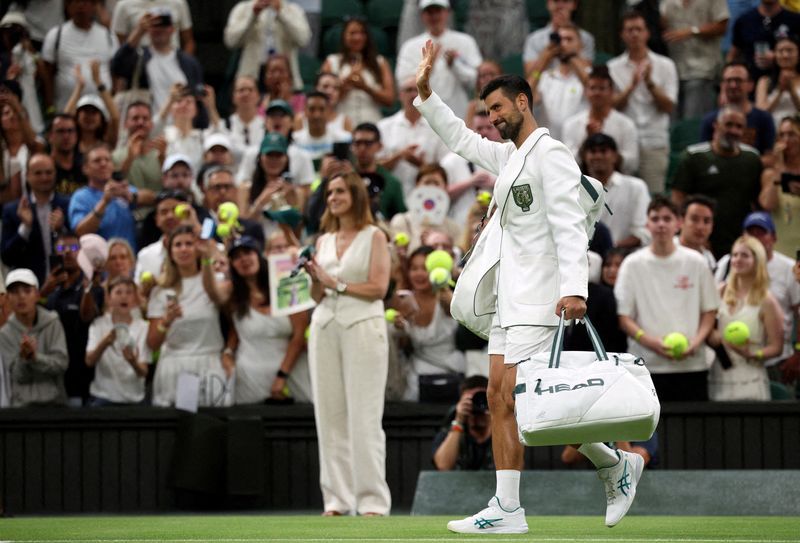
Wimbledon's grass courts have long been synonymous with pristine white attire and conservative elegance, yet this year's Championships are witnessing an unexpected sartorial shift. Male players, emboldened by Naomi Osaka's headline-grabbing entrance in a kimono-inspired outfit, are now seizing the pre-match walk-on as a vehicle for personal expression and brand visibility. The development signals a fundamental change in how professional tennis views the intersection of athleticism, personality, and fashion—one that has implications for how the sport positions itself to younger audiences and global markets.
Novak Djokovic, the 24-time Grand Slam champion, has commanded attention by arriving on court in a custom Lacoste blazer paired with tailored shorts, while American sixth seed Taylor Fritz opted for a crisp white Hugo Boss jacket, long trousers, and silk scarf ensemble. These choices represent a deliberate departure from the functional minimalism traditionally expected of male players, particularly at the All England Club. The timing of this shift is deliberate: both players benefit from sponsor support keen to amplify their brands through high-profile media moments, yet the underlying momentum reflects a broader cultural acceptance of fashion as a legitimate form of athletic expression rather than vanity.
Joelle Michaeloff, the chief creative officer at Wilson sports brand, frames this evolution as part of a natural progression within professional tennis. Speaking to the growing trend, she emphasises that male players are increasingly viewing clothing as a medium for self-expression while simultaneously drawing inspiration from iconic Wimbledon moments throughout the tournament's storied history. This observation resonates particularly in Southeast Asia, where tennis viewership has expanded considerably and where younger demographics respond positively to athletes who transcend traditional sporting personas. The region's audiences, accustomed to seeing fashion-forward personalities in other sports and entertainment, are receptive to this reimagining of tennis culture.
However, the Wimbledon context carries particular constraints and risks. As the sole Grand Slam enforcing a strict all-white dress code, the tournament limits the chromatic experimentation available at the French Open, Wimbledon, or the US Open. This restriction paradoxically creates greater creative pressure: designers and players must innovate within a monochromatic palette, focusing on silhouette, texture, layering, and accessory choices. For Fritz, the stakes of fashion-forward entrance are heightened by performance expectations. The American candidly acknowledged that arriving in a statement outfit while losing in early rounds would constitute a credibility disaster. His progression to the third round without dropping a set has granted him the confidence to disrobe his jacket and long trousers mid-court, transitioning seamlessly from fashionable entrance to competitive focus.
The commercialisation of these moments has not escaped brand strategists. Sponsors now view Wimbledon walk-ons as critical marketing infrastructure, amplifying their visibility through coordinated social media campaigns and press engagement. Nike and Osaka's team strategically shared imagery and video content of her striking arrival, while Hugo Boss maintained consistent promotional messaging around Fritz's tailored ensemble. Ukrainian player Marta Kostyuk similarly collaborated with Wilson on her distinctive match dress, recognising the dual value proposition: the garment must function aesthetically during the walk-on while potentially generating conversation throughout her tournament run. This convergence of athlete agency, sponsor ambition, and media appetite represents a qualitative shift in how tennis packages its global appeal.
Russian player Karen Khachanov exemplifies the deeper engagement now characterising athlete-brand relationships. Rather than passively accepting sponsor designs, contemporary players increasingly demand meaningful input across every dimension—from fabric composition and colour gradations to neckline placement and fit specifications. This collaborative model reflects a maturing understanding that fashion statements succeed only when they authentically align with the athlete's personal aesthetic sensibilities and on-court comfort requirements. The balance between fashionability and functional performance has become paramount, particularly as players recognise that unsuccessful sartorial choices generate ridicule rather than admiration.
Wimbledon's fashion heritage stretches far deeper than contemporary trends suggest. The tournament witnessed Ted Tinling's revolutionary white bodysuit in 1985 and Roger Federer's sophisticated jacket in 2007, moments that Eleanor Thomas, the All England Lawn Tennis Club's collections lead, now contextualises alongside Osaka's contributions. Yet the current phenomenon extends further still, with roots traceable to tennis legends of the 1960s and 1970s. Arthur Ashe's influential style choices, for instance, preceded modern fashion consciousness by decades, establishing a lineage wherein sartorial choices became expressions of identity and cultural positioning. Michaeloff's comparative analysis suggests that contemporary male players are recovering and amplifying this historical continuum rather than inventing something entirely novel.
Fritz's candid observation that women players have pioneered the walk-out outfit as performance spectacle carries particular weight. Female athletes have successfully elevated match arrivals into theatrical productions, with Osaka's successive major tournament appearances—from the French Open's black Kevin Germanier skirt through to the Australian Open's jellyfish-inspired creation—establishing increasingly ambitious stylistic benchmarks. Her Wimbledon kimono, unveiled on Friday, represents the culmination of a sustained campaign to remake tennis as a platform where personality and aesthetic presentation command equal attention to serve velocity or backhand consistency. Male players, following incrementally, are learning that fashion engagement need not compromise competitive credibility; instead, it can enhance marketability and cultural relevance.
The resistance Matteo Berrettini encountered illustrates the institutional constraints still governing Wimbledon's fashion ecosystem. The Italian's proposed outfit fell victim to the All England Club's rigorous whiteness specifications, a reminder that innovation operates within established parameters. This gatekeeping function, while occasionally restrictive, maintains Wimbledon's distinctive visual identity and ensures that fashion statements enhance rather than undermine the tournament's traditional aesthetic authority. For Malaysian and broader Southeast Asian audiences, these dynamics offer instructive lessons about how established institutions negotiate between heritage preservation and contemporary cultural expression.
Looking forward, the question remains whether this trend represents a permanent reorientation or a cyclical enthusiasm destined to fade once novelty diminishes. Fritz's tentative suggestion that male participation in fashion-forward walk-ons may expand reflects genuine uncertainty about whether peers will embrace similar strategies or retreat into conventional anonymity. Yet the commercial incentives supporting this evolution appear substantial, and the positive media response suggests audiences welcome the humanisation and personalisation of professional tennis through fashion. For the sport's global expansion—particularly in markets where personality-driven marketing resonates more forcefully than pure athletic achievement—this shift toward sartorial expressiveness may prove strategically consequential. Wimbledon's 2023 Championships have inadvertently become a referendum on whether tennis can authentically accommodate fashion as an integral component of its competitive theatre.

