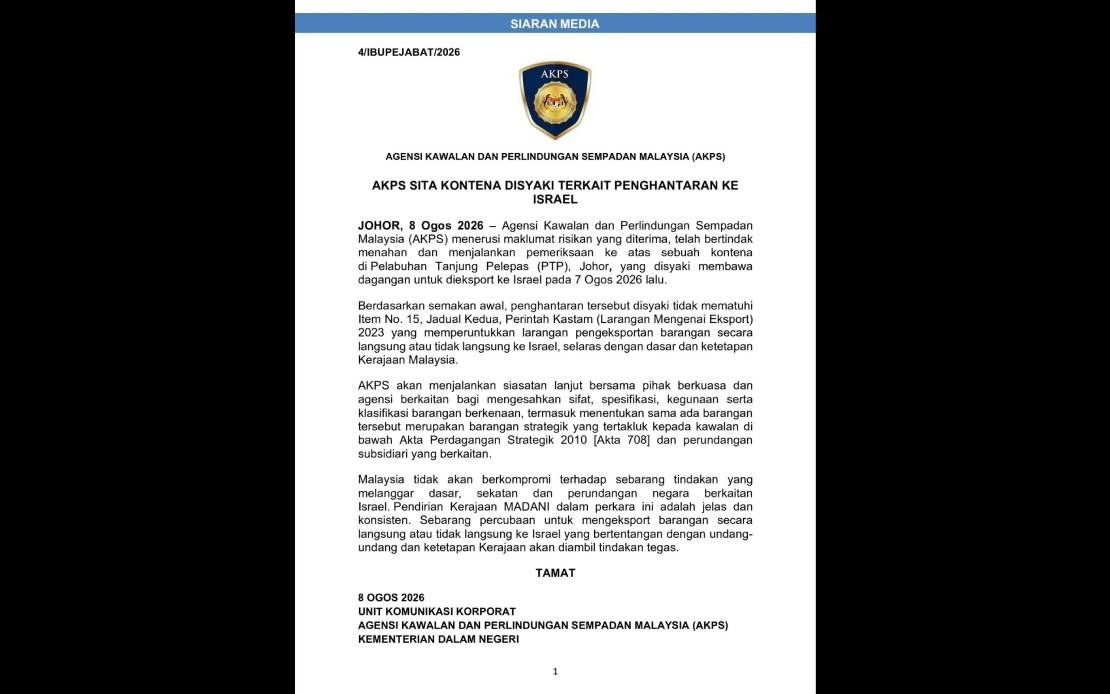
Prime Minister Datuk Seri Anwar Ibrahim has commended the Malaysian Border Control and Protection Agency (AKPS) for its prompt interception of a container suspected of holding strategic merchandise earmarked for Israel at the Port of Tanjung Pelepas in Johor. The seizure, announced yesterday and acknowledged by the Prime Minister through a social media statement today, represents a concrete enforcement action aligned with Malaysia's declared foreign policy position regarding the Israeli-Palestinian conflict.
The detained shipment violated provisions under Item No. 15 of the Second Schedule of the Customs (Prohibition of Exports) Order 2023, which explicitly prohibits direct or indirect shipment of goods destined for Israel in accordance with Malaysian government directives. This regulatory framework has been in place for several months, forming part of a broader governmental approach to restrict trade activities that could indirectly facilitate Israeli operations or contribute to what Malaysia characterises as atrocities perpetrated against Palestinian populations.
Anwar's public endorsement of the interception underscores the Malaysian government's consistency in translating its stated diplomatic principles into tangible customs enforcement. The Prime Minister emphasised that the seizure demonstrates Malaysia's determination to ensure its ports and shipping infrastructure do not become conduits for commerce benefiting the Israeli state. This message carries particular significance given the strategic importance of Malaysian ports in regional and global maritime trade, and signals to businesses operating in the country that compliance with these export restrictions will be rigorously monitored and enforced.
The action is positioned within Malaysia's participation in The Hague Group, an international coalition concerned with humanitarian and legal issues. By framing the seizure in this context, the government seeks to present its stance as part of a coordinated, internationally-engaged approach rather than unilateral action. This diplomatic framing may be intended to insulate Malaysia from potential trade disputes by suggesting alignment with broader international consensus on Palestinian rights.
Since December 2023, Malaysia has maintained an active prohibition against Israeli vessels and cargo-carrying ships destined for Israel from accessing national ports. The latest interception represents the enforcement mechanism behind this maritime policy, demonstrating that the prohibition extends beyond vessel registration to include goods in transit. This layered approach suggests the government views preventing resource flows to Israel as a comprehensive objective requiring vigilance across multiple enforcement domains.
The Prime Minister's statement reaffirmed Malaysia's commitment to advancing principles of international law, human rights, and what the government describes as justice for the Palestinian people. By explicitly linking the seizure to these broader values rather than framing it purely as customs compliance, Anwar positions Malaysia's trade restrictions as expressions of humanitarian concern rather than punitive measures. This rhetorical choice may be designed to resonate with Malaysia's domestic constituency, particularly communities that have expressed strong solidarity with Palestinian causes.
The Port of Tanjung Pelepas, located in Johor, remains one of Southeast Asia's busiest container terminals, handling hundreds of thousands of containers annually. The strategic significance of intercepting prohibited cargo at this particular facility amplifies the message about government resolve, given the volume of legitimate trade flowing through the port. Port authorities and shipping companies operating in Malaysian waters now have clear evidence that goods flagged for Israel will be subject to detailed inspection and potential seizure, which may influence shipping route planning and goods declaration practices across the region.
For Malaysian businesses involved in trade, the seizure serves as a sharp reminder that export compliance extends beyond standard commercial and regulatory requirements to encompass government-defined foreign policy objectives. Companies engaged in goods production or logistics must now evaluate whether their customers or supply chain partners have connections to Israel, adding a geopolitical layer to routine commercial due diligence. This intersection of commerce and foreign policy creates additional compliance burdens for Malaysian exporters seeking to avoid inadvertent violations.
The AKPS interception also reflects broader regional dynamics, where Southeast Asian nations have adopted varying approaches to Israeli trade and relations. While some countries in the region maintain robust commercial ties with Israel, Malaysia has chosen a distinctly different path, implementing trade restrictions that are among the most stringent in the region. This policy differentiation positions Malaysia as a leader among nations prioritising Palestinian advocacy, though it also potentially exposes Malaysian businesses to complications in global supply chains where Israeli components or partners are involved.
The effectiveness of Malaysia's export restrictions ultimately depends on sustained enforcement capacity and vigilance against smuggling or transshipment schemes designed to circumvent the ban. The public announcement of this seizure may serve both as a warning to potential violators and as reassurance to Palestinian solidarity advocates that the government is actively implementing its stated commitments. However, the volume of cargo passing through Malaysian ports presents an inherent enforcement challenge that requires continuous investment in detection capabilities and personnel training.
Government officials and analysts have noted that comprehensive enforcement of trade restrictions against Israel requires coordination not only between Malaysian agencies but also with neighbouring countries and international shipping authorities. Intelligence sharing about suspicious shipments and coordination on transshipment prevention become critical in a region where goods can be routed through multiple jurisdictions. The success of Malaysia's policy may ultimately depend on whether regional partners adopt complementary measures or whether Malaysia's restrictions remain isolated, potentially redirecting prohibited cargo through alternative routes.

