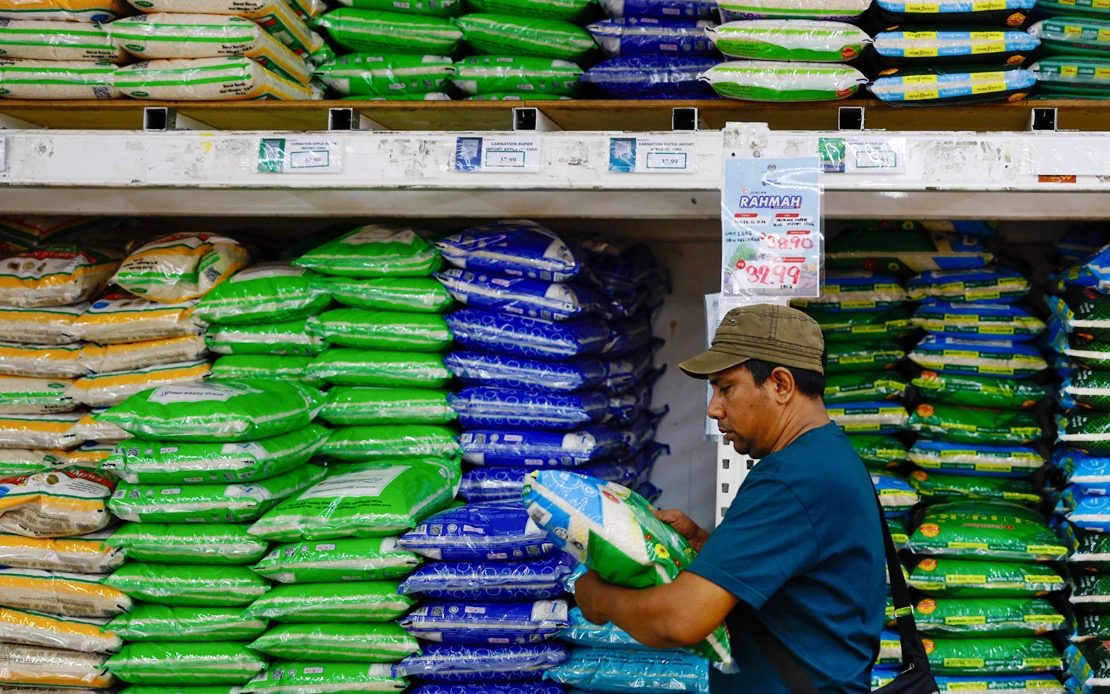
The government has reassured lawmakers that Malaysia's rice security remains intact despite mounting international tensions, with current stockpiles positioned to sustain domestic demand for half a year. Deputy Agriculture and Food Security Minister Datuk Chan Foong Hin disclosed to the Dewan Negara that the country holds 1.237 million tonnes of rice across its reserves, encompassing both strategic buffer stocks and commercial supplies. This dual-layered approach reflects the administration's careful management of one of Southeast Asia's most critical commodities at a time when geopolitical instability in West Asia threatens to disrupt global supply chains affecting numerous sectors.
The reserve composition itself reveals a deliberate strategy. The national buffer stock maintained by Padiberas Nasional Berhad (BERNAS) accounts for 200,000 tonnes of the total, while commercial stockpiles contribute 1.037 million tonnes. Together, these quantities create a protective mechanism designed specifically to shield Malaysia from sudden shocks to international rice markets. This layered security apparatus becomes particularly relevant given that global food supply chains have proven vulnerable to regional conflicts and unexpected disruptions over the past several years.
Beyond mere quantity, the government's price management framework adds another dimension to food security strategy. By sustaining government subsidies on locally produced white rice, authorities have established a pricing buffer that insulates consumers from the volatile swings that plague other commodities when international markets surge. This intervention effectively decouples Malaysian household rice prices from global market turbulence, a crucial advantage for a staple consumed daily by virtually every household in the country. Such subsidization, while fiscally demanding, serves as economic stabilization that prevents purchasing power erosion for lower-income Malaysians most vulnerable to food inflation.
Looking beyond immediate crisis management, the Ministry of Agriculture and Food Security (KPKM) has articulated an ambitious longer-term vision centred on achieving 80 percent self-sufficiency in rice production by 2030. This target addresses a troubling reality: Malaysia's domestic rice production has contracted in recent years, creating increasing import dependence that heightens vulnerability to external shocks. The self-sufficiency ratio, currently below this target, exposes the nation to currency fluctuations, trade disruptions, and the opportunistic pricing practices of major rice-exporting nations.
To bridge this production gap, the ministry is pursuing an agricultural modernization agenda focused on climate resilience. The deployment of new drought-resistant rice varieties, particularly MR 380, MR 381, and MR 382, represents a direct response to mounting climate uncertainty. The El Niño phenomenon, which creates extended dry periods across tropical agricultural zones, poses an existential threat to conventional rice farming. By transitioning to varieties genetically optimized for water scarcity, Malaysian farmers can maintain yields despite increasingly erratic rainfall patterns that characterize Southeast Asian agriculture in the climate change era.
Water management practices form another pillar of the productivity enhancement strategy. The Alternate Wetting and Drying (AWD) technique and System of Rice Intensification (SRI) methodology both promise substantial efficiency gains by optimizing irrigation patterns and reducing water consumption. These approaches, already successful in other Asian rice-producing nations, could simultaneously address water scarcity concerns increasingly pressing across Malaysia's agricultural regions while boosting per-hectare output. Such efficiency improvements become especially valuable given that agricultural water competes with urban and industrial demand across the peninsula.
The intensified cultivation schedule represents an additional innovation in production scaling. A five-season rice cultivation programme spanning two years within areas administered by the Muda Agricultural Development Authority (MADA) aims to extract greater productive capacity from existing agricultural infrastructure. This acceleration of planting cycles, coupled with system upgrades to irrigation networks, reflects recognition that achieving self-sufficiency targets demands productivity gains rather than merely expanding cultivated land area.
Financial incentives form a critical complement to technological interventions. The 2026 planting season will see padi farmers' ploughing incentives nearly double from RM160 to RM300 per hectare, an increase channeling approximately RM40 million in additional support to nearly 200,000 farmers nationwide. This direct income enhancement addresses a fundamental challenge undermining local rice production: the razor-thin profit margins that make farming uncompetitive relative to alternative land uses or occupations. Without such financial support, farmers rationally abandon rice cultivation for more lucrative ventures, accelerating the production decline the government seeks to reverse.
Cost mitigation through tax exemptions further alleviates pressure on farmer profitability. The temporary waiver of Sales and Service Tax on agricultural fertilisers including rock phosphate and magnesium sulphate, extending from January 2026 through December 2027, addresses the input cost inflation eroding farming viability. By reducing the fertilizer expenses that constitute a substantial portion of cultivation costs, the government indirectly subsidizes production while maintaining the fiction of market prices, a politically palatable approach to agricultural support.
The convergence of these measures—maintained reserves, price stabilization, yield improvement through new varieties, enhanced water efficiency, accelerated cultivation cycles, production incentives, and input cost reduction—constitutes a comprehensive food security architecture. For Malaysian consumers and policymakers alike, the message is dual-layered: immediate tranquility comes from existing reserves sufficient for extended supply disruptions, while medium-term confidence derives from structural reforms intended to reduce import dependence. This two-timeline approach acknowledges the political necessity of short-term stability while addressing the economic imperative of long-term self-reliance in an increasingly unpredictable global environment.

