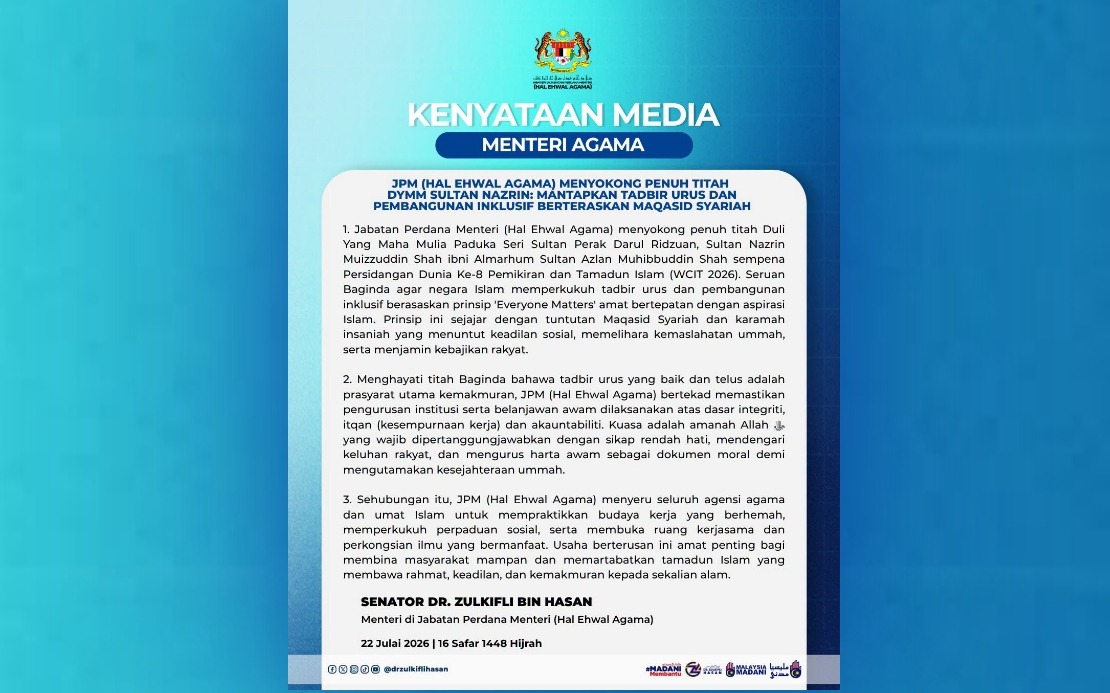
The Prime Minister's Department (Religious Affairs) has committed itself to strengthening the administrative structures that oversee Malaysia's religious institutions according to principles of integrity, public accountability and collective welfare. This alignment represents a direct response to remarks delivered by Sultan Nazrin Shah at the 8th World Conference on Islamic Thought and Civilisation, where the Perak ruler articulated a vision of governance premised on the concept of "Everyone Matters"—a principle positioning all citizens as deserving of equal attention regardless of their racial, religious or political identity.
Dr Zulkifli Hasan, the Minister in the Prime Minister's Department (Religious Affairs), has underscored that Sultan Nazrin's governance framework resonates deeply with Islamic scholarship and Malaysia's constitutional aspirations. The minister emphasized that the "Everyone Matters" ethos finds substantive grounding in Maqasid Syariah, the overarching objectives of Islamic jurisprudence concerned with safeguarding faith, life, intellect, lineage and property. Equally central to this framework is karamah insaniah, the Islamic concept of human dignity, which demands that administrative structures operate to preserve the welfare of the broader Muslim community while protecting individual rights and social cohesion.
In his royal address, Sultan Nazrin elaborated on the intimate connection between governance quality and national prosperity. He contended that public services reflecting true inclusivity—where bureaucrats serve citizens across all demographic lines—embody the substance of national unity while demonstrating leadership grounded in humility and genuine responsiveness. The Sultan further emphasized that modern development requires outward-looking policies rather than insularity, since no nation can thrive in isolation when trade flows, capital movements, technological advancement and knowledge networks fundamentally shape economic outcomes across borders. This internationalist dimension carries particular resonance for Malaysia, a trading nation whose prosperity depends on maintaining robust regional and global connections.
Dr Zulkifli has translated these royal observations into concrete commitments for the Religious Affairs Ministry's operational framework. He pledged that institutional management and public budgeting will be anchored in three pillars: integrity in financial stewardship, itqan—a concept denoting excellence and meticulous attention to detail in executing duties—and transparent accountability mechanisms. These administrative virtues, the minister suggested, flow directly from Islamic theological principles, particularly the understanding that those wielding authority do so as trustees of public trust bestowed by Allah Himself. This theological grounding distinguishes the Religious Affairs Ministry's approach from purely technocratic governance models, embedding religious and moral reasoning into administrative decision-making.
The minister articulated a complementary vision of institutional culture that extends beyond formal procedures to encompass values embedded in daily workplace interactions. He called upon religious agencies and Muslim officials to cultivate courtesy and respect in their engagements, viewing professional conduct as an expression of Islamic values rather than merely secular professional standards. Simultaneously, he emphasized strengthening social cohesion within Malaysia's pluralistic context, suggesting that the Religious Affairs Ministry should foster cross-community collaboration and facilitate the exchange of knowledge beneficial to all stakeholders. This cultural dimension reflects a recognition that governance reform operates at multiple registers—institutional structures, financial systems and the underlying ethos animating official interactions.
The emphasis on listening to public grievances before formulating policy represents a notable departure from top-down administrative models. Sultan Nazrin's framing suggests that Islamic governance, properly understood, privileges consultation and responsiveness over executive unilateralism. For Malaysia's religious institutions, this carries implications for how policies affecting Muslim communities are developed and communicated. The Religious Affairs Ministry's endorsement of this approach signals a willingness to rebuild public confidence through demonstrable receptiveness to concerns arising from the communities these institutions serve, whether those concerns relate to Islamic education, halal standards, mosque administration or the balance between religious law and civil governance.
The broader context for this governance reorientation involves global debates about institutional legitimacy in Muslim-majority societies. Sultan Nazrin's WCIT address positioned Malaysia as offering a model where Islamic values and contemporary governance best practices mutually reinforce rather than contradict each other. This framing proves strategically significant for Southeast Asian readers, as it suggests that religious governance need not be viewed as archaic or impediment to development. Instead, properly executed Islamic administration informed by transparency and human dignity can command public legitimacy across diverse communities, strengthening rather than fragmenting the nation's social fabric.
The principle of karamah insaniah deserves particular attention for Malaysian audiences, as it underpins constitutional protections enshrined in the Federal Constitution regarding fundamental liberties and equal protection. By explicitly connecting this concept to the Religious Affairs Ministry's governance philosophy, Dr Zulkifli positions the ministry as custodian not only of Islamic jurisprudential traditions but also of secular constitutionalism protecting individual rights. This dual commitment reflects Malaysia's distinctive constitutional architecture, wherein Islamic law operates alongside civil law within a framework of fundamental liberties applicable to all citizens regardless of faith.
The minister's appeal for Muslims to manage public funds as a moral responsibility directly addresses concerns about financial stewardship within religious institutions. Throughout Southeast Asia, questions about transparency in waqf administration, mosque finances and Islamic charitable organizations have periodically surfaced in public discourse. By characterizing financial management as a moral obligation flowing from Islamic principles, the Religious Affairs Ministry frames good financial governance not as external imposition but as religious imperative. This framing proves particularly potent when communicated to Muslim stakeholders who may view traditional concepts like amanah (trusteeship) as more compelling than technical audit procedures.
Regional implications extend beyond Malaysia's borders, as the approach articulated by Sultan Nazrin and endorsed by Dr Zulkifli offers a template that other Muslim-majority nations in Southeast Asia might consider. Indonesia, Brunei and regional Islamic organizations frequently engage with questions about reconciling Islamic governance with contemporary administrative expectations. Malaysia's experience navigating this terrain—maintaining Islamic institutions while embedding them within democratic constitutional structures—holds instructive value for neighboring jurisdictions wrestling with comparable tensions. The emphasis on inclusive development and human dignity provides common ground across diverse Muslim-majority societies regardless of their particular constitutional arrangements.
Moving forward, the Religious Affairs Ministry faces the practical challenge of translating these philosophical commitments into measurable institutional reforms. Beyond public statements, meaningful implementation requires reforming recruitment practices, training officials in both Islamic jurisprudence and contemporary administrative techniques, establishing transparent budget allocation mechanisms, and creating formal channels through which community concerns can influence policy development. The ministry's credibility will ultimately depend on demonstrating sustained commitment to these principles through concrete actions observable to the publics these institutions serve, particularly Malaysia's Muslim majority who rightfully expect their religious institutions to exemplify the ethical standards Islam demands.

