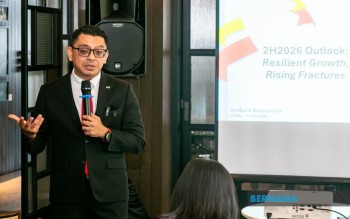
Malaysia's strategic position along one of the world's busiest maritime corridors is translating into tangible commercial advantages for the country's port sector, buoyed by structural shifts in international trade patterns and a broader industry transition toward environmental sustainability. AmBank (M) Bhd chief economist Firdaos Rosli outlined these opportunities during a recent economic briefing, highlighting how geopolitical tensions in West Asia have inadvertently strengthened Malaysia's role as a dependable transhipment hub within an increasingly risk-conscious global supply chain.
The country's major container ports have demonstrated measurable momentum in recent years. Port Klang and the Port of Tanjung Pelepas (PTP) together handled 29.17 million twenty-foot equivalent units (TEUs) during 2025, with Port Klang accounting for 15.14 million TEUs and PTP managing 14.03 million TEUs. This combined capacity underscores Malaysia's significance in Asia's maritime infrastructure landscape. The growth trajectory has continued into 2026, with container volumes at Port Klang expanding by five per cent year-on-year during the first five months of the year, while PTP achieved a more robust eight per cent increase over the same period.
The underlying driver of this expansion reflects a deliberate recalibration of global logistics networks away from traditionally congested or politically unstable regions. Companies seeking to de-risk their supply chains have increasingly recognised Malaysia's geographical advantages and operational reliability, particularly as tensions in the Middle East persist in creating uncertainty around conventional shipping routes. This rerouting phenomenon has fundamentally altered cargo flows, with Malaysia emerging as a preferred node for container transfers between major shipping lines and for consolidation of goods destined for regional markets.
However, the sector faces a paradox that deserves closer examination. While trade volumes have recovered strongly, transportation costs have defied normal market dynamics. The Baltic Exchange Index (BDI), a key indicator of global shipping rates, surged more than 120 per cent year-on-year twice during 2026—in February and again in May—and remained elevated at 64.6 per cent in June. Typically, freight rates decline sharply once temporary supply disruptions resolve, yet Malaysian and regional shipping operators have witnessed persistent cost pressures that suggest deeper structural imbalances in maritime capacity.
Firdaos attributed this anomaly to sustained supply-side constraints affecting global shipping markets. Although Middle Eastern geopolitical tensions may no longer be directly distorting oil markets, their ripple effects continue reverberating through maritime transportation networks. Shipping companies have struggled to restore capacity quickly enough to match the surge in demand, and the extended timeline for vessel construction means this supply-demand imbalance will likely persist. For Malaysian port operators and customers, this environment presents both opportunity and caution: elevated freight rates support margin recovery for logistics providers but threaten to narrow margins for shippers and retailers reliant on thin cost structures.
Beyond near-term volume dynamics, Malaysia is positioning itself to capture a growing segment of the maritime industry's transition toward environmental sustainability. The government's Green Bunkering Regulatory Roadmap establishes an ambitious target of low-carbon fuels comprising 40 per cent of maritime fuel consumption by 2050, acknowledging the shipping sector's increasing exposure to international climate regulations and corporate sustainability commitments. This represents a wholesale transformation of how vessels refuel, with profound implications for port infrastructure and competitive advantage among regional hubs.
The Port of Tanjung Pelepas has already begun executing this transition by introducing liquefied natural gas (LNG) and methanol bunkering operations. These alternative marine fuels represent a material shift from conventional heavy fuel oil, which dominates bunker markets globally. LNG substantially reduces greenhouse gas emissions while methanol offers both environmental and operational advantages as shipping lines experiment with carbon-neutral propulsion pathways. By establishing early-mover capabilities in these fuel categories, PTP positions itself to attract vessels operating under stricter emissions compliance requirements and to capture a premium segment of the global maritime industry.
For Malaysian ports, the convergence of supply chain restructuring and environmental transition creates both synergies and competitive pressures. Port operators must navigate the capital-intensive requirements of upgrading facilities to handle alternative fuels while simultaneously expanding conventional container-handling capacity to meet growing transhipment demand. Infrastructure investment becomes not merely desirable but essential for sustaining competitive positioning against rival regional ports in Singapore, Hong Kong, and increasingly, in Indonesia and Thailand.
The economic implications extend beyond port operators themselves. Enhanced transhipment activity supports employment in logistics, warehousing, and maritime services, contributing to Malaysia's services sector growth. The alignment with global decarbonisation trends positions the country advantageously as multinational shipping lines and logistics providers increasingly incorporate environmental criteria into port selection decisions. However, realising these benefits hinges on continued government commitment to infrastructure modernisation and on port operators' willingness to absorb the considerable capital expenditure required for technology upgrades.
AmBank's economic assessment underscores that Malaysia's port sector enters this period of structural change from a position of relative strength. The combination of geographic convenience, operational efficiency, and proactive policy positioning on green shipping creates genuine competitive advantages. Yet complacency poses a tangible risk. Regional competitors are simultaneously investing in capacity and capabilities, and the window for consolidating first-mover advantages in green bunkering may narrow as other ports accelerate similar programmes.
The outlook for Malaysian ports therefore hinges on execution. Consistent volume growth from supply chain diversification appears likely to persist, supported by ongoing geopolitical fragmentation and companies' desire to reduce concentration risk. The transition toward alternative marine fuels aligns with inevitable global regulatory trends and offers genuine commercial opportunity. But sustaining these advantages requires sustained investment discipline, operational excellence, and strategic infrastructure planning at a scale that Malaysian port authorities have only occasionally demonstrated in recent years.

