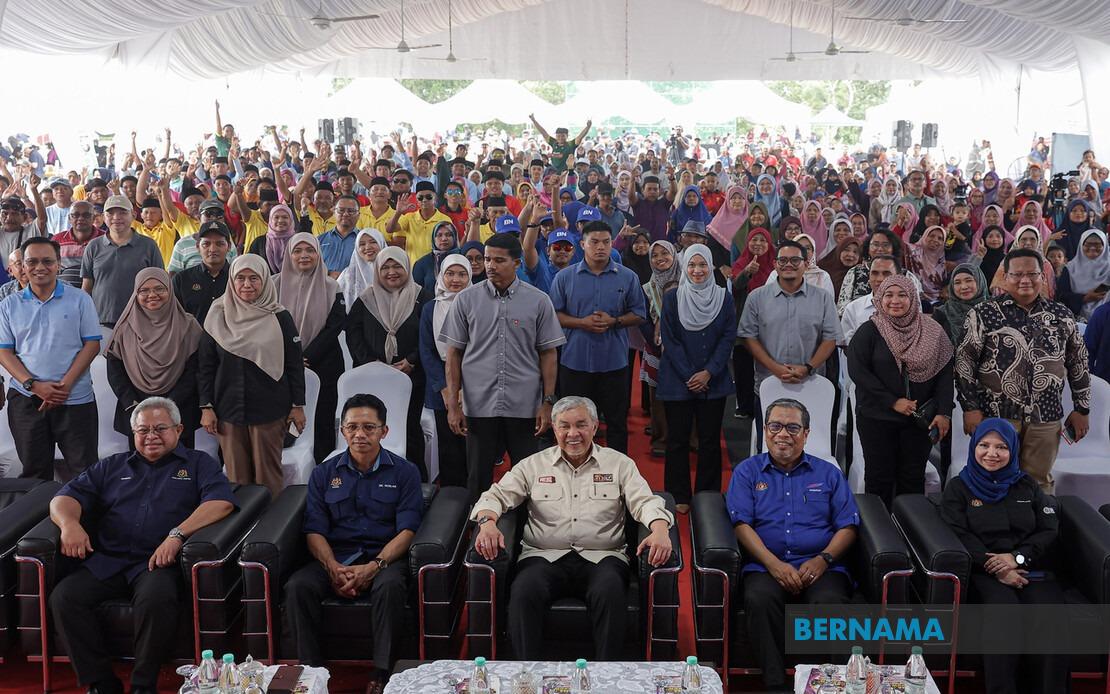
Malaysia's fractured political landscape demands fresh strategic thinking from all major coalitions, according to Barisan Nasional chairman Datuk Seri Dr Ahmad Zahid Hamidi, who underscored the urgency of devising flexible approaches to maintain political stability in an increasingly unpredictable environment. Speaking at an event in Jempol on July 18, Ahmad Zahid outlined how the complex dynamics of contemporary Malaysian politics require coalitions to move beyond rigid structures and explore pragmatic cooperation where it serves the national interest.
The BN chief pointed to the current understanding between his coalition and Perikatan Nasional ahead of the 16th Negeri Sembilan state election as a practical experiment in managing competition without destabilising the broader political system. Rather than view this as a temporary arrangement confined to a single state contest, Ahmad Zahid suggested that the lessons learned from Negeri Sembilan would inform decisions about similar approaches in the Melaka state election and, more significantly, in the preparations for the next General Election. This signals BN's willingness to adopt tactical flexibility when circumstances warrant, even as the coalition remains committed to its core identity and principles.
Crucially, Ahmad Zahid sought to clarify that the arrangement with PN does not constitute a formal merger or binding alliance. Instead, he characterised it as a strategic understanding aimed at a narrowly defined objective: preventing the wasteful overlap of candidatures in the same constituencies that could inadvertently fragment support and hand victories to opposition forces. By cordoning off specific seats for each coalition, both BN and PN aim to maximise their combined electoral efficiency without surrendering autonomy or compromising their separate political identities.
This nuanced distinction reflects the reality of Malaysian coalition politics, where public opinion increasingly rewards pragmatism over ideological purity. Voters across Peninsular Malaysia have grown weary of fractious alliances that collapse over personality clashes or resource disputes, and leaders like Ahmad Zahid are responding to demand for arrangements that deliver tangible governance benefits rather than endless political drama. The no-binding-agreement framing allows both coalitions to retain rhetorical independence while cooperating tactically, a formula that may prove durable precisely because it acknowledges the provisional nature of political partnerships in a volatile environment.
The immediate test case comes in Negeri Sembilan, where early voting is scheduled for July 28 and polling day for August 1. This state election carries significance beyond its local implications, as observers will scrutinise whether the BN-PN arrangement produces electoral synergies or creates complications. A successful outcome—defined as both coalitions winning more seats collectively than they would have separately—would provide compelling evidence for extending the model. Conversely, poor results or voter backlash could persuade leaders that such arrangements generate more friction than benefit.
For Malaysian voters and political analysts, the real interest lies in what Ahmad Zahid's comments reveal about the trajectory of national politics. Rather than pointing toward grand realignments or transformative coalitional shifts, his measured language suggests a pragmatic middle ground: maintaining the broad BN-PN rivalry while allowing tactical cooperation on specific issues and contests. This reflects a political culture increasingly characterised by fluid, transactional relationships rather than the ideologically coherent blocs that once dominated Malaysian politics.
The implications for the 16th General Election are particularly significant. Should the Negeri Sembilan experiment succeed and be replicated in Melaka and other states, GE16 could feature unprecedented flexibility in the coalition landscape, with seat-level arrangements potentially varying sharply from state to state. This atomisation of politics to the constituency level would represent a fundamental shift from post-1998 politics, where coalitions projected unified national images. Whether such granular arrangements actually strengthen political stability or create new sources of confusion and gaming remains an open question.
Ahmad Zahid's framing of politics as inherently dynamic and requiring continuous recalibration also acknowledges the reality of demographic change and shifting voter preferences. Younger Malaysians, in particular, show less loyalty to grand coalitional narratives and more interest in performance and competence. Leaders responding to these constituencies cannot afford to appear dogmatic about coalition structures; they must demonstrate adaptability and results-oriented pragmatism.
The BN chairman's comments come at a moment when both BN and PN face pressure from Pakatan Harapan and independent candidates, making electoral efficiency a genuine concern for both coalitions. Against this backdrop, the Negeri Sembilan understanding emerges not as a gesture of ideological affinity but as a response to the harsh arithmetic of competitive politics. When vote-splitting can hand power to less-preferred alternatives, even rivals find reason to cooperate.
Looking ahead, the success or failure of this tactical arrangement will likely influence how Malaysian coalitions approach the next decade of politics. If flexibility and narrowly tailored cooperation prove electorally rewarding without destabilising governance, other states and parties may follow suit. Conversely, if such arrangements generate friction, resentment among party members, or voter confusion, the Malaysian political system may revert to clearer, more stable coalition boundaries. Either outcome will reshape how voters understand and navigate the political choices available to them.

