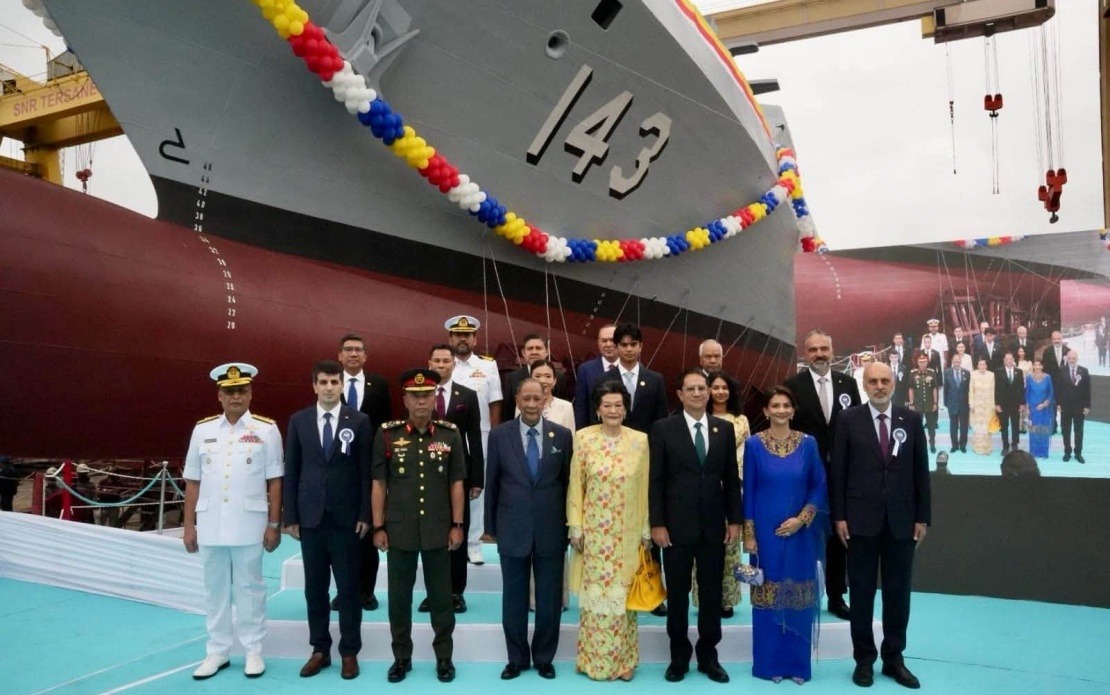
The Royal Malaysian Navy requires continuous investment in advanced military platforms to meet the mounting complexities of regional maritime security, Defence Minister Datuk Seri Mohamed Khaled Nordin said during a significant naval commissioning event in Kuala Lumpur. His remarks underscore growing recognition within Malaysia's defence establishment that conventional naval capabilities increasingly fall short in an environment marked by evolving threats, contested waters, and competing maritime interests across Southeast Asia.
Mohamed Khaled made these observations while presiding over the formal naming and launch of the third Littoral Mission Ship Batch 2 vessel, christened Tunku Osman Jewa. The ceremony honoured the memory of the late General Tan Sri Tunku Osman Tunku Mohammad Jewa, a senior military figure who served as Armed Forces chief and belonged to the Kedah royal family. The distinguished attendance of Al Aminul Karim Sultan Sallehuddin Sultan Badlishah, Sultan of Kedah, and Sultanah Maliha Tengku Ariff underscored the national significance attached to the acquisition programme.
The completion of this three-vessel construction series represents a watershed moment for Malaysian naval modernisation efforts. Each new ship embodies enhanced capabilities designed to address contemporary maritime policing, territorial defence, and regional stability operations. The vessels fill a critical capability gap in the RMN's operational inventory, providing platforms suited to littoral operations—the shallow coastal waters that characterise much of Malaysia's maritime domain and remain strategically vital.
What distinguishes this procurement initiative is its unprecedented nature as the first direct Government-to-Government warship acquisition collaboration between Malaysia and Turkiye. This partnership transcends simple commercial transactions, establishing a defence technology relationship with a NATO-aligned regional power. Such cooperation signals Malaysia's strategic openness to diversifying supplier relationships beyond traditional partners, reducing dependency risks while accessing Turkish maritime engineering expertise developed through Istanbul's own experience navigating complex waters around the Black Sea, Mediterranean, and Eastern Mediterranean regions.
The Malaysian government has positioned these acquisitions within a broader strategic modernisation framework known as the 15-to-5 Transformation Plan. This initiative aims to systematically upgrade the RMN's operational capacity through targeted procurement, training improvements, and doctrine development. The plan reflects understanding that Malaysia's maritime environment—encompassing the Strait of Malacca, the South China Sea, and waters extending toward Brunei and the Philippines—demands vessels capable of sustained operations, sophisticated surveillance capabilities, and interoperability with regional naval forces.
Delivery of all three Littoral Mission Ships is scheduled to conclude by end of 2027, providing the navy with nearly a decade to integrate these platforms into operational structures. This timeline allows crews to undergo comprehensive training, maintenance protocols to be established, and combat systems to be thoroughly evaluated against operational requirements. The phased introduction prevents disruptive gaps in naval readiness during the transition from older asset classes to modern platforms.
The strategic rationale for this investment extends beyond naval capability alone. Malaysia's maritime interests encompass fisheries protection, anti-piracy operations, drug interdiction, and maintenance of freedom of navigation across critical sea lanes. The country's exclusive economic zone spans hundreds of thousands of square kilometres, and contemporary threats range from traditional maritime crime to sophisticated naval operations by neighbouring states. Modern vessels equipped with advanced sensors and communications systems enable more effective presence projection and response capabilities.
Regionally, Malaysia's naval modernisation programme fits within broader Southeast Asian patterns of maritime capability upgrading. Vietnam, Thailand, and Indonesia have all pursued significant naval acquisitions in recent years, reshaping the maritime balance throughout the region. For Malaysia, maintaining relative operational parity and demonstrating commitment to maritime security helps sustain regional influence and credibility in multilateral forums addressing contested waters and maritime governance questions.
The Turkish partnership dimension warrants particular attention for Malaysian defence policymakers and regional observers. Turkiye's domestic shipbuilding industry has matured substantially, producing sophisticated corvettes, frigates, and landing craft exported to multiple nations. Selecting Turkish platforms and construction expertise offers Malaysia access to proven designs at potentially favourable economics compared to established Western suppliers. Additionally, Turkish industrial participation creates pathways for knowledge transfer and potential future local value addition in Malaysian defence manufacturing.
Civil-military coordination appears evident in the ceremony's royal participation, reflecting traditional Malaysian governance structures where defence matters command palace-level attention. This institutional involvement signals to the international community and domestic constituencies that naval modernisation enjoys elite consensus, providing political stability for sustained commitment across multiple budget cycles—a significant consideration given defence procurement timelines extending years into the future.
For Malaysian stakeholders monitoring defence spending, the Littoral Mission Ship acquisition represents a calculated prioritisation of capability over expansion. Rather than attempting to increase total vessel numbers, the RMN is selectively upgrading platform quality. This approach reflects fiscal discipline while still advancing operational effectiveness—a sensible strategy for a middle-power nation managing competing budgetary demands across healthcare, education, and infrastructure sectors.
The statement by Mohamed Khaled that government remains committed to equipping the RMN with necessary capabilities signals continuity beyond current political configurations. Defence modernisation programs typically transcend electoral cycles, and public ministerial declarations regarding procurement commitments help insulate these initiatives from political volatility, ensuring the navy can plan with confidence in sustained support for the 15-to-5 Transformation Plan.
Looking forward, the successful integration of these Turkish-built vessels will likely influence subsequent RMN procurement decisions. If the Littoral Mission Ships perform to expectations and Turkish cooperation proves productive, Malaysia may expand this relationship for additional platforms or complementary systems. Conversely, any operational or integration challenges could prompt reorientation toward traditional suppliers, though the precedent established by this collaboration appears likely to persist regardless of specific outcomes with these three vessels.

