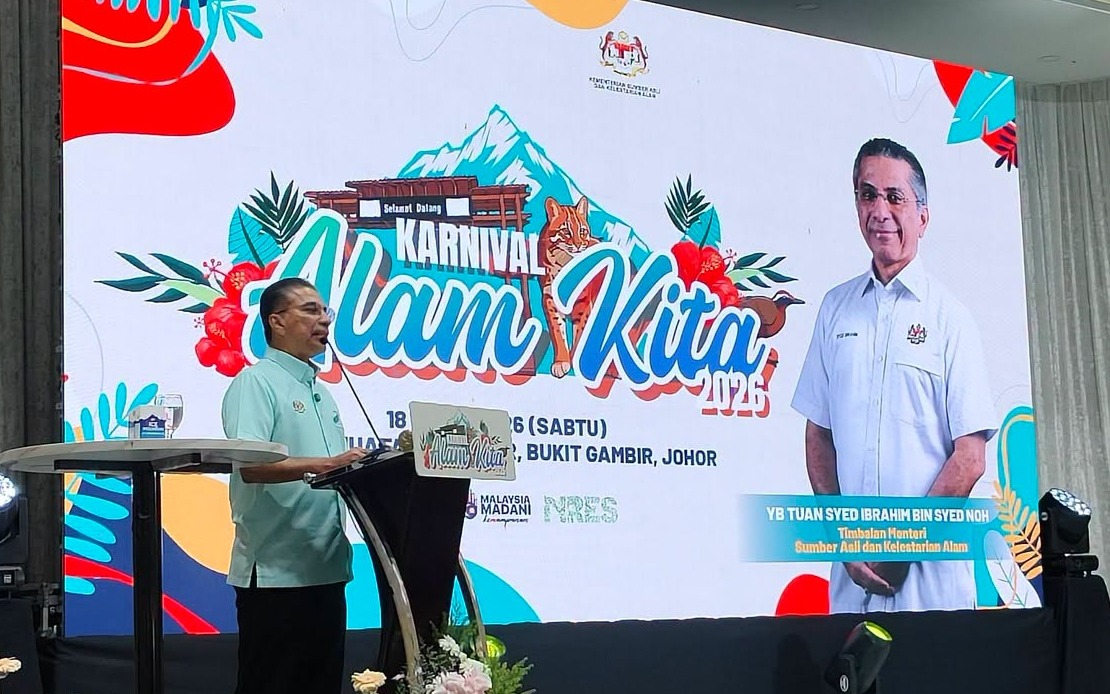
The Ministry of Natural Resources and Environment (NRES) has initiated Karnival Alam Kita 2026 in Johor Bahru as part of an expanded drive to embed environmental consciousness and sustainable practices into the daily routines of Malaysian households, workplaces, and communities. Held at Dewan Muafakat Bukit Gambir, the carnival represents a strategic pivot towards making environmental stewardship tangible and accessible for ordinary citizens rather than treating sustainability as an abstract policy objective.
Deputy Minister Syed Ibrahim Syed Noh articulated the underlying philosophy guiding this year's carnival: translating environmental concepts into practical, relatable language that resonates with how Malaysians actually live. Rather than positioning sustainability as a specialised domain populated by technical jargon around rare earth elements, electronic waste, or climate science, the ministry seeks to demonstrate how conservation and green practices integrate seamlessly into domestic and workplace environments. This reframing acknowledges a persistent communication challenge within environmental advocacy—the gap between government messaging and public comprehension.
Central to the carnival's mission is the recognition that environmental responsibility cannot rest solely on regulatory bodies or corporate compliance frameworks. Instead, the ministry frames sustainability as a collective endeavour beginning at the household level, extending through educational institutions, embedded within employment settings, and reinforced through neighbourhood and community structures. This multi-layered approach suggests an understanding that lasting behavioural change requires saturation of messaging across all social contexts where decisions about consumption, waste, and resource use occur.
The Young Environmental Ambassador Programme represents a significant component of the carnival's longer-term strategy, targeting secondary school students as the primary drivers of generational attitude shifts. By cultivating environmental champions among adolescents, the ministry anticipates these young ambassadors will influence not only their peer groups but also guide their families toward sustainable lifestyle choices. This approach recognises that youth often serve as cultural intermediaries within households, translating new values and practices to older generations who might otherwise resist institutional messaging.
Parallel to educational initiatives, the carnival features the KUDAH clean-up operation, executed collaboratively between the NRES Lestari Squad and partner organisation Bateriku (M) Sdn Bhd. During the launching event, this initiative collected 37 kilogrammes of waste material, including 17.3 kilogrammes of plastic bottles. Beyond the immediate cleanup outcome, the activity quantified environmental impact through carbon reduction metrics, demonstrating that the collection prevented approximately 43.2 kilogrammes of carbon dioxide equivalent emissions—equivalent to emissions generated by a petrol-powered vehicle travelling roughly 100 kilometres.
This translation of waste collection into carbon reduction equivalents serves a pedagogical function, making abstract environmental benefit concrete and relatable. By comparing carbon savings to familiar units like vehicular distance, the ministry attempts to bridge the comprehension gap between environmental data and public understanding. Such quantification also supports Malaysia's overarching commitment to achieving net-zero carbon emissions by 2050, situating local carnival activities within a national decarbonisation timeline.
The carnival's programming encompasses diverse interactive components designed to engage multiple stakeholder groups. Government agencies, non-governmental organisations, and commercial partners collaborate to deliver exhibitions, workshops, and sales opportunities spanning electronic waste recycling, used cooking oil collection initiatives, biodiversity awareness campaigns, and green product distribution. This heterogeneous ecosystem of participants suggests a recognition that environmental transitions require coordination across public, civil society, and commercial sectors—no single institution possesses sufficient capacity or legitimacy to orchestrate comprehensive sustainability transformation.
For Malaysian readers, particularly those in Johor and surrounding regions, the carnival signals heightened institutional attention to environmental sustainability as a policy priority rather than a peripheral concern. The allocation of ministerial resources, coordination across multiple government bodies, and structured programming around environmental education indicates that green transition considerations now shape how government agencies approach community engagement and public health infrastructure.
The timing and location of Karnival Alam Kita 2026 carries particular significance for Johor, a state with substantial manufacturing, agricultural, and resource extraction industries. Promoting sustainable practices within this economically diverse region requires messaging that acknowledges industrial contexts whilst advocating for greener operational standards. The carnival's emphasis on practical implementation—demonstrating how sustainability functions within real-world environments—directly addresses the scepticism that often accompanies environmental advocacy in industrialised communities where economic livelihood depends on resource-intensive activities.
Looking forward, the success of Karnival Alam Kita 2026 will partly depend on whether the carnival succeeds in converting awareness into sustained behavioural change. Environmental carnivals frequently excel at generating temporary enthusiasm and media attention but struggle to translate short-term engagement into long-term practice modification. The Young Environmental Ambassador Programme may prove instrumental in sustaining momentum by embedding environmental advocacy within school structures and peer networks that persist throughout the academic calendar.
The carnival also reflects broader regional trends within Southeast Asia, where governments increasingly recognise that environmental governance requires public participation and cultural acceptance rather than top-down regulatory imposition alone. Malaysia's approach aligns with practices in neighbouring countries where environmental ministries have adopted community-centred strategies, though the specific Indonesian, Thai, or Singaporean contexts differ significantly in implementation. Malaysian policymakers appear to have absorbed lessons about the necessity of translating technical environmental concepts into accessible community narratives.
For businesses and organisations operating in Malaysia, the carnival and accompanying youth ambassador programme signal that environmental expectations will increasingly permeate institutional and educational environments. Companies seeking to maintain social licence and attract talent will likely find themselves navigating an operating context where environmental responsibility becomes normalised through school curricula and community expectations cultivated by initiatives like Karnival Alam Kita 2026.

