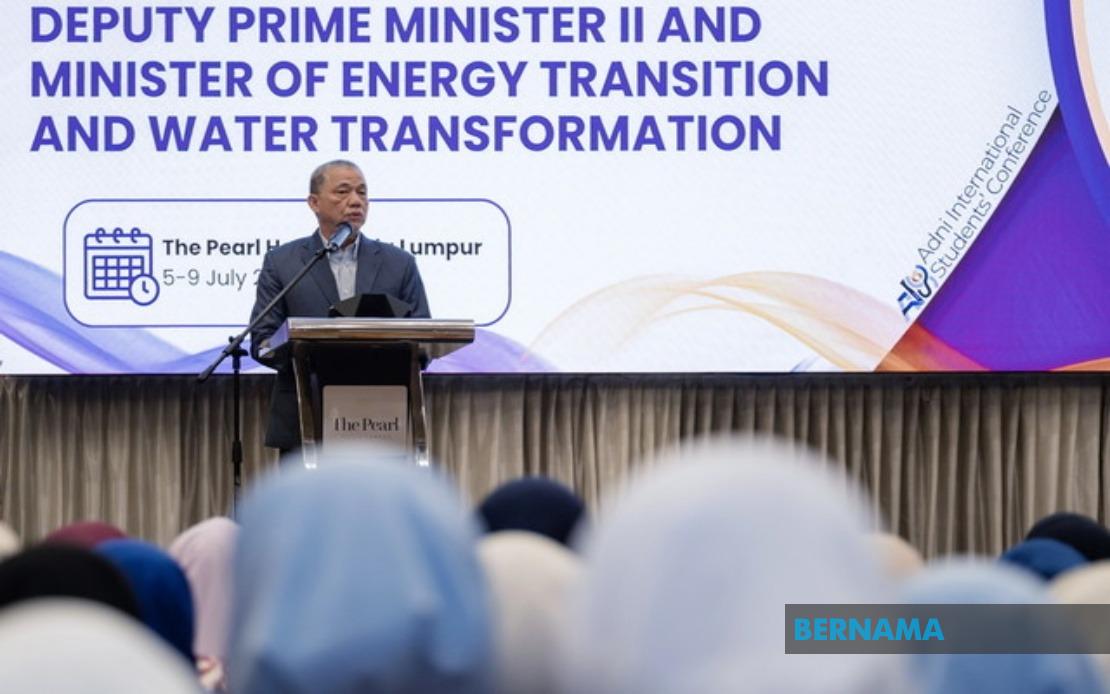
Deputy Prime Minister Datuk Seri Fadillah Yusof has underscored a fundamental truth about Malaysia's trajectory: the nation's trajectory will be determined not by machines or money alone, but by the calibre of its people. Speaking at the ADNI International Students' Conference (AISC) 2026 in Kuala Lumpur on July 6, Fadillah articulated a vision that extends beyond conventional measures of development, positioning human capital as the cornerstone of national competitiveness in an era of rapid global transformation.
The Deputy Prime Minister's remarks reflect a growing recognition among policymakers worldwide that technological prowess and fiscal strength, while important, are insufficient guarantees of sustainable progress. Fadillah emphasised that Malaysia requires individuals equipped with the capacity for analytical thinking, the ability to express ideas with clarity, and the flexibility to navigate constant change within an increasingly interconnected planetary system. This reframing of national success metrics moves beyond GDP growth and innovation indices to encompass the softer but arguably more durable foundations of societal resilience.
The challenges confronting the world in coming decades—climate disruption, pandemic preparedness, the digital revolution, and persistent disparities in opportunity—resist isolated solutions within national borders. These transnational problems demand that governments, universities, commercial enterprises, non-profit organisations, and younger generations work in concert. Malaysia's strategic positioning in Southeast Asia means it cannot solve these challenges unilaterally; regional cooperation and the ability to coordinate across cultural and institutional boundaries will prove essential.
The MADANI Government has explicitly anchored human capital development within its broader developmental philosophy, Fadillah noted, drawing a lineage to principles articulated by Malaysia's third Prime Minister Tun Hussein Onn. That historical reference serves as a reminder that nation-building has always been rooted in the character and cohesion of the populace rather than in hardware or infrastructure alone. In contemporary terms, this principle gains urgency as societies grapple with fragmentation and polarisation.
Fadillah invoked a memorable distinction: technology can link devices, but only shared principles, reciprocal esteem, and confidence can genuinely integrate communities. This observation carries particular weight in Malaysia, a multicultural federation where social harmony depends on mutual recognition and acceptance. The statement suggests that artificial connections—digital networks without underlying social bonds—risk exacerbating rather than resolving societal rifts.
According to the Deputy Prime Minister, authentic advancement encompasses not only academic achievement and material prosperity, but also physical and mental well-being, moral grounding, innovation capacity, environmental responsibility, and the institutional strength that allows diverse groups to coexist. This holistic conception of development aligns closely with the United Nations Sustainable Development Goals, which Malaysia has committed to pursuing.
The AISC 2026, which convened approximately 150 students from Malaysia and abroad—including participants from Thailand, the Philippines, and Indonesia—embodied this integrative approach. The conference theme, 'Thriving Together: Diversity, Education and Wellness in a Digital World', explicitly connects learning, inclusion, governance, and cross-sectoral partnerships. By bringing together young people across borders and backgrounds for substantive dialogue, such forums create the interpersonal networks and mutual understanding that policy frameworks alone cannot generate.
Fadillah underscored the significance of intellectual exchange and interaction across cultural boundaries in producing globally informed citizens who retain strong values and sense of self. In an age when digital platforms enable instantaneous connection yet often amplify insularity and prejudice, face-to-face engagement among young people from different nations offers a counterbalance—fostering the kind of wisdom and ethical grounding that artificial intelligence, however sophisticated, cannot cultivate.
A crucial observation from the Deputy Prime Minister warrants particular attention: while machines may grow more computationally capable, they will never acquire wisdom. Similarly, technological systems, however advanced, cannot replicate human compassion. These statements push back against a technocratic optimism that sometimes dominates policy discussions. For Malaysia, a nation investing heavily in digital infrastructure and innovation, this reminder that human values remain irreplaceable offers important ballast against the temptation to reduce development to mere technological acquisition.
The composition of AISC 2026, with its regional representation from Southeast Asia, highlights the potential for intra-regional collaboration on human capital challenges. As the region grapples with demographic shifts, skills mismatches, and the pressures of globalisation, platforms that enable young people across ASEAN nations to engage substantively carry strategic value. The cross-pollination of ideas among Thai, Filipino, Indonesian, and Malaysian students creates informal networks and mutual learning that may influence how the next generation of regional leaders approach shared problems.
For Malaysia specifically, the emphasis on human capital quality speaks to long-standing concerns about the employability and adaptability of graduates, particularly in emerging sectors. As manufacturing-dependent economies across Southeast Asia confront disruption from automation and competition from lower-cost jurisdictions, the ability to produce workers and innovators capable of thriving in knowledge-intensive fields becomes a critical competitive advantage. Fadillah's framing positions this imperative not as a narrow economic calculation but as a matter of national dignity and social stability.
The Deputy Prime Minister's invocation of Tun Hussein Onn's legacy serves as a subtle reminder that Malaysia's multicultural experiment depends on continuous recommitment to the principles that enable coexistence. In a region where social cohesion is sometimes tested by rapid economic change and ideological crosscurrents, investing in human capital understood as encompassing moral and civic virtues—not merely technical skills—represents a deliberate choice to strengthen society from within. This investment in the character and capabilities of Malaysia's people may ultimately prove more valuable than any infrastructure project or tax incentive.

