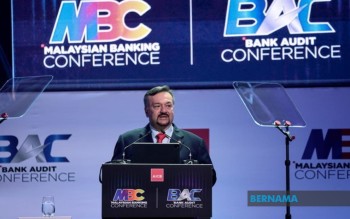
Malaysia's finance sector cannot afford to pursue technological advancement at the expense of human capital, according to Finance Minister II Datuk Seri Amir Hamzah Azizan, who warned that the future competitiveness of the nation's banking system depends on a deliberate combination of machine capability and human judgement. Speaking at the Asian Institute of Chartered Bankers (AICB) Nexus 2026 Conference in Kuala Lumpur on July 8, Amir Hamzah articulated a vision of financial modernisation that resists the notion that sophisticated algorithms and advanced technology alone guarantee institutional success or systemic stability.
The minister's remarks come at a critical juncture for Southeast Asia's financial architecture. As banks across the region accelerate digital transformation and integrate AI into decision-making processes—from credit assessment to fraud detection—regulatory and industry leaders face mounting pressure to demonstrate that automation enhances rather than displaces human expertise. Amir Hamzah's intervention suggests the Malaysian government recognises that competitive advantage in finance increasingly hinges on how deftly institutions navigate the intersection of technological capability and human acumen, rather than pursuing either in isolation.
Amir Hamzah's central argument challenges a prevailing assumption within financial services globally: that technological superiority and system sophistication automatically confer market leadership. Instead, he posited that banks which truly thrive will be distinguished by their capacity to employ people capable of comprehending and governing intricate systems, exercising sound judgement when algorithms face edge cases or market anomalies, and maintaining ethical standards when commercial pressures intensify. This framing implicitly acknowledges that AI systems, however sophisticated, remain tools that require human oversight, contextual understanding, and moral clarity to function optimally within society.
Central to the minister's thesis is the proposition that talent development must be reconceptualised as core infrastructure for the banking sector rather than a peripheral human resources function. This reframing carries substantial implications for Malaysian financial institutions, many of which have historically concentrated investment in technology procurement and systems integration while treating workforce development as a cost centre rather than a strategic asset. By elevating human capital to the status of foundational infrastructure alongside capital adequacy and regulatory compliance, Amir Hamzah signalled to industry leaders that the government views skills, training and professional development as essential to systemic resilience.
The minister stressed that a banking workforce cannot be positioned as future-ready if its personnel lack the capabilities, adaptability and trusted judgment demanded by an AI-augmented environment. This formulation resonates particularly in Malaysia and across Southeast Asia, where financial institutions compete increasingly with global fintech players and international banks possessing vastly greater technological resources. For domestic institutions to retain competitive relevance, they must leverage their understanding of local markets, customer relationships and regulatory nuance—advantages that remain rooted in human expertise and institutional knowledge that machines cannot easily replicate.
Amir Hamzah identified the Asian Institute of Chartered Bankers as a crucial partner in building workforce capability at scale, crediting the organisation with providing professional standards, qualifications, leadership development programmes and industry forums through which banking professionals can deepen their expertise. This institutional partnership model reflects the government's understanding that capability building requires coordination across multiple stakeholders: regulators, financial institutions, professional bodies and government agencies. No single entity possesses sufficient leverage or resources to drive sector-wide transformation unilaterally, necessitating collaborative frameworks that can cultivate trust and align incentives across the financial ecosystem.
Underlying the minister's remarks is an implicit critique of approaches to AI adoption in finance that prioritise speed and cost reduction over governance, ethics and accountability. He emphasised that ethical leadership and responsible innovation must guide AI integration, suggesting that the Malaysian banking sector should adopt a deliberately measured approach to automation that preserves space for human judgment and maintains transparent accountability mechanisms. This positioning aligns Malaysia with emerging regulatory trends in jurisdictions such as Singapore and the European Union, where supervisory authorities increasingly scrutinise AI systems for bias, explainability and compliance with ethical standards.
The minister's invocation of integrity as a connecting thread across government, regulators, industry and professional bodies reinforces a fundamentally conservative message: that sound banking rests ultimately on people motivated by service to customers and commitment to ethical standards rather than maximisation of shareholder returns or technological novelty for its own sake. This framing harks back to traditional banking principles that have proven durable across economic cycles and technological transitions, suggesting that the challenge facing modern financial institutions is not to abandon these principles but to integrate them into contemporary technological frameworks.
For Malaysian policymakers and bankers, the implications are multifaceted. The finance sector must substantially increase investment in training programmes that develop AI literacy among banking professionals while preserving and deepening expertise in risk management, customer service and regulatory compliance. Financial institutions should evaluate AI adoption projects not solely on cost savings or processing speed but on their contribution to institutional resilience, customer outcomes and ethical standards. Regulators require enhanced capacity to assess the governance, transparency and fairness of AI systems deployed by supervised institutions, necessitating recruitment of technically sophisticated supervisory personnel.
Amir Hamzah's intervention also carries significance beyond banking narrowly construed. His emphasis on human-centred technology adoption and ethical innovation implicitly endorses a developmental model for Malaysia's digital economy that prioritises inclusive growth and social stability over pure technological prowess. As the country pursues its ambitions as a regional financial centre and digital economy hub, maintaining public confidence in financial institutions requires demonstrable commitment to responsible innovation and human welfare—considerations that cannot be optimised away through algorithms or automated processes.
The minister's address ultimately reflects sophisticated understanding that technological transformation in finance occurs within a social and political context that demands continuous negotiation between efficiency and legitimacy, automation and employment, innovation and stability. By articulating this tension explicitly and calling for integrated approaches that preserve human agency and ethical accountability, Amir Hamzah has positioned Malaysia as pursuing a distinctive path to financial modernisation—one that leverages technology strategically while remaining grounded in professional standards, human judgment and service to society. Whether Malaysia's financial institutions can translate this vision into practice at scale will largely determine the sector's competitiveness and social legitimacy over the coming decade.

