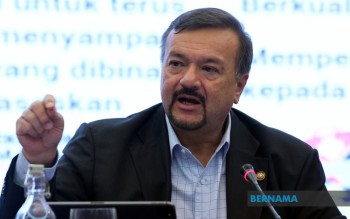
Malaysia's economic resilience continues to defy international headwinds, with Finance Minister II Datuk Seri Amir Hamzah Azizan unveiling a trajectory of consistent expansion that signals confidence in the country's development pathway. Speaking at a GEAR-uP Progress Report briefing in Putrajaya on August 7, he highlighted that Malaysia has achieved 5.6 per cent cumulative gross domestic product growth so far this year, maintaining momentum amid persistent global uncertainties and regional geopolitical tensions.
The country's economic performance has been remarkably steady over the past two years. After notching 5.2 per cent growth in 2024—a period marked by international trade disputes—Malaysia replicated that same rate in 2025 before accelerating further. The first quarter of this year delivered 5.4 per cent expansion, with the government's advance estimates pointing to an even stronger 5.8 per cent for the second quarter. This upward trajectory represents a marked departure from many developed economies struggling with stagnation and suggests Malaysia is successfully navigating challenges that have destabilised other nations.
Amir Hamzah's remarks underscore how Malaysia's growth story contrasts sharply with the turbulent external environment. Trade wars that roiled global markets in 2024 and ongoing geopolitical instability in West Asia this year have proven insufficient to derail the country's advancement. This resilience points to a fundamental shift in Malaysia's economic model—one increasingly anchored to domestic drivers rather than vulnerable external dependencies. The finance minister's emphasis on internal momentum reflects a strategic pivot that policymakers have deliberately engineered over recent years.
The engine powering this expansion is the MADANI Economy Framework, the government's overarching development agenda designed to foster inclusive and sustainable growth. The framework's success, according to Amir Hamzah, lies in its practical implementation through targeted initiatives that are now demonstrably translating into real economic benefits. This marks a crucial transition from policy announcements to tangible outcomes—a distinction that often separates aspirational development plans from genuine transformations. The framework's comprehensive approach addresses both macroeconomic stability and microeconomic dynamism, creating conditions where businesses can thrive and ordinary Malaysians experience improved living standards.
Central to this strategy is the GEAR-uP programme, which the Ministry of Finance has shepherded since 2024. This initiative mobilises RM120 billion in domestic direct investment spread across the 2024 to 2028 period, a substantial commitment signalling the government's determination to redirect capital towards productive domestic sectors. Rather than pursuing overseas funding sources with uncertain returns, GEAR-uP focuses on channelling resources where they can compound national wealth. The program's scale—averaging RM24 billion annually—demonstrates serious financial commitment to recalibrating Malaysia's economy away from external vulnerabilities toward self-reinforcing growth dynamics.
Government-linked investment companies and government-linked companies form the institutional backbone of GEAR-uP's execution. These entities function not merely as capital allocators but as sophisticated catalysts capable of attracting talent, transferring expertise, and magnetising foreign direct investment. By combining patient domestic capital with professional management, GLICs and GLCs create conditions where international investors recognise complementary opportunities. This multiplier effect—where government-anchored investments attract private sector participation—amplifies the impact of public resources beyond their nominal size. For Malaysian industries, this support translates into access to world-class talent pools and technological know-how that would otherwise remain inaccessible.
Amir Hamzah articulated a crucial distinction in development philosophy: mobilising capital alone remains insufficient for genuine economic advancement. Without strategic direction, disciplined implementation, and institutional capacity, funding flows become sterile transfers that fail to generate sustainable prosperity. The finance minister stressed that Malaysia's objective extends beyond merely accumulating foreign reserves or impressive headline investment figures. Instead, the ambition centers on ensuring that deployed capital creates tangible improvements in Malaysians' welfare, generates employment at higher skill levels, and positions the country more competitively within global value chains. This outcome-oriented perspective reflects maturation in development thinking.
The confluence of steady macro-level growth and targeted sectoral investment through GEAR-uP creates positive feedback loops across Malaysia's economy. As domestic industries strengthen through government-supported initiatives, they generate employment that sustains consumer demand, which in turn encourages further private investment and expansion. This virtuous cycle becomes increasingly self-sustaining as private sector confidence builds. The robust first-half 2025 performance—averaging 5.6 per cent—suggests these mechanisms are functioning as designed, creating momentum that could accelerate further if sustained.
From a regional perspective, Malaysia's economic performance carries broader implications for Southeast Asia. As the region's third-largest economy, Malaysia's growth patterns influence investor confidence across ASEAN, serve as a bellwether for regional development models, and demonstrate that sustained middle-income expansion remains achievable despite global volatility. Malaysia's ability to maintain 5-plus per cent growth while regional peers struggle provides a template for how deliberate policy design, institutional capacity, and sustained investment can overcome external constraints.
Amir Hamzah's confidence in Malaysia's trajectory toward developed-nation status reflects more than optimistic projection. The consistent performance data—5.2 per cent, 5.2 per cent, rising to 5.6 per cent—demonstrates measurable progress on a development pathway that, if sustained, could materially elevate Malaysia's per-capita income and regional standing. The minister's invocation of the MADANI framework as the guiding philosophy suggests that Malaysia's leadership views the coming years not as cyclical recovery but as foundational transformation toward structural economic sophistication.
Government officials' messaging around the GEAR-uP programme and MADANI Economy Framework emphasises cooperation across public and private sectors as essential to realising development aspirations. This framing acknowledges that government cannot unilaterally drive prosperity—market forces, private entrepreneurship, and international partnerships remain indispensable. By positioning GLICs and GLCs as facilitators rather than dictators of economic direction, the government creates space for market dynamism while maintaining strategic oversight. This balancing act, if successfully executed, could sustain Malaysia's expansion trajectory through the remainder of this decade and beyond.
Looking forward, Malaysia's challenge lies not in achieving near-term growth targets but in sustaining momentum through inevitable cycles and ensuring that expansion translates into broad-based prosperity rather than concentrated wealth. The GEAR-uP initiative's emphasis on talent development, technology transfer, and industrial diversification addresses these longer-term imperatives. If implementation remains disciplined and responsive to emerging opportunities and challenges, Malaysia's trajectory toward developed-country status appears increasingly credible rather than aspirational.

