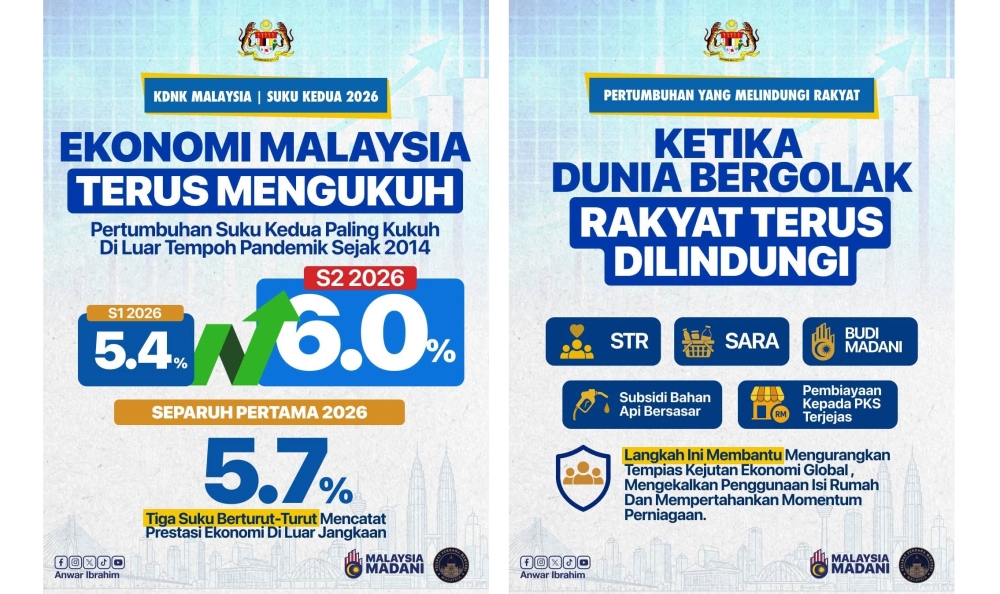
Malaysia's economy is gathering pace after a softer start to the year, with Prime Minister Datuk Seri Anwar Ibrahim highlighting the government's role in shielding citizens from the persistent global cost-of-living crisis that has battered many neighbouring economies. Speaking on August 14 in Kuala Lumpur, the premier signalled satisfaction with revised growth figures for the April-to-June period, underscoring how targeted policy interventions have maintained purchasing power even as international commodity prices and supply chain disruptions continue to pose headwinds across the region.
The stronger-than-anticipated performance in the second quarter represents a turning point after Malaysia's economy posted more muted gains in the opening months of 2024. This acceleration is particularly significant given the external environment: developed economies have grappled with stubborn inflation, central banks have kept interest rates elevated to combat price pressures, and emerging markets have faced capital outflows and currency depreciation. That Malaysia has managed to sidestep the worst of these dynamics speaks to both structural factors and deliberate choices by policymakers in managing the economy's trajectory.
Government interventions form the centrepiece of the administration's explanation for why domestic demand has held up relative to regional peers. Price controls on essential goods, targeted subsidies on fuel and electricity, and direct cash transfers to lower-income households all feature prominently in this protective umbrella. For Malaysian readers accustomed to comparative regional economic data, this framing reflects a deliberate philosophical contrast with some neighbouring countries that have pursued more rapid subsidy reduction or market-driven pricing mechanisms. The government's calculus has been to prioritize near-term stability and social cohesion over speedier fiscal consolidation, betting that economic growth itself will eventually create the fiscal space to address imbalances.
The implications of this approach ripple across multiple sectors of the Malaysian economy and extend into household decision-making. When families face lower utility bills relative to regional counterparts, and when staple food prices remain relatively capped, consumer confidence typically remains more resilient. Retail spending, restaurant patronage, and discretionary purchases all benefit from this stability. The knock-on effect is sustained demand for labour and continued expansion in services sectors, which employ the bulk of Malaysia's workforce and generate substantial tax revenues that support the broader fiscal position.
Anwar's public endorsement of these outcomes carries political weight beyond mere economic commentary. The premier has staked considerable credibility on delivering inclusive growth that reaches ordinary Malaysians, not merely headline GDP figures that mask widening inequality or concentrated gains. By explicitly linking the government's anti-inflation measures to the economy's outperformance, he is framing these protections as essential rather than optional—a position that may constrain future governments' flexibility in reorienting economic policy toward more orthodox fiscal tightening should international conditions shift.
Regionally, Malaysia's relative economic steadiness contrasts with challenges elsewhere in Southeast Asia. Several neighbouring economies have wrestled with more severe inflation, steeper currency pressures, or slower growth. Thailand and the Philippines have faced distinct structural headwinds, while Vietnam has managed respectable growth but with inflation concerns. Singapore, while performing solidly, occupies a different economic niche as a financial hub. Malaysia's positioning—anchored by energy exports, a diversified manufacturing base, and significant domestic consumption—has allowed it to navigate the post-pandemic environment with greater flexibility than some counterparts.
The second-quarter turnaround also reflects broader economic recovery dynamics beyond the government's protective measures. As supply chains normalise and global demand stabilises, Malaysia's export sectors have benefited from renewed competitiveness. Electronics manufacturing, petrochemicals, and refined petroleum products have all seen improved pricing and volumes. Palm oil, despite international criticism and price volatility, continues generating substantial export earnings. These external tailwinds have provided crucial support to overall growth rates and employment figures across the manufacturing heartland of the Klang Valley and Penang.
However, the sustainability of this momentum depends on several moving parts aligning over the coming quarters. Inflation expectations, though moderating, could spike again if geopolitical tensions disrupt oil markets or if logistics costs unexpectedly rise. The strength of consumer spending hinges partly on confidence levels that could waver if unemployment creeps upward or if asset prices deteriorate. Moreover, the government's protective measures, while politically popular and economically stabilising in the short term, do carry medium-term costs in terms of fiscal pressures and potential distortions in price signals that might affect resource allocation over time.
For Malaysian policymakers and investors, the Q2 data provides a breathing space but not grounds for complacency. The government faces a balancing act between maintaining the support structures that have provided stability while gradually implementing the fiscal consolidation and structural reforms necessary for long-term prosperity. Interest rate decisions by Bank Negara Malaysia, foreign investment inflows, and the trajectory of global growth will all influence how successfully Malaysia sustains its current positive momentum.
Anwar's remarks also serve a crucial signalling function to international investors and rating agencies that Malaysia remains a coherent, growth-focused economy under steady stewardship. In an era when geopolitical uncertainties and economic volatility have prompted capital reallocation across Asia, maintaining confidence in Malaysian institutions and policymaking capacity is vital for attracting the foreign direct investment and portfolio flows that support the ringgit and fund current account needs.
Looking ahead, the government's challenge will be translating this cyclical improvement into durable structural gains. That means investing in human capital, modernising manufacturing capabilities, deepening financial markets, and gradually transitioning toward higher-value economic activities. The Q2 data represents a solid foundation, but the real test lies in whether Malaysia can maintain this trajectory while simultaneously addressing medium-term challenges around productivity, competitiveness, and fiscal sustainability that ultimately determine whether growth remains inclusive and robust beyond the next few quarters.

