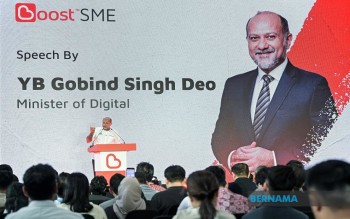
Malaysia's push to become a digitally-driven economy is gathering momentum, with Digital Minister Gobind Singh Deo confirming that the sector remains firmly on course to comprise 30 per cent of the nation's gross domestic product by the end of the decade. Speaking at the launch of a new digital banking platform in Kuala Lumpur, Gobind underscored the government's confidence in reaching this ambitious milestone, which would represent a significant jump from the digital economy's 25.5 per cent contribution recorded last year. The trajectory reflects both the inherent dynamism of Malaysia's tech sector and the deliberate policy architecture now supporting its expansion.
Two major strategic frameworks are anchoring this digital transformation agenda. The National Artificial Intelligence Action Plan 2026-2030 and the Malaysia Digital 2030 framework serve as the primary catalysts for achieving the GDP target, according to Gobind. These initiatives are not isolated announcements but represent a comprehensive approach to embedding digital technologies throughout the economy. The government has tasked MyDigital Corporation, a dedicated implementation agency, with ensuring that the policies translate into tangible economic outcomes. This institutional focus signals a departure from mere rhetoric towards measurable accountability in digital transformation efforts.
Prime Minister Datuk Seri Anwar Ibrahim's vision of positioning Malaysia as an AI Nation by 2030 underpins much of this strategic direction. Gobind reiterated the Digital Ministry's commitment to realising this vision, framing AI adoption not merely as a technological upgrade but as a foundational economic restructuring. This alignment between ministerial policy and the Prime Minister's overarching vision creates clarity for both private sector investors and international partners observing Malaysia's digital ambitions. The vision signals that AI integration is not a peripheral concern but central to how Malaysia intends to compete in the evolving global economy.
Small and medium enterprises occupy a particularly crucial position within this transformation agenda. During the Budget 2027 allocation discussions, the Digital Ministry has prioritised efforts to democratise AI technology for SMEs, recognising that these businesses collectively represent a substantial portion of Malaysia's economic activity yet often lack the resources or expertise to adopt cutting-edge technologies independently. The budget emphasis reflects an understanding that broad-based digital adoption, rather than concentration among large corporations, will determine whether the 30 per cent GDP target becomes reality. Without meaningful SME participation, the digital economy gains would remain concentrated among a handful of tech-savvy large firms.
Cost remains one of the most significant barriers to AI adoption among smaller businesses across Malaysia and the region. Gobind explicitly acknowledged this challenge, emphasising the ministry's determination to ensure that artificial intelligence tools remain affordable and accessible to enterprises operating on tighter margins. This policy focus addresses a real constraint: many capable SME owners understand the potential of digital technologies but cannot justify the expense given their current operating models. By addressing affordability through budget measures and potentially subsidies or incentive schemes, the government seeks to remove this fundamental obstacle to adoption.
Equally important is the knowledge gap that separates many Malaysian SMEs from the digital frontier. Beyond mere access to AI platforms, business owners must develop understanding of how these technologies can be integrated into their specific operations. The Digital Ministry recognises that providing tools without accompanying education and support frameworks would yield disappointingly low adoption rates. This holistic approach—combining accessibility, affordability, and education—reflects learning from digital initiatives elsewhere that failed because they overlooked the human dimension of technological change.
The newly launched Boost SME platform exemplifies the practical implementation of these principles. Developed by Boost, a prominent digital financial services and e-wallet application, this platform represents an ecosystem approach to business banking that integrates multiple financial functions into a unified digital environment. Rather than requiring SMEs to navigate separate systems for banking, financial products, and payment processing, the platform consolidates these services, reducing friction and complexity. This design philosophy acknowledges that SMEs often operate with limited administrative capacity and cannot afford to maintain multiple vendor relationships for different financial functions.
Boost SME specifically targets underserved segments of Malaysia's business community—those enterprises that may lack formal relationships with traditional banking institutions or have been unable to access financing solutions at reasonable terms. By focusing on this segment, the platform addresses a critical gap in Malaysia's financial infrastructure. Many worthy business ideas fail not from lack of commercial potential but from inadequate access to capital and financial services. Digital platforms that reduce the barriers to financial inclusion can therefore catalyse broader economic participation and growth.
The platform's potential impact extends beyond immediate financial transactions to encompassing business growth opportunities more broadly. By integrating banking, finance, and payments within a single ecosystem, SMEs gain clearer visibility into their cash flows and financial positions. This transparency can support better business decision-making and position these enterprises to scale more effectively. For the digital economy targets to be achieved, SMEs must not merely adopt technology but genuinely transform their operations, and financial clarity represents a foundational requirement for such transformation.
Malaysia's trajectory towards a 30 per cent digital economy contribution positions the country advantageously within Southeast Asia's broader digital revolution. Several regional economies are pursuing similar objectives, but Malaysia's institutional focus and budget allocation suggest serious commitment rather than aspirational rhetoric. The combination of AI-focused policy frameworks, dedicated implementation agencies, and concrete platforms targeting SMEs creates a mutually reinforcing system where policy intention can translate into business reality.
However, achieving this ambitious target will require sustained effort beyond 2027, when the budget cycle continues. The current emphasis on SME digitalisation and AI affordability must persist through multiple election cycles and policy adjustments. International economic conditions, technology cost trajectories, and regional competition will all influence Malaysia's ability to reach 30 per cent. Nonetheless, the clear articulation of targets, the institutional mechanisms for accountability, and the practical initiatives emerging from this vision suggest that Malaysia is approaching digital transformation with greater sophistication than many of its peers.

