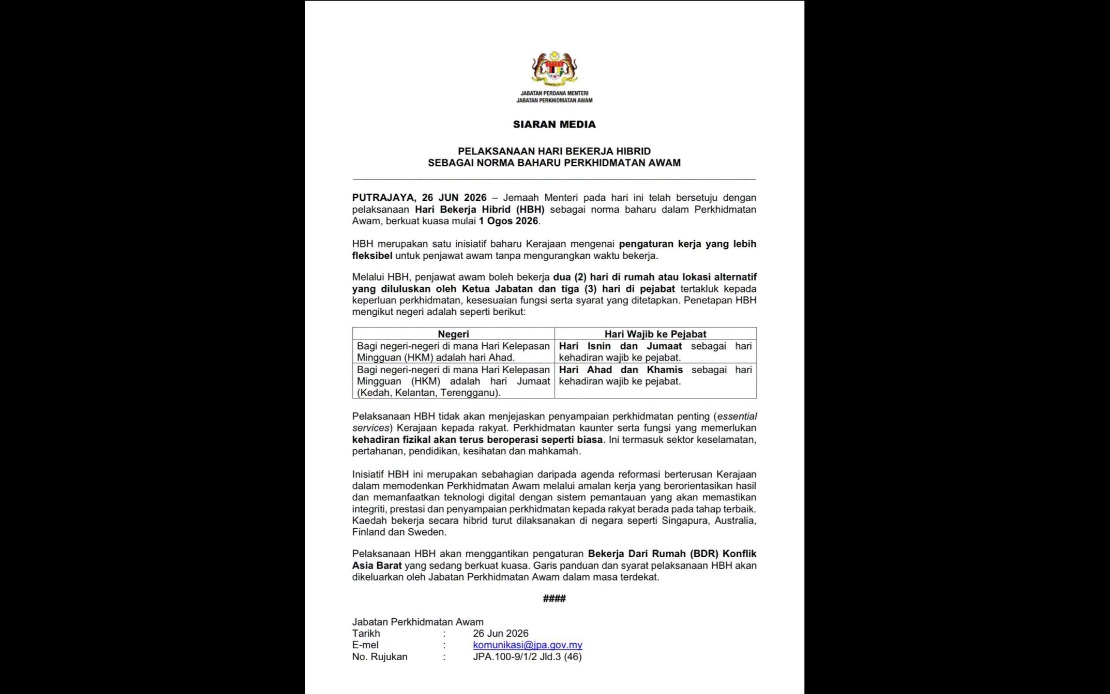
Malaysia's Cabinet has formally endorsed a hybrid work framework that will reshape how the nation's civil service operates, with the new arrangement taking effect on August 1. The Public Service Department announced the decision on June 26, marking a significant shift from pandemic-era remote work policies toward a more structured and standardised approach across government agencies. This transition represents part of a broader modernisation initiative aimed at balancing workforce flexibility with the need to maintain operational excellence in public service delivery.
Under the new Hybrid Work Day system, civil servants will spend two days working remotely—either from home or an alternative location approved by their department head—while maintaining a mandatory three-day in-office presence each week. The arrangement maintains existing working hours and conditions, with no reduction in contracted hours. The framework explicitly acknowledges that implementation will be subject to individual service requirements, job suitability assessments, and established departmental protocols, recognising that not all government functions can be performed equally effectively outside office environments.
The hybrid model replaces the existing Work From Home arrangement that has been in place since the COVID-19 pandemic disrupted conventional office operations. Rather than perpetuating indefinite remote work options, the new policy seeks to establish a consistent norm that applies across the entire public sector. This standardisation should eliminate the fragmented approaches that various agencies and departments have adopted over the past few years, creating clearer expectations for both employers and employees across government.
Public service leadership has emphasised that critical frontline services will continue uninterrupted under the new arrangement. Counter services in government offices, security and defence operations, teaching in schools and universities, healthcare provision, and judicial functions are explicitly exempted from flexible arrangements. These sectors will maintain traditional office-based operations to ensure citizens receive uninterrupted access to essential services. The government recognises that certain functions—particularly those involving direct public interaction or time-sensitive responsibilities—cannot function effectively under hybrid arrangements.
State-level variations in weekly rest days have been accommodated within the framework. For states observing Sunday as the weekly rest day, including most peninsular states, Monday and Friday become mandatory in-office days. Conversely, Kedah, Kelantan, and Terengganu, which observe Friday as their weekly holiday, will designate Sunday and Thursday as compulsory office attendance days. This flexibility demonstrates administrative sensitivity to regional differences while maintaining the fundamental two-remote, three-office structure across all jurisdictions.
The Public Service Department has positioned this initiative within Malaysia's broader public service transformation agenda. Officials argue that the hybrid model represents progress toward modernised work practices centred on measurable results rather than physical presence monitoring. The policy assumes that technological advancement and digital infrastructure have matured sufficiently to enable substantial portions of administrative and policy work to occur outside traditional office spaces without compromising quality or accountability. This reflects assumptions about the digital readiness of Malaysian government agencies that warrant ongoing verification.
International precedent features prominently in official justifications for the change. The department cited implementation in Singapore, Australia, Finland, and Sweden as validation that hybrid arrangements function effectively in developed economies. These references suggest the Malaysian government views the policy as convergence with international best practices rather than experimental innovation. However, the applicability of models from these nations to Malaysia's specific context—varying digital infrastructure, workforce diversity, and operational challenges—remains subject to practical testing.
Accountability mechanisms will be central to successful implementation. The Public Service Department has committed to introducing monitoring systems designed to maintain integrity standards, performance metrics, and service delivery quality during the transition. The specifics of these monitoring frameworks—including performance indicators, evaluation methods, and consequence mechanisms—have not yet been detailed, representing a significant gap in the policy announcement. Departments will require clear guidance on measuring remote work productivity and maintaining oversight without reverting to excessive surveillance approaches.
Detailed implementation guidelines remain forthcoming, with the Public Service Department promising comprehensive protocols in subsequent announcements. These guidelines will likely address departmental variation, individual role assessments, dispute resolution procedures, and transition arrangements from the existing work-from-home landscape. The timeline between now and August 1 allows approximately five weeks for agencies to prepare operational adjustments, train managers in new policies, and establish supporting infrastructure for coordinated hybrid scheduling.
For Malaysian readers and observers, this policy carries broader implications for workforce culture and economic productivity. The hybrid model may influence recruitment and retention in the civil service by offering flexibility that increasingly defines competitive employment propositions. Simultaneously, implementation quality will demonstrate whether Malaysian government can manage distributed workforces effectively—a capability essential for future adaptability to unexpected disruptions or technological change. The success or failure of this initiative may influence private sector hybrid arrangements and shape expectations about normal work practices across the Malaysian economy for years ahead.

