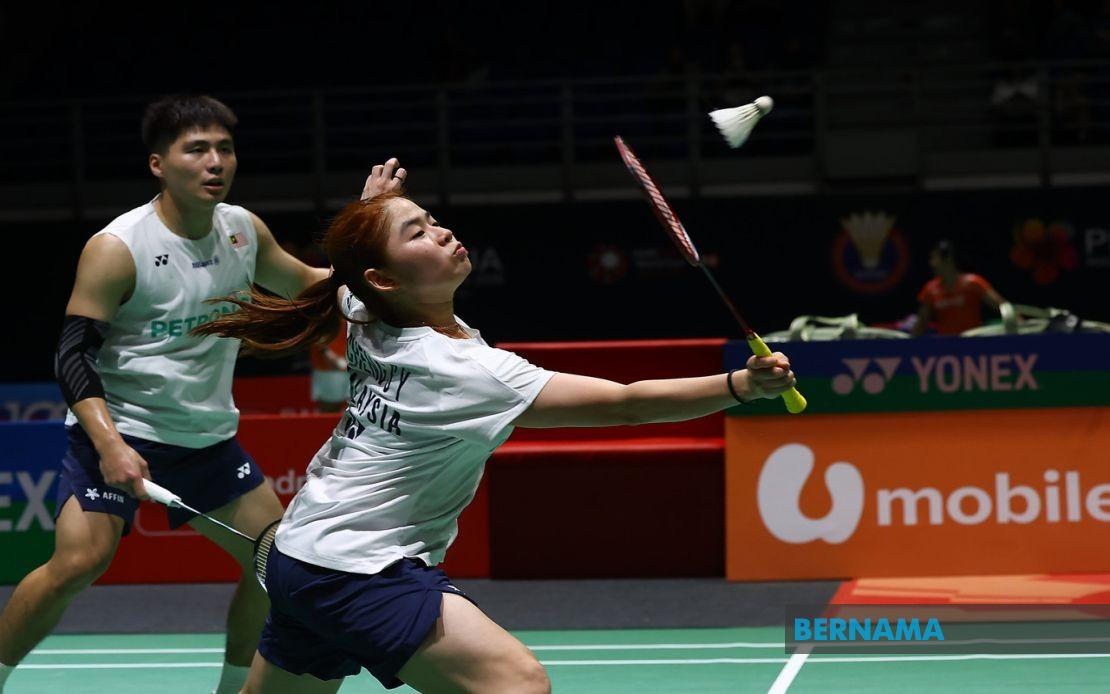
Malaysia's promising run at the 2026 Japan Open badminton championship came to an end on July 18 when the nation's final two remaining pairs exited the tournament during semi-final competition in Tokyo. The mixed doubles combination of Jimmy Wong and Cheng Su Yin, along with the men's doubles team of Goh Sze Fei and Nur Izzuddin Rumsani, both fell to stronger opposition, bringing to a close what had been an encouraging showing by Malaysian badminton at one of Asia's premier tournaments.
The unseeded mixed doubles pair had captured considerable attention throughout the tournament with their unexpected success against higher-seeded opponents, but their remarkable journey was halted by Hong Kong's experienced Tang Chun Man and Tse Ying Suet. The Malaysian pair fought tenaciously across a demanding 69-minute encounter, ultimately succumbing 17-21, 21-18, 21-15 in a match that showcased their competitive mettle despite the eventual outcome. The performance demonstrated that Wong and Cheng have developed the technical proficiency and tactical awareness required to challenge established international combinations, even if they ultimately fell short against the polished Hong Kong duo's experience and court control.
While the defeat ended their tournament participation, the achievement represents a significant benchmark for the mixed doubles pairing. Their ability to progress through earlier rounds and reach the semi-final stage of such a prestigious event indicates that Malaysian mixed doubles badminton possesses genuine competitive potential. For a relatively unseeded combination to advance this far reflects creditable preparation and execution, establishing them as contenders for future international competitions.
Parallel disappointment struck the men's doubles category, where Goh Sze Fei and Nur Izzuddin Rumsani encountered the formidable challenge of South Korea's Kim Won Ho and Seo Seung Jae, the world's top-ranked men's doubles partnership. The 58-minute semi-final proved intensely competitive, with the Malaysian duo initially struggling to establish rhythm and cohesion in the opening set, suffering a decisive 12-21 reverse. However, they demonstrated resilience and tactical adjustment by launching a commanding response in the second set, dominating play to secure a convincing 21-11 victory and extend the encounter into a decisive third set.
The final game proved beyond their grasp, as the South Korean world number one pairing reasserted their superiority with a 21-13 triumph. This marked the Malaysians' third loss across their five competitive meetings against Kim and Seo, illustrating the consistency of the South Korean partnership's tactical advantages in head-to-head confrontations. The pattern suggests that while Goh and Nur Izzuddin are capable of generating pressure and forcing competitive matches, they have yet to identify the specific strategic adjustments necessary to convert competitive encounters into victories against this particular opponent.
The Malaysia team's overall performance at the 2026 Japan Open reflects the current trajectory of Malaysian badminton on the international stage. While the nation continues to develop competitive pairs capable of reaching prestigious tournament semi-finals, the results underscore the continued dominance of established Asian powers, particularly South Korea and Hong Kong, in premier doubles competitions. The gap between Malaysia's emerging talent and the world's elite remains evident, though not insurmountable.
For Malaysian badminton stakeholders and coaching staff, these results offer valuable diagnostic information about the preparation and tactical approaches required to compete at the highest international level. The mixed doubles pairing's progress through the tournament bracket suggests that investment in developing mixed doubles combinations may yield promising returns in coming seasons, while the men's doubles encounter against the world's leading pair provides concrete data about specific technical and strategic weaknesses that warrant attention in training programmes.
The Japan Open remains one of badminton's most challenging and prestigious tournaments, attracting elite players from across Asia and globally. The semi-final exits, while representing tournament conclusions for Malaysian participants, should be contextualized within the broader competitive landscape where reaching such advanced stages at this calibre of event represents creditable international achievement. The experience accumulated by Wong, Cheng, Goh, and Nur Izzuddin in competing against world-class opponents will likely inform their preparation strategies for upcoming tournaments throughout the international badminton calendar.
Looking forward, Malaysian badminton federations and coaching structures will likely leverage these semi-final experiences to refine player development pathways and international competition exposure. The results highlight both the promise evident in pairs capable of advancing through major tournament brackets and the remaining performance gaps separating Malaysia's elite players from the world's most consistently dominant partnerships. Continued investment in technical development, tactical sophistication, and strategic match preparation will be essential for Malaysian pairs seeking to progress from semi-final regulars to consistent championship contenders at Asia's premier badminton events.

