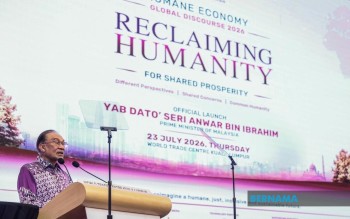
The Malaysian government will commence preparations for Budget 2027 next month, with the spending blueprint scheduled for parliamentary tabling in early October, according to Prime Minister Datuk Seri Anwar Ibrahim. Speaking at the Humane Economy Global Discourse (HGED) 2026 in Kuala Lumpur, Anwar—who holds the dual portfolios of Prime Minister and Finance Minister—outlined a fundamental reorientation of how the government measures economic success and allocates resources.
Central to Anwar's vision is a departure from conventional metrics that gauge progress purely through expansion of gross domestic product or aggregate wealth creation. Instead, the upcoming budget will embed what the Prime Minister describes as the principle that economic development must yield tangible, visible improvements in the daily lives of ordinary Malaysians. This represents a notable philosophical pivot from narrower economic accounting, suggesting the government intends to tie fiscal performance directly to household welfare outcomes.
The Prime Minister articulated this approach through a pointed critique of growth-for-growth's-sake reasoning. He characterised the economy as fundamentally instrumental—a tool serving human flourishing rather than an endpoint in itself. Anwar's framing challenges assumptions that higher consumption levels, increased market activity, or concentrated wealth accumulation constitute progress worthy of pursuit. Instead, he posed a series of probing questions that will ostensibly guide major budgetary decisions: whether growth expands or constrains opportunity, whether it fortifies or destabilises families and communities, and crucially, whether development treats citizens as active partners or merely as factors of production.
This philosophical underpinning carries particular significance for Southeast Asia's second-largest economy. Malaysia has long grappled with tensions between rapid industrialisation and social cohesion, between urban-centric development and rural equity, and between wealth creation and distributional fairness. By anchoring Budget 2027 to Anwar's humanistic framework, the government signals an intention to address these persistent imbalances more directly through fiscal policy rather than relying on trickle-down mechanisms or market-driven redistribution.
The Prime Minister stressed that Budget 2027 cannot be formulated in isolation from broader strategic initiatives including semiconductor strategy, energy transition, and digital transformation. However, these technical policy domains must remain subordinate to what he termed the "moral purpose of governance and development." This positioning suggests that Malaysia's industrial modernisation and technological advancement—areas where the country has invested substantially—will henceforth be evaluated partly through their contribution to human dignity rather than competitiveness metrics alone.
An important practical dimension of this reframing concerns wage structures and employment quality. Anwar explicitly connected budget outcomes to higher wages and meaningful work rather than employment quantity alone. This distinction matters considerably for Malaysia, where underemployment, wage stagnation, and precarious work arrangements have affected millions despite overall economic expansion. By elevating wage adequacy within the fiscal framework, the government suggests willingness to address labour market inequality that previous growth periods failed to resolve.
Housing affordability and accessibility emerged as another priority within this humanistic framework. Malaysia's property market has become increasingly stratified, with housing prices in major urban centres outpacing income growth for years. The Prime Minister's explicit mention of affordable housing within the Budget 2027 philosophy suggests the government recognises this as a critical development challenge requiring fiscal intervention rather than market solutions alone. For Malaysian workers and young families facing mounting homeownership barriers, this signals potential policy shifts in taxation, subsidies, or public housing investment.
Healthcare and education accessibility represent additional pillars within Anwar's articulated vision. These sectors have experienced resource constraints and quality challenges despite Malaysia's status as an upper-middle-income nation. By centring healthcare access and educational quality within the budget's moral framework, the government acknowledges that aggregate wealth figures mask significant gaps in service provision affecting millions. Such emphasis could translate into increased allocations or structural reforms within these critical human development sectors.
The concept of social mobility held particular emphasis in Anwar's remarks. Malaysia's rigid class structures, limited occupational mobility across generations, and persistent educational disparities between income groups have perpetuated inequality despite development gains. Positioning genuine social mobility as a budget objective suggests the government intends to fund mechanisms—whether through education, skills training, or economic opportunity creation—that genuinely enable upward movement rather than preserve existing hierarchies.
Sustainability constitutes another dimension of this humanistic approach, with Anwar explicitly framing it as preventing the transfer of environmental, financial, and social costs to future generations. This temporal perspective acknowledges that contemporary fiscal decisions create long-term obligations and liabilities. For Malaysia, facing climate vulnerability, fiscal challenges from accumulated obligations, and potential resource depletion, this framing represents overdue recognition of intergenerational responsibility within budget frameworks that conventionally focus on single-year expenditure and revenue.
The relationship between innovation and human capability expansion offers a final analytical layer. Anwar warned against innovation that deepens social exclusion or concentrates benefits among narrow populations—a cautionary note particularly relevant as Malaysia pursues digital transformation and advanced manufacturing. By tying innovation to inclusive capability expansion rather than mere technological adoption, the government signals that future-oriented policies must be evaluated through inclusive growth criteria.
That these principles will substantially reshape Budget 2027 remains to be determined. Converting philosophical commitments into concrete fiscal allocations and structural reforms involves significant political and economic constraints. However, Anwar's articulation at an international development forum suggests the government intends to present Budget 2027 as fundamentally oriented toward human dignity rather than conventional growth maximisation. For Malaysian citizens and regional observers, the budget's October tabling will reveal whether this humanistic framing translates into substantive policy reorientation or remains primarily rhetorical.

