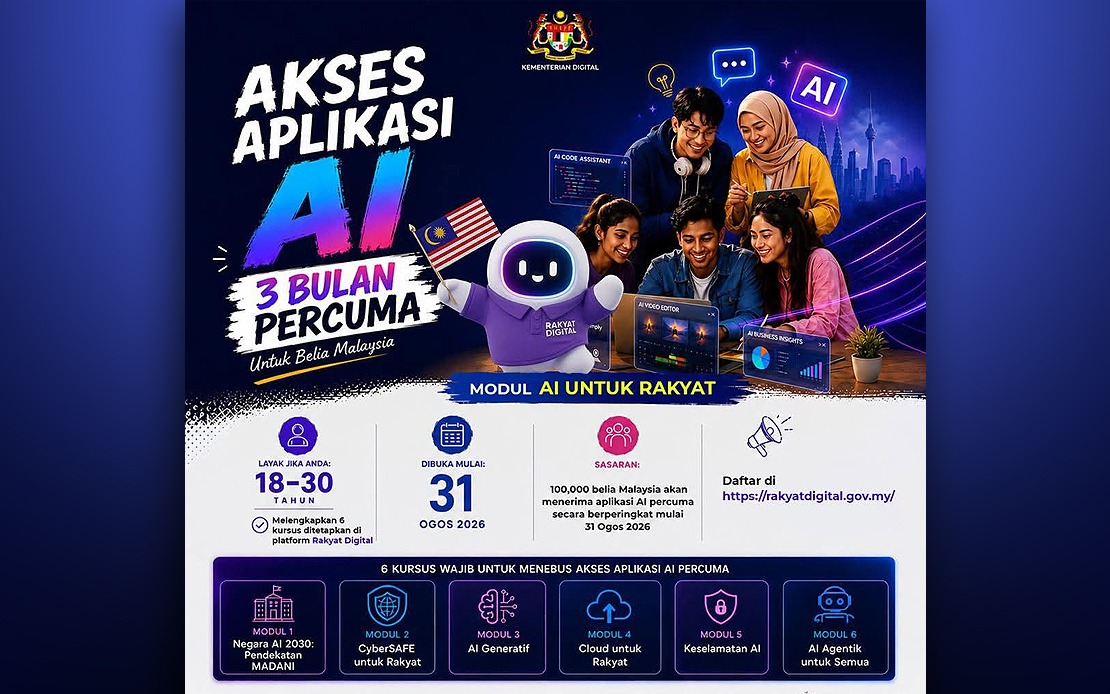
Prime Minister Datuk Seri Anwar Ibrahim unveiled the AI For The People programme on August 30 as a cornerstone initiative to democratise artificial intelligence access among Malaysian youth, positioning the nation's generational workforce to compete in an AI-driven economy. The scheme, which will roll out in phases via the Rakyat Digital portal, represents an ambitious attempt to reach 100,000 Malaysians between 18 and 30 years old by 2027, establishing a substantial cohort of AI-literate workers before the end of the decade.
The programme operates through a structured learning pathway requiring participants to successfully complete and pass six carefully designed modules before gaining access to premium AI tools. These modules—AI Nation 2030: The MADANI Approach, CYBERSAFE for the People, Generative AI, AI Security, Agentic AI for All, and Cloud for the People—form a comprehensive curriculum spanning both theoretical understanding and practical security considerations. By bundling modules on foundational AI knowledge with cybersecurity training, the programme acknowledges that responsible AI adoption requires simultaneous attention to digital safety, a concern increasingly relevant for Southeast Asian markets navigating rapid technology deployment.
Upon successful completion, participants receive a valuable incentive: a complimentary three-month subscription to selected artificial intelligence applications and software. This tangible benefit transforms the programme from purely educational into a practical entry point for young Malaysians to experiment with enterprise-grade tools they might not otherwise access. For many participants, particularly those outside urban technology hubs, this subscription period provides critical hands-on experience with professional-level AI platforms before employment or further studies.
The initial partner technology providers reflect both local innovation and international leadership in AI development. YTL AI Labs contributes IlmuChat, a locally-developed solution reflecting Malaysia's growing AI entrepreneurship ecosystem. Alibaba provides Wonderclip and MuleRun, connecting Malaysian users to Chinese technology excellence. Google supplies Gemini Enterprise, ensuring participants gain exposure to American AI innovation. This tripartite approach—local, regional, and global—demonstrates strategic thinking about balanced technological partnerships while reducing dependency on any single ecosystem.
The Digital Ministry signalled its intention to expand this toolkit progressively, announcing plans to add AI software and tools from additional technology companies in subsequent phases. This incremental approach allows for iterative improvement based on participant feedback and emerging technology capabilities, though it also creates opportunities for new domestic AI startups to demonstrate value to a government-backed audience of 100,000 potential corporate customers. The phased expansion could inadvertently accelerate Malaysia's AI startup scene by providing validation and exposure through state-sponsored channels.
Digital Ministry secretary-general Datuk Fabian Bigar framed the programme as ensuring that Malaysian youth not only comprehend AI technology theoretically but actually manipulate professional tools, bridging the gap between classroom instruction and workplace capability. This dual emphasis on knowledge and access directly addresses a persistent skills gap in developing economies, where understanding AI concepts often outpaces practical familiarity with deployment interfaces. For Malaysia, where youth unemployment and skills mismatches plague labour markets, providing subsidised access to tools currently gatekept by subscription costs represents meaningful economic inclusion.
The initiative aligns with broader government ambitions crystallised in two policy frameworks: the aspiration to develop an inclusive AI Nation by 2030 and the Malaysia Digital 2030 strategic vision. These commitments signal governmental willingness to invest in foundational digital competencies as prerequisites for sustainable economic growth. By targeting specifically the 18-30 age bracket, policymakers are investing in workers who will shape Malaysian productivity, innovation, and competitive advantage throughout the 2030s and 2040s, a demographic window where skill acquisition yields decades of economic returns.
The Rakyat Digital portal, overseen by MyDIGITAL Corporation, functions as the institutional apparatus delivering this programme. Operating as the national digital learning platform, Rakyat Digital extends beyond AI For The People to encompass broader digital literacy initiatives. Its use here reflects Malaysian government strategy of consolidating digital upskilling through a centralised, accessible portal rather than fragmenting efforts across multiple platforms. For citizens, this concentration means single-point registration and credential verification, reducing friction and potentially improving completion rates compared to dispersed programme structures.
For Southeast Asia writ large, Malaysia's approach signals a regional trend toward government-sponsored AI democratisation. Unlike purely private-sector-driven AI education prevalent in developed economies, this model positions the state as an active guarantor of technological access and capability-building. This positioning carries implications for neighbouring countries evaluating their own AI readiness, potentially inspiring similar initiatives in Indonesia, Thailand, or Philippines seeking to prevent widening digital divides between affluent and underserved populations.
The three-month subscription window warrants particular scrutiny regarding sustainability and long-term outcomes. While providing introductory access, three months represents a compressed timeline for developing genuine mastery or confidence with complex AI platforms. Participants who develop meaningful competency may face barriers when free subscriptions expire, potentially reproducing the access inequality the programme seeks to remedy. Success metrics should track not merely completion rates but whether graduates continue engaging with AI tools post-subscription, either through paid personal accounts or employment pathways leveraging their newfound skills.
The initiative also reflects acknowledgement that Malaysia cannot compete on AI research and development alone, necessitating widespread adoption and application of existing technologies by frontline workers and entrepreneurs. By distributing access broadly rather than concentrating it among elite institutions or corporations, the programme implicitly endorses a diffusion-based strategy where marginal returns from democratised AI adoption exceed centralised innovation investment. This philosophy, if validated through rigorous programme evaluation, could influence how other developing nations allocate limited resources between advanced research facilities and grassroots capability-building.
Ultimately, AI For The People represents a bet that Malaysian youth, equipped with foundational knowledge and practical access, will drive innovation and productivity improvements throughout the economy. Whether this gamble succeeds depends partly on factors beyond the programme's control: the availability of AI-friendly employment opportunities, the compatibility of learned skills with actual job requirements, and the willingness of businesses to hire graduates for AI-related positions. The coming years will reveal whether 100,000 trained young Malaysians catalyse genuine digital transformation or represent symbolic investment in aspirational policy unmatched by market demand.

