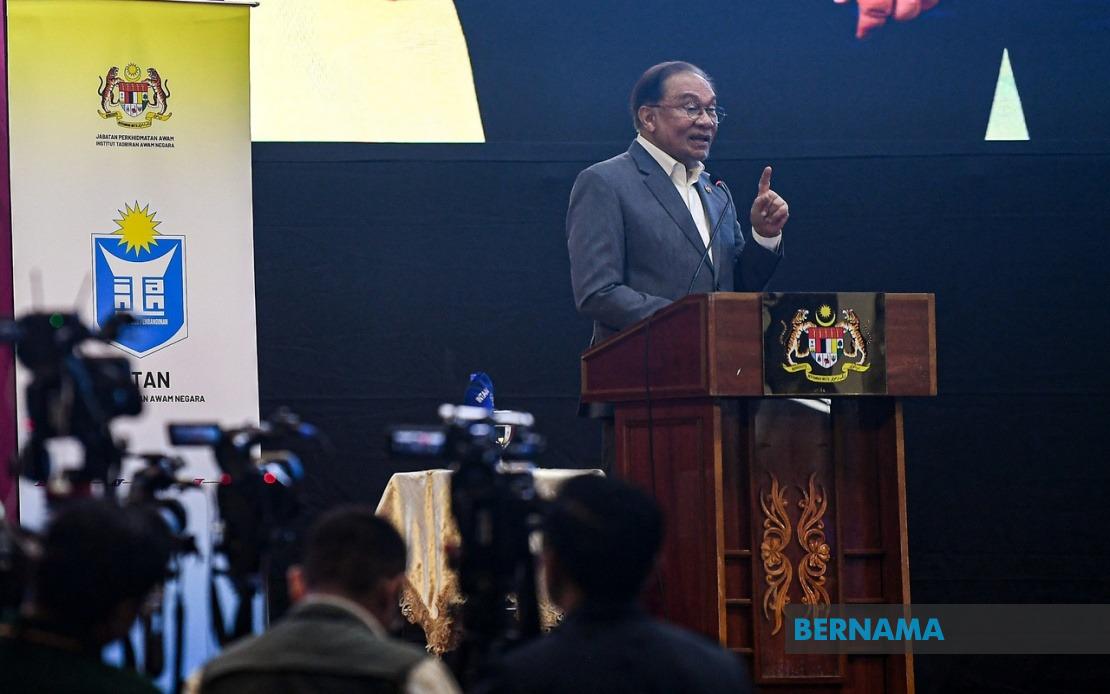
Prime Minister Datuk Seri Anwar Ibrahim has delivered a pointed critique of what he characterises as an ingrained colonial mentality among Malaysians, calling on the nation to move beyond viewing Western institutions and practices as the gold standard for progress. Addressing civil servants from the Central Zone at Universiti Islam Selangor in Bangi, Anwar argued that nearly seven decades of independence have not fully liberated Malaysian thinking from the psychological imprint of colonial rule, with many still measuring national achievement through an external lens rather than internal compass.
The Prime Minister's remarks zeroed in on a particular demographic that continues to perpetuate this cultural dependency: post-independence Malaysians who nonetheless retain what Anwar termed "half-English thinking." According to his observation, this cohort—despite possessing brown skin and Malaysian citizenship—systematically privilege Western frameworks across multiple domains of national life. The critique extends beyond superficial preferences into foundational policy areas, from educational curriculum design to economic structures to governance philosophies.
Anwar illustrated his point by examining education specifically, noting that many Malaysians regard English-medium instruction as categorically superior to alternatives, seeing the language itself as intrinsically connected to quality learning outcomes. This perception extends to cultural matters, where Western cultural products and practices are assumed to represent modernity and sophistication, while local traditions are often dismissed as backward or provincial. The Prime Minister suggested that this hierarchy of value operates across political and economic domains as well, with Western democratic and capitalist models treated as blueprints to be emulated rather than reference points for critical adaptation.
The underlying argument carries significant weight for Malaysia's policymaking establishment. Anwar positioned the challenge as a matter of genuine independence—suggesting that political sovereignty achieved in 1957 remains incomplete without corresponding intellectual and cultural sovereignty. This distinction matters because it reframes development debates: the question becomes not whether Malaysia should follow international best practices, but whether the nation has sufficiently examined its own strengths, values and contextual realities before adopting external models wholesale.
For regional observers, Anwar's intervention reflects broader tensions across Southeast Asia regarding modernisation and identity. Nations throughout the region grapple with balancing international standards and competitive pressures against the preservation of distinct cultural and political traditions. Malaysia's particular challenge involves managing this equilibrium across a multicultural society where different communities may hold varying views on the relationship between Western influence, religious values and national identity.
The Prime Minister's audience of Central Zone civil servants carries particular significance, as government bureaucrats occupy pivotal roles in translating political rhetoric into administrative practice. By directing his message to this cohort, Anwar signalled that addressing colonial mentality requires institutional change at the implementation level, not merely rhetorical repositioning at the political apex. The presence of Chief Secretary Tan Sri Shamsul Azri Abu Bakar and Public Service Director-General Tan Sri Wan Ahmad Dahlan Abdul Aziz underscored the administration's intention to channel these principles through the machinery of governance.
Implementing such a shift presents substantial complications, however. Malaysia operates within deeply integrated global systems that privilege Western technical standards, financial protocols and institutional frameworks. Educational exchanges with Western universities, international business partnerships, and participation in multilateral institutions all embed Western practices into Malaysian professional and intellectual life. Anwar's challenge therefore does not simply involve rhetorical repositioning but requires sustained examination of which Western models genuinely serve Malaysian interests and which represent unnecessary cultural subordination.
The remarks also invite scrutiny regarding what constitutes authentically Malaysian values and models worthy of prioritisation. Anwar's prescription to build development "on its own values, identity and strengths" presupposes clarity about what those values encompass. Given Malaysia's religious, ethnic and socioeconomic diversity, different communities may identify distinct foundational values, creating potential friction in translating the Prime Minister's vision into coherent policy frameworks.
Conversely, Anwar's intervention addresses genuine constraints that Malaysia's development strategy encounters. When decision-makers automatically privilege foreign expertise, international consulting firms and externally-designed solutions, the nation may overlook indigenous knowledge, local innovation and contextually-rooted problem-solving approaches. Encouraging greater confidence in Malaysian institutions and methodologies could unlock latent capacity and reduce unnecessary dependency on foreign technical services.
The timing of Anwar's remarks coincides with the government's broader nation-building agenda and efforts to strengthen institutional credibility following previous political turbulence. By framing the challenge as psychological liberation from colonial patterns rather than anti-Western confrontation, Anwar positioned his argument in terms of completing Malaysia's independence journey rather than rejecting international engagement. This framing allows simultaneous pursuit of global integration while reasserting local agency in determining which external practices merit adoption.
Moving forward, the practical implications of Anwar's call will become evident through specific policy decisions in education, economic development and governance reform. Whether the administration demonstrates systematic commitment to examining and valuing Malaysian approaches—or whether the appeal to reject colonial mentality remains primarily rhetorical—will ultimately determine whether this intervention catalyses genuine institutional change or constitutes largely symbolic posturing.

