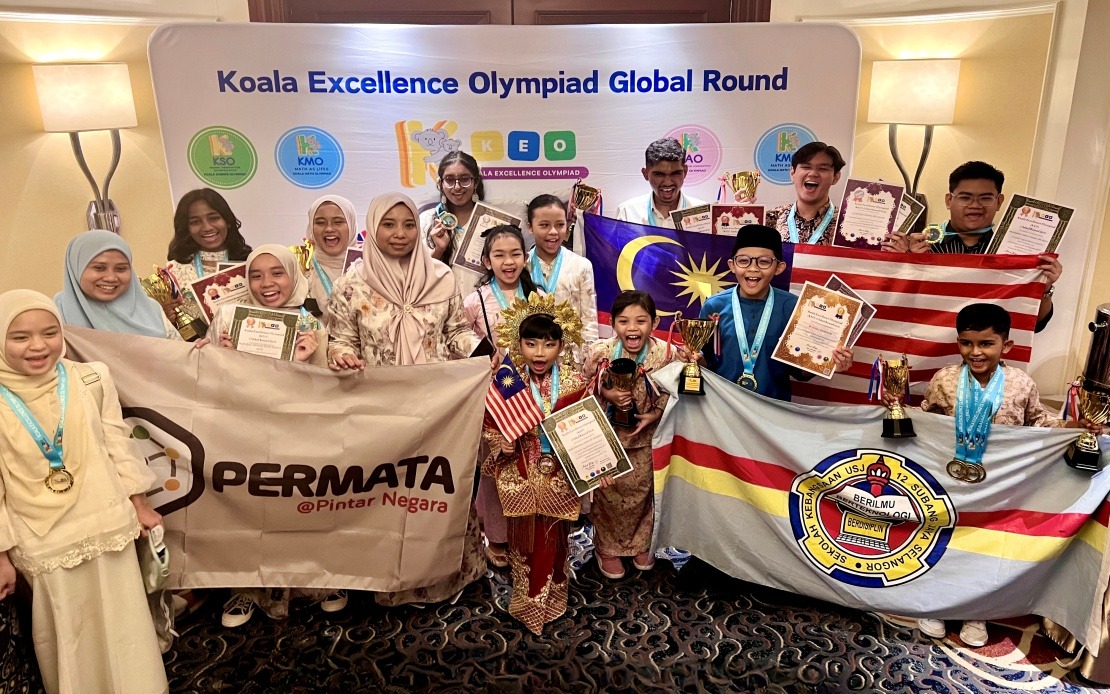
Seventeen Malaysian students have demonstrated the nation's growing strength in international academic competitions after securing nine overall awards and a combined tally of 22 medals at the Koala Excellence Olympiad 2026, which concluded in Macau this week. The contingent's performance underscores Malaysia's capacity to nurture young talent capable of competing successfully on the global stage, bringing recognition to educational institutions across the country and validating the effectiveness of targeted academic development programmes.
Led by Aidah Misran, the coordinator of the Malaysian Young Scientists Organisation (MYSO), the Malaysian team returned with an impressive medal distribution comprising five gold medals, six silver medals, and 11 bronze medals. This balanced spread across different medal tiers indicates consistent performance across multiple competitors and subjects, rather than reliance on isolated high performers. The success reflects both the quality of individual student preparation and the institutional support systems that enabled their participation in this international platform.
The Koala Excellence Olympiad, organised jointly by KEO and Miss Man International Group with Malaysian coordination provided by MYSO, represents a rigorous testing ground for academic excellence. The competition spans four core disciplines—English, Mathematics, Science, and Arts—designed by Australian educational experts specifically to encourage critical thinking, creative problem-solving, and the practical application of knowledge rather than mere memorisation. For Malaysian participants, engaging with such internationally benchmarked assessments provides invaluable exposure to global standards and methodologies increasingly important for higher education and career advancement.
The Malaysian contingent drew participants from eight different schools and institutions, reflecting the geographic spread of academic excellence across the country. Kolej PERMATA@Pintar Negara Universiti Kebangsaan Malaysia contributed four students, while Sekolah Menengah Kebangsaan Ungku Aziz sent six representatives. Sekolah Sultan Alam Shah participated with two students, and Sekolah Kebangsaan Convent (2) Bukit Nanas provided three competitors. Individual representatives came from Sekolah Menengah Kebangsaan Convent Teluk Intan, Sekolah Kebangsaan USJ 12, Sekolah Kebangsaan Seri Hartamas, and Sekolah Kebangsaan Convent Sentul 1. This institutional diversity demonstrates that excellence is not confined to any single school system or region, but emerges across both government and independent institutions throughout Malaysia.
Year Six pupil Mukridz Mardzuki from Sekolah Kebangsaan Seri Hartamas emerged as Malaysia's standout performer, capturing the overall Science Olympiad championship in the primary school category. His achievement is particularly noteworthy as it demonstrates that young students, even those at primary level, can achieve top international honours when equipped with proper guidance and encouragement. Such individual achievements often serve as catalysts, inspiring peers and younger students to pursue academic excellence with greater determination.
At the secondary level, Alfie Rizq Danial Azlan from Sekolah Sultan Alam Shah secured the runner-up position in the Science Olympiad, continuing Malaysia's strong showing in the natural sciences. Sarah Isabel Maryam Ahmad Suhael from Sekolah Kebangsaan Convent (2) Bukit Nanas achieved the runner-up spot in the primary school Science Olympiad category, indicating that scientific aptitude among Malaysian students transcends age groups and institutional backgrounds. These placements position Malaysia favourably among competing nations and suggest a pipeline of scientifically-minded young people who may pursue STEM fields at higher educational levels.
Beyond science achievements, the Malaysian contingent secured recognition across other disciplines. Ayra 'Adani Muhammad 'Aizat from Kolej PERMATA@Pintar Negara, UKM, was named overall runner-up in the English Olympiad, demonstrating that Malaysian students are equally capable of excellence in language and communication skills. This diversification across disciplines is significant given Malaysia's regional role as an English-language business and educational hub; strong English proficiency remains a critical competitive advantage for Malaysian professionals in the global marketplace.
Five third-place finishes rounded out the medal tally, with several students achieving multiple category wins. Marvyn Zef Mark Philip secured two third-place awards across Science and English categories, while P Prem achieved a third-place finish in Science. Muhammad Khairul Mauidz Khairul Azman earned third place in Mathematics, and AK Shashini secured a third-place finish in English. The breadth of these achievements across different students and disciplines suggests systematic strength rather than isolated excellence.
The significance of Malaysia's performance at KEO 2026 extends beyond medal counts. Participation in internationally-recognised academic competitions provides Malaysian students with exposure to peer groups from diverse countries and educational systems, fostering cross-cultural understanding at a formative age. Such experiences often prove transformative for young people, expanding their worldviews and creating networks that may facilitate future academic and professional collaborations. For Malaysia's education sector, hosting successful teams at such events enhances the country's soft power and reputation as a centre of educational excellence in Southeast Asia.
The Malaysian Young Scientists Organisation's role in coordinating participation and providing necessary support structures demonstrates the importance of non-governmental educational advocacy organisations in supplementing formal school systems. MYSO's ability to identify talented students, facilitate their preparation, and coordinate logistics for international participation addresses a critical gap in ensuring that academic excellence is nurtured regardless of a student's school's resources or geographic location. Such institutional capacity-building at the non-governmental level strengthens the overall educational ecosystem.
Looking forward, the sustained participation of Malaysian students in competitions like the Koala Excellence Olympiad should be seen as investment in the nation's intellectual capital. Each successive generation of students who experience international academic competition carries forward lessons in rigour, perseverance, and excellence that extend into their future careers and contributions to Malaysian society. The recognition accorded to these 17 students serves as encouragement not only to their peers but also to educators and policymakers committed to elevating academic standards and creating pathways for gifted young Malaysians to achieve on the world stage.

