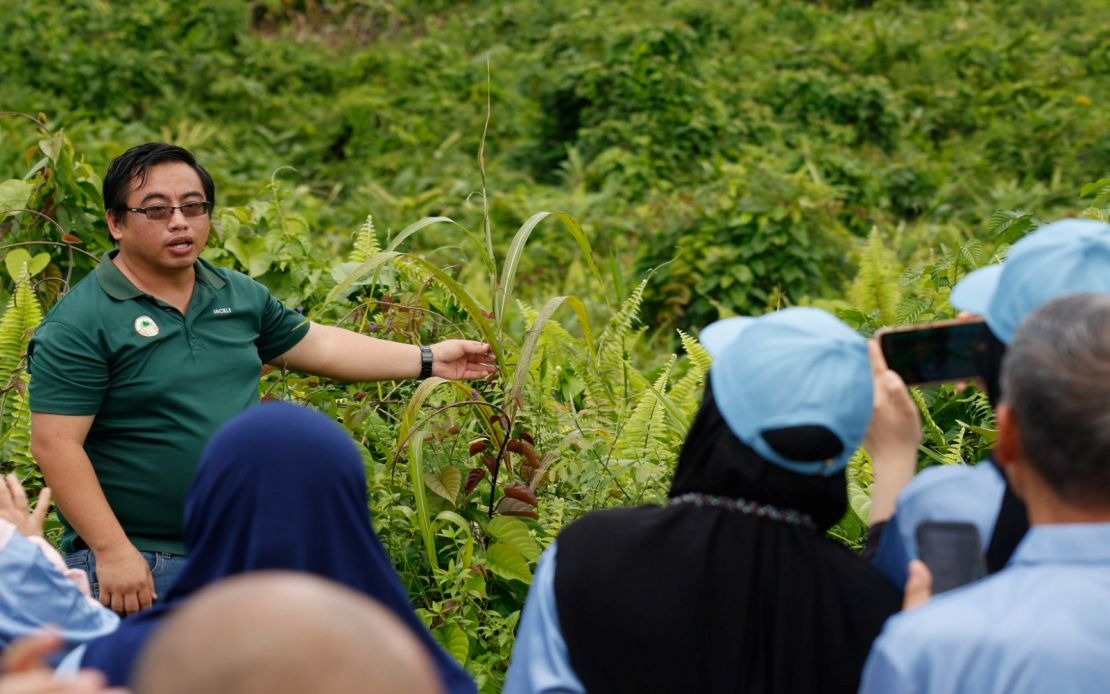
Across 6,000 hectares of Sabah's Ulu Segama-Malua Forest Reserve, a transformation is underway. The Lower Kawag landscape, reduced to ecological shadow by consecutive El Niño fires in 1983, 1997 and 1998, followed by three decades of intensive logging through 2007, is gradually regaining its forest canopy through a structured restoration programme that combines environmental rehabilitation with community economic benefit.
The Orangutan Habitat Forest Restoration Project, a collaborative effort between the Malaysian Palm Oil Green Conservation Foundation (MPOGCF) and the Sabah Forestry Department, represents a strategic shift in how Sabah approaches landscape recovery. Rather than allowing degraded areas to remain as degraded land, the initiative treats forest restoration as an investment in biodiversity, economic resilience, and human-wildlife coexistence. The project commenced in 2019 and operates under a structured ten-year timeline extending to 2029, supported by RM10 million in MPOGCF funding, with an initial footprint of 2,500 hectares across Lower Kawag.
According to Jackly Ambrose, Forest Conservation Officer with the Sabah Forestry Department, approximately 90 per cent of the Lower Kawag forest had been severely degraded before restoration began. The combination of fire and logging had eliminated the forest structure that wildlife depends upon. Historical logging practices, conducted before modern forestry science influenced management decisions, had not prioritised forest recovery. The fires that followed El Niño episodes compounded this damage, leaving behind a landscape incapable of supporting complex ecosystems. This degradation underscores a critical challenge across Southeast Asia: recovering forests that have experienced multiple sequential disturbances requires more than passive reforestation.
The restoration methodology employed reflects international best practice in forest landscape recovery. Rather than planting commercially valuable species immediately, the project begins with native pioneer species including Laran, Binuang and Talisai, which establish canopy cover relatively quickly and create conditions suitable for more sensitive species. Only after this pioneer phase does the project introduce hardwood species from the Dipterocarpaceae family, such as Kapur and Seraya, which require established forest conditions to thrive. This two-stage approach acknowledges that forest restoration is not instantaneous tree planting but rather a managed succession process that must follow ecological logic.
Progress across the three implementation phases demonstrates the project's momentum. The first phase, covering 25 hectares in 2019, established proof of concept. The second phase, involving 200 hectares that is now 90 per cent complete, has provided critical monitoring data confirming that planted trees are establishing healthy growth patterns. The third phase, launched this year, represents an acceleration, covering 332 hectares with an ambitious target of planting 132,800 tree saplings through 2029. In total, 225 hectares have already been successfully restored, indicating that the project has moved beyond experimental stage into sustained implementation.
Monitoring outcomes validate the ecological investment. When the Kinabatangan Orang-utan Conservation Programme (HUTAN) conducted joint assessments of Lower Kawag in August 2023, they documented orangutan density ranging between one and 3.5 individuals per square kilometre, suggesting that habitat restoration is translating into measurable population response. Beyond orangutans, the project has recorded over 20 mammal species across the restoration zone, including 12 threatened species such as banteng, elephants and sun bears. Bird monitoring has identified more than 180 species, encompassing rare and endemic taxa including pittas, Bornean ground cuckoos and multiple hornbill species. This biodiversity recovery indicates that the restoration is functioning as genuine ecosystem recovery, not merely a tree-planting exercise.
The project has also delivered wildlife corridor benefits. By restoring forest connectivity across previously fragmented landscapes, Lower Kawag is becoming a functioning passage for elephants and other large mammals. This connectivity reduces pressure on adjacent plantation areas where human-wildlife conflict typically escalates when animals lack suitable habitat corridors. For Sabah's plantation sector, which operates across landscapes adjacent to forest reserves, this represents an economically rational investment in conflict reduction alongside conservation benefit.
Community engagement has transformed the project's social dimension. The Kampung Tampenau Nursery Community, comprising 114 members primarily from Tambunan, Penampang and Ranau, supplies saplings for the restoration programme. Rather than importing seedlings from distant nurseries, the project sources stock locally, reducing costs while embedding economic opportunity within participating villages. Saplings are priced between RM5 and RM7 per polybag depending on species and order volume, generating sustainable income for community members who historically supplemented household earnings through handicraft sales.
Participant Fololita Palandis exemplifies the programme's livelihood impact. As one of many housewives participating in the nursery community, she has accessed training in tree species identification, propagation techniques and seedling management. Community members can produce up to 200 saplings daily, translating skill acquisition into direct income generation. During the second phase alone, community suppliers provided 80,000 saplings, demonstrating both the scale of local employment and the programme's reliance on community capacity. This model transforms forest restoration from an external intervention into a locally-rooted economic activity that builds human capability while advancing environmental goals.
International certification has provided external validation of the project's rigor. The initiative has received Preferred by Nature (PbN) certification under the Ecosystem Restoration Verification Standard Version 3.1, confirming that Lower Kawag's restoration follows international best practice protocols for degraded landscape recovery. This certification matters beyond symbolic recognition: it creates transparency around restoration claims and provides assurance to global markets and conservation partners that the work meets established standards. For Malaysia, seeking to position itself as a conservation leader regionally and globally, such certification strengthens credibility.
The Lower Kawag project offers instructive lessons for forest landscape recovery across Southeast Asia. The region contains millions of hectares of degraded forest that cannot regenerate unaided—areas that have experienced fire, logging or both, leaving soils and forest structures insufficient to support natural recovery. The MPOGCF initiative demonstrates that systematic, long-term commitment with appropriate funding, technical expertise and community engagement can reverse such degradation. The ten-year timeline is particularly significant: it signals that restoration requires patient investment rather than short-term intervention. For Malaysia and neighbours confronting similar landscape challenges, this model suggests that strategic restoration at scale is ecologically feasible and economically viable when structured appropriately.
Looking toward 2029, the Lower Kawag project will have restored approximately 557 hectares, with potential for further phases if initial success continues. The combination of orangutan habitat recovery, wildlife corridor establishment, community income generation and international certification creates a compelling narrative around landscape restoration that goes beyond simple tree planting. As Sabah and Malaysia navigate the tension between economic development and biodiversity conservation, the Lower Kawag experience demonstrates that these objectives need not be entirely opposed when restoration is treated as a deliberate, well-resourced priority rather than an afterthought.

