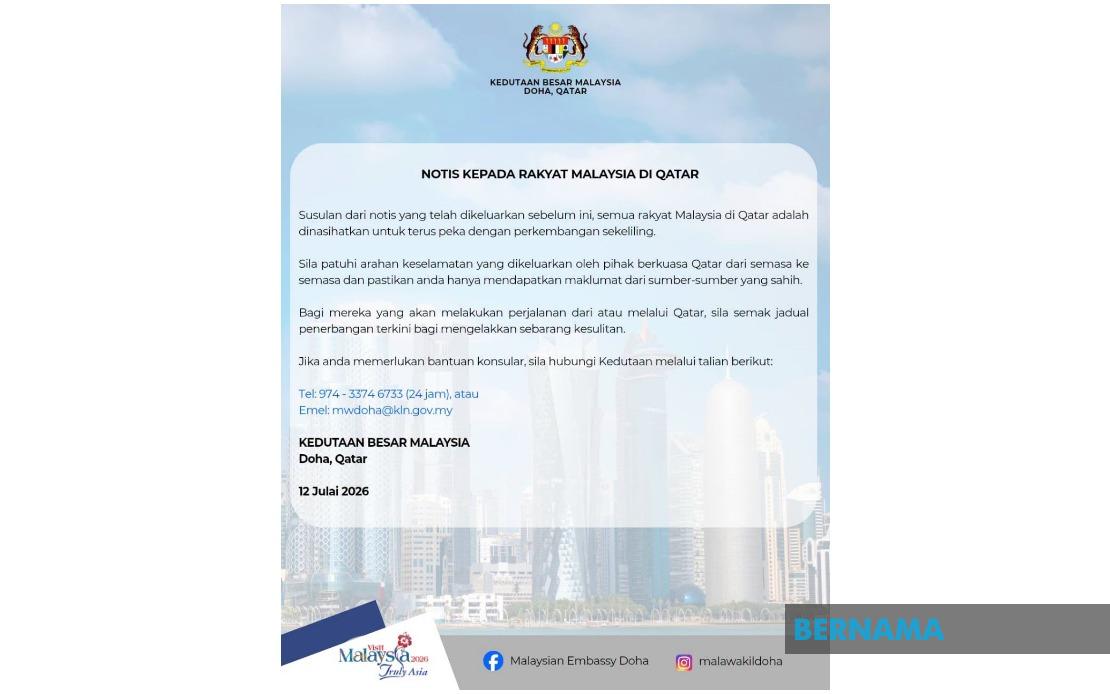
The Malaysian Embassy in Qatar has issued a security advisory to Malaysian nationals residing in or transiting through Doha, urging them to remain vigilant and adhere to guidance issued by local authorities. The diplomatic mission made the announcement through its official social media channels following a fresh round of military confrontations between Washington and Tehran in the Persian Gulf region. The embassy stressed the importance of obtaining information exclusively from authoritative sources during this period of heightened regional uncertainty.
The escalation marks a significant setback to diplomatic efforts that had appeared promising just weeks earlier. In June, Tehran and Washington had reached a Pakistan-brokered understanding designed to terminate hostilities that erupted in late February. The memorandum of understanding explicitly addressed key grievances: it mandated an immediate cessation of all military operations across multiple theatres, required the removal of the US naval blockade restricting Iranian shipping, and committed both sides to restoring free passage through the Strait of Hormuz—one of the world's most strategically vital chokepoints for global energy trade.
Despite this agreement, the consensus proved fragile. This week alone, the two powers have engaged in three separate waves of military action centred on the Strait of Hormuz, a waterway through which approximately one-third of the world's seaborne traded crude oil transits daily. The renewed hostilities were triggered when Iran's Islamic Revolutionary Guard Corps navy reportedly fired upon a commercial vessel navigating through the strait and subsequently declared an effective blockade of the passage. Iran announced that no vessels would be permitted transit until what it characterised as American interventionist policies in the region ceased entirely.
In response, United States military forces launched strikes against Iranian targets on Sunday, marking the most recent escalation in what has become a cyclical pattern of retaliation. The Iranian military's actions, combined with the closure announcement, fundamentally violated the spirit and letter of the June understanding. For Malaysian policymakers and business leaders, the deterioration carries immediate ramifications. Malaysia's substantial petrochemical sector, its role as a regional shipping hub, and its energy security all depend upon unimpeded access to Gulf oil supplies routed through the Strait of Hormuz.
The closure of this critical waterway presents cascading risks throughout Southeast Asia's supply chains and energy markets. Should the blockade persist, regional economies including Malaysia would face elevated fuel costs, potential shortages of crude feedstock for refineries, and disruptions to maritime commerce. Insurance premiums for vessels transiting the region have already begun climbing in anticipation of further deterioration. For Malaysian shipping companies and traders with operations in the Gulf, the security environment has become considerably more unpredictable.
Malaysia's diplomatic position as a non-aligned nation means Kuala Lumpur maintains relationships with both the United States and Iran, though traditionally tilts slightly towards Iran owing to substantial Muslim populations and historical commercial ties. The current crisis places Malaysian policymakers in a delicate position, requiring careful neutrality whilst protecting citizens and economic interests. The embassy's advisory reflects this pragmatic approach, steering clear of political commentary whilst emphasising practical safety measures for Malaysian nationals on the ground.
For Malaysians currently based in Qatar or those planning to transit through Doha, the embassy has provided specific guidance. Citizens are instructed to monitor updates from Qatari authorities continuously, as host-nation security protocols may change rapidly depending on developments. The embassy particularly cautioned Malaysians whose travel plans involve departures from or connections through Qatar to verify current flight schedules with airlines, as regional instability frequently triggers unexpected service interruptions and rerouting. This practical advice acknowledges that Doha's Hamad International Airport serves as a major regional hub through which thousands of Malaysian travellers transit monthly.
Consular support remains accessible around the clock for Malaysians requiring assistance. The embassy has activated its 24-hour emergency hotline (+974-3374 6733) and email channels to field queries and provide support for citizens facing unexpected difficulties. This infrastructure becomes particularly important during periods of heightened tension, when minor incidents can sometimes snowball into larger complications for foreign nationals.
The broader context underscores how quickly regional geopolitical gains can unravel. The June memorandum represented a significant breakthrough after months of escalating tension, suggesting that patient diplomacy and third-party mediation could bridge even seemingly intractable divides. The rapid reversion to military posturing within weeks demonstrates the underlying fragility of any agreement when fundamental strategic interests—in this case, control over critical maritime passages and regional influence—remain contested. For Malaysia and other Southeast Asian nations with substantial interests in Middle Eastern stability, the message is sobering: durable peace in the Gulf requires far more than provisional agreements; it demands genuine resolution of core disagreements.
As the situation remains fluid, Malaysian authorities will likely continue monitoring developments closely. Should military activity expand beyond the immediate Strait of Hormuz vicinity or threaten civilian infrastructure in Qatar, additional protective measures for Malaysian nationals may become necessary. Meanwhile, Malaysian businesses with exposure to Gulf markets are reassessing risk profiles and contingency plans, preparing for scenarios ranging from temporary supply chain disruptions to more prolonged regional instability.

