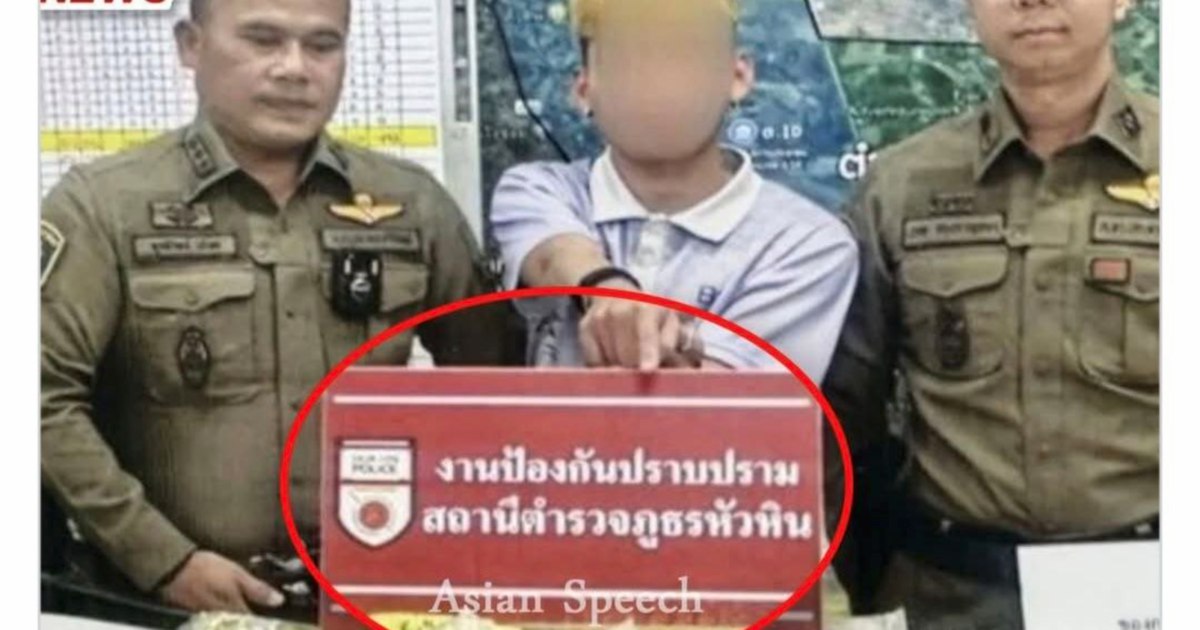
Thai law enforcement has apprehended a 20-year-old Malaysian national in Hua Hin, Prachuap Khiri Khan province, in connection with what appears to be one of the region's largest recent drug seizures. The arrest occurred on Saturday following an incident at a checkpoint where the suspect allegedly attempted to flee in a BMW vehicle, triggering a pursuit that would culminate in the discovery of massive quantities of crystal methamphetamine, locally known as syabu.
The contraband recovered during the operation totalled 166 kilograms of the crystalline stimulant, a quantity that authorities valued at approximately RM8 million or more. The sheer volume of the seizure underscores the scale of drug manufacturing and trafficking operations that continue to plague Southeast Asia despite coordinated enforcement efforts across the region. For Malaysia, the incident carries particular significance given that one of the nation's own citizens was implicated in what appears to be a major transnational trafficking operation centred on Thailand's infrastructure.
The circumstances surrounding the checkpoint evasion reveal patterns common to high-value drug trafficking in the region. When law enforcement signalled the BMW driver to stop for routine inspection, the suspect's decision to accelerate and bypass the checkpoint immediately elevated the situation from a standard customs operation to an active pursuit. This evasive behaviour, though risky and ultimately unsuccessful, highlights the desperation and significant financial stakes involved in moving bulk quantities of narcotics across national borders.
Hua Hin's location in Prachuap Khiri Khan province along Thailand's western coast makes it a strategically important junction for drug trafficking networks. The town serves as a corridor connecting Bangkok and the northern provinces with routes extending to Malaysia and beyond. Enforcement agencies in Thailand have historically identified this region as a vulnerable transit point, particularly for methamphetamine shipments destined for lucrative Southeast Asian markets. The proximity to maritime routes and relatively porous border infrastructure creates ideal conditions for trafficking organisations to operate.
The value assigned to the seized shipment—exceeding RM8 million—reflects the astronomical street prices commanded by crystal methamphetamine in retail markets. This valuation suggests the drugs were intended for distribution networks capable of generating substantial revenues for the trafficking organisation. For context, such quantities typically represent either a significant haul from a manufacturing facility or consolidation point, or represent inventory accumulated for distribution across multiple Southeast Asian jurisdictions.
The involvement of a young Malaysian national, at just 20 years old, illustrates a troubling trend whereby traffickers increasingly recruit individuals in their late teens and twenties to serve as couriers and drivers. These young operatives typically receive modest compensation relative to the enormous profits generated upstream, yet face severe criminal penalties upon capture. The practice reflects how trafficking networks exploit economic disparities and limited employment opportunities to secure expendable personnel willing to assume substantial legal risks.
Malaysia's law enforcement agencies maintain ongoing coordination with Thai authorities to combat cross-border drug trafficking. This arrest will likely feature prominently in briefings between Malaysian and Thai narcotics divisions, as it provides operational intelligence regarding trafficking routes, vehicle usage patterns, and the methods employed by smuggling organisations. Such intelligence sharing has become increasingly sophisticated, though the persistence of major seizures suggests trafficking networks continue to adapt faster than enforcement can adapt to suppress them.
The incident raises broader questions about the effectiveness of checkpoint systems and interdiction strategies along major trafficking corridors. Despite significant investment in surveillance, personnel, and technology, the quantity of drugs seized in this single operation demonstrates that enforcement remains fundamentally reactive. Law enforcement agencies identify and intercept shipments based largely on intelligence, suspicious behaviour, or random inspection, rather than through systematic prevention of trafficking at source.
For Malaysian policymakers, the case serves as a reminder that drug trafficking represents not merely a domestic law enforcement challenge, but a regional phenomenon requiring coordinated responses. The involvement of a young Malaysian courier suggests that recruitment and radicalisation into trafficking organisations may be occurring within Malaysian communities, potentially driven by poverty, peer influence, or coercion. Prevention strategies targeting vulnerability factors remain inadequately resourced compared to post-arrest prosecution and incarceration.
The suspect now faces serious charges under Thai narcotics legislation, including possession of methamphetamine with intent to distribute. Thailand's drug laws carry severe penalties, including lengthy imprisonment and, in some circumstances, capital punishment for trafficking convictions. As a foreign national, the Malaysian driver's case will also likely require diplomatic engagement to ensure consular access and fair legal proceedings, adding layers of complexity to what already represents a significant transnational enforcement success.
This seizure, while substantial, represents only a fraction of methamphetamine production and trafficking occurring across Southeast Asia. Regional law enforcement estimates suggest that such intercepted shipments constitute perhaps five to ten percent of total trafficking volumes. The implication is sobering: for every 166 kilograms seized, substantially larger quantities likely reach intended markets across the region, contributing to addiction, associated crime, and public health crises affecting millions of Southeast Asians. The arrest and seizure, though operationally successful, underscores the magnitude of the challenge confronting enforcement agencies throughout the region.

