Coronary artery disease remains a leading health threat across Southeast Asia, with millions facing the progressive accumulation of plaque within their heart vessels. Managing this condition—medically termed atherosclerosis—requires a multi-pronged approach combining lifestyle modifications, pharmaceutical interventions, and in many cases, surgical procedures. The challenge intensifies significantly when calcium deposits harden the arterial walls, creating what cardiologists call severe coronary artery calcification. This development has prompted Malaysian cardiovascular specialists to investigate cutting-edge solutions that could transform treatment outcomes for high-risk patients across the region.
Arterial plaque itself represents a complex biological deposit comprising cholesterol, fatty substances, calcium, cellular debris, and fibrin, a blood-clotting protein that gradually accumulates along vessel walls. Over years or decades, this material narrows the internal diameter of arteries and can eventually obstruct blood flow entirely. When coronary arteries—the vessels supplying the heart muscle—become compromised, oxygen-rich blood cannot reach vital heart tissue, precipitating risks of myocardial infarction, heart failure, and stroke. The consequences ripple beyond individual patients, straining healthcare systems throughout the region already managing rising cardiovascular disease burdens.
Conventional interventional approaches have long relied on percutaneous coronary intervention, coronary artery bypass grafting, and balloon angioplasty to restore patency. These procedures operate on straightforward principles: physicians deliver a balloon catheter to the blockage site, inflate it to compress soft plaque and create space within the vessel, then deploy a stent—a small metal mesh scaffold—to maintain that opening and prevent restenosis. Datuk Dr Tamil Selvan Muthusamy, a consultant cardiologist, explains that this strategy works effectively for typical plaque composition. However, when calcium predominates, the arterial wall becomes fundamentally different in mechanical properties, rendering conventional balloons ineffective and complicating stent placement substantially.
The emergence of heavily calcified lesions has prompted development of specialised techniques including rotational atherectomy, high-pressure balloon angioplasty, and intravascular lithotripsy. Intravascular lithotripsy represents a significant advancement, employing sonic pressure waves generated by catheter-based devices to fracture calcium deposits and restore adequate lumen dimensions. Yet despite its breakthrough potential, the conventional IVL technology carries meaningful limitations. External ultrasound pulse generators impose restrictions on treatment protocols—older devices permit only eight pulses, while newer iterations offer twelve, yet both caps constrain optimal calcium fragmentation. Furthermore, the bulky catheter design struggles to navigate through severely compromised vessels with minimal internal space, sometimes requiring supplementary techniques and reducing procedural efficiency.
Additional complications stem from the one-size-fits-all design philosophy of current devices. Coronary arteries are inherently tapered structures, varying in diameter along their length, yet standard IVL balloons must match a single vessel measurement throughout the procedure. An artery measuring 3.5 millimetres proximally but narrowing to 2 millimetres distally creates a mismatch problem: a 3-millimetre balloon may not adequately treat proximal disease while oversizing the distal segment, compromising procedural effectiveness and safety margins. These cumulative limitations have motivated investigation of alternative technologies that might address fundamental design constraints while maintaining therapeutic effectiveness.
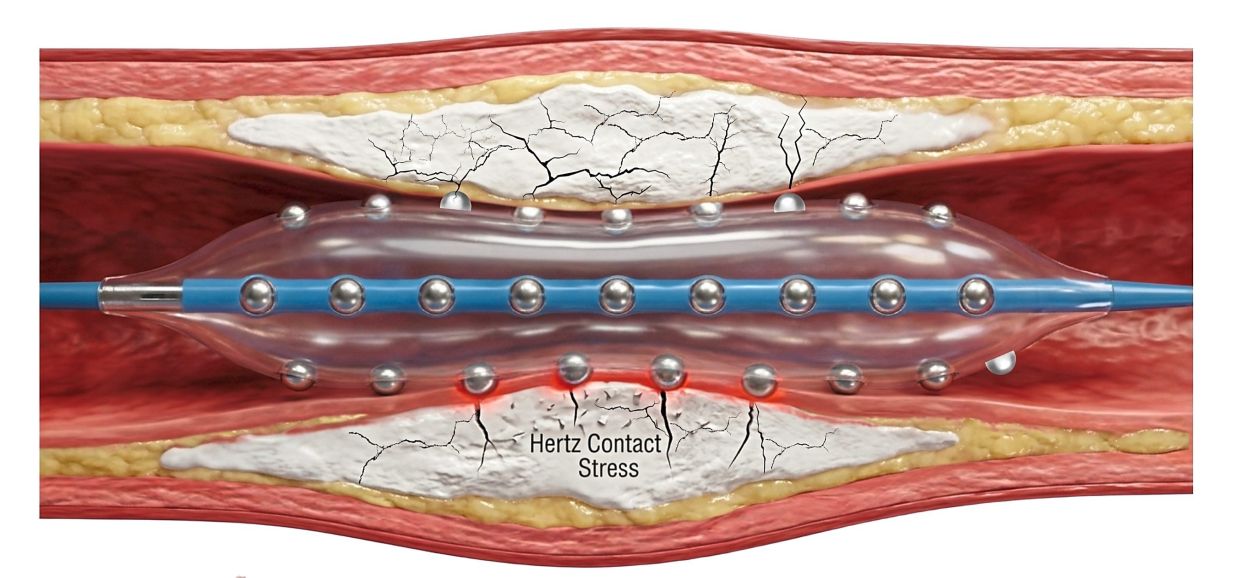
Recognising these gaps, a Malaysian cardiology team spearheaded by Datuk Dr Tamil Selvan embarked during 2025 on clinical evaluation of the Hertz Contact-IVL System, a mechanically-based lithotripsy innovation fundamentally distinct from energy-dependent predecessors. Rather than relying upon external ultrasound generators, this device incorporates integrated metallic hemispheres within the treatment balloon itself. When contact pressure is applied against calcified plaques, these structures create focal amplification of mechanical force, multiplying the applied pressure beyond the balloon surface to achieve calcium fracture. This mechanical principle generates deep, wide fissures within hardened plaques while sparing surrounding healthy tissue—a critical distinction minimising collateral vascular injury and allowing natural arterial expansion that accommodates stent deployment with reduced complications.
The technical advantages of this novel approach address previous limitations comprehensively. By embedding the pressure-amplifying hemispheres directly within the treatment balloon, the Hertz Contact-IVL System eliminates dependence on external energy generators and their associated pulse limitations. The improved deliverability profile permits the catheter to traverse heavily calcified vessels previously difficult to access, enabling single-balloon treatment of multiple lesions or extensive disease segments. Datuk Dr Tamil Selvan emphasises that this mechanical approach maintains calcium-fracturing capability whilst fundamentally improving the practical aspects of device placement and lesion coverage. The architectural redesign transforms what was previously a technical constraint into a genuine clinical advantage.
The decision to conduct comprehensive local investigation reflects measured scientific prudence. While the device developer had sponsored small multi-centre trials within United States facilities, Malaysian researchers recognised the value of independent validation through larger-scale investigation. Given regional variations in patient demographics, coronary anatomy patterns, and healthcare infrastructure, conducting dedicated research within Malaysia's healthcare context provides evidence directly applicable to Southeast Asian populations. This approach also establishes Malaysia's cardiovascular research credentials, positioning local institutions as contributors to global advancement rather than merely adopting externally-developed solutions.
The implications for Malaysian patients are substantial. Approximately one in three adults suffers from hypertension, a primary atherosclerosis accelerant, whilst diabetes prevalence continues rising across the region. These conditions disproportionately affect calcified plaque formation, rendering conventional intervention increasingly inadequate for many patients. Advanced lithotripsy technologies that simplify treatment, reduce procedural complications, and improve immediate and long-term outcomes could significantly improve survival and quality of life for countless individuals facing coronary intervention. Healthcare economics also favour more efficient procedures requiring fewer interventions and shorter hospital stays, reducing burden upon already-stretched cardiovascular services throughout Southeast Asia.
Beyond individual benefit, this Malaysian research initiative demonstrates regional capacity in cardiovascular innovation and clinical research methodology. Southeast Asian healthcare systems often lag in adopting cutting-edge technologies, partly reflecting limited local research evidence and partly stemming from reliance upon external validation. When Malaysian cardiologists conduct rigorous independent investigation of advanced therapies, they generate locally-relevant evidence strengthening regional competence and confidence in evidence-based selection between treatment options. This builds institutional expertise and encourages continued investment in cardiovascular research infrastructure across Malaysia and potentially neighbouring nations seeking collaborative advancement.
The integration of mechanical principles into interventional cardiology equipment represents broader industry evolution toward devices that function effectively across varied clinical scenarios without excessive complexity or external dependencies. As calcified plaque deposits become increasingly prevalent amid ageing populations and metabolic disease epidemics, technologies capable of addressing this morphological challenge will become standard rather than specialised. Malaysian research validating such approaches contributes meaningfully to global evidence whilst directly serving local populations facing progressive coronary disease burden that shows no signs of diminishing without comprehensive prevention and advanced treatment strategies.

