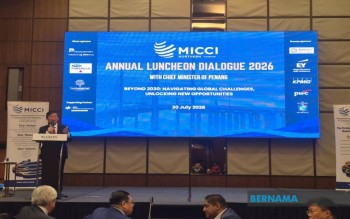
The Malaysian International Chamber of Commerce and Industry (MICCI) is mounting a concerted push for its members to redirect resources towards human capital and cutting-edge innovation, warning that without sustained investment in these areas, Malaysian enterprises risk losing their competitive edge in a rapidly transforming global economy. The call, made by MICCI Northern Branch chairman Datuk Brian Tan Guan Hooi at the MICCI Northern Branch Annual Luncheon Dialogue 2026 in George Town on July 30, reflects growing anxiety within Malaysia's business leadership about the pace of technological change and its implications for employment structures and workforce readiness.
Technological advancement presents a paradox that Malaysian business leaders must navigate with care. While artificial intelligence, automation and digitalisation are displacing workers from traditional roles and eliminating entire categories of employment, they simultaneously generate entirely new industries and professional opportunities that did not exist a decade ago. The challenge for Malaysian businesses is not to resist this transformation but to position their organisations and employees to thrive within it. According to Tan, this requires a fundamental shift in how companies approach workforce development, moving beyond the accumulation of formal qualifications towards a more holistic skill set that prepares employees for an uncertain future.
The skill profile demanded by tomorrow's economy differs markedly from what traditionally sufficed in Malaysia's industrial and service sectors. Beyond technical expertise directly tied to specific job functions, employers increasingly prioritise creativity, robust communication abilities and—perhaps most critically—an intrinsic willingness to engage in lifelong learning. These soft capabilities enable workers to pivot between roles, adapt to new tools and methodologies, and contribute meaningfully even as their primary job descriptions evolve. Tan's emphasis on this broader competency framework suggests that Malaysian companies cannot rely on one-time training programmes or hiring strategies but must embed continuous skill development into their organisational DNA.
A particularly sharp observation from Tan concerns the disconnect between educational systems and industry needs. Malaysia's schools and training institutions have historically operated on time-lags, producing graduates equipped for yesterday's job market rather than tomorrow's. As AI and automation accelerate the pace of change, this lag threatens to widen unless deliberate bridges are constructed between academia and industry. Educational curricula must be regularly refreshed based on real-time feedback from employers about which capabilities matter most. Without this alignment, Malaysia risks graduating cohorts of young people whose formal credentials fail to translate into employability, a structural challenge that affects not only individual livelihoods but national economic productivity.
The broader context for MICCI's call involves Malaysia's positioning within global competition for investment and talent. Southeast Asian economies including Vietnam, Thailand and Indonesia are similarly grappling with technological disruption, but success will favour jurisdictions whose workforces can demonstrate adaptability and innovation capacity. Malaysian companies that invest early in talent development will build internal capabilities that attract higher-value manufacturing and services work, generate more stable employment and position the nation as a preferred hub for multinational operations seeking skilled, innovative teams. Conversely, businesses that delay or neglect these investments may find themselves relegated to lower-value, labour-intensive sectors where automation poses an existential threat.
Innovation investment must extend beyond software and machinery to encompass organisational culture and business models. Datuk Tan's framing implicitly recognises that technology alone does not generate competitive advantage; rather, it is the human capacity to deploy technology creatively, to identify novel applications and to recombine existing tools in unexpected ways that produces differentiation. This perspective aligns with evidence from high-performing economies where innovation ecosystems thrive not through top-down mandates but through cultures that encourage experimentation, tolerate intelligent failure and reward creative problem-solving. Malaysian businesses aspiring to remain globally competitive must deliberately cultivate these conditions.
The call for deeper collaboration between government and private sector carries particular weight given Malaysia's political economy. Datuk Tan's articulation—that government sets direction and creates enabling environments while business supplies capital, expertise and employment—reflects a pragmatic partnership model rather than an adversarial one. However, realising this partnership requires mechanisms for continuous dialogue and mutual accountability. Industry associations like MICCI play a bridging role, translating business concerns into actionable policy recommendations and helping government understand how regulatory frameworks, infrastructure investments and educational policies affect commercial viability. For Malaysian policymakers, this suggests the need for formalised channels through which industry insights systematically inform decisions about taxation, skills funding, infrastructure development and trade policy.
Penang's presence at the dialogue, represented by Chief Minister Chow Kon Yeow as guest of honour, indicates that this conversation has reached state government level and is being framed as integral to economic strategy. Penang, already established as Malaysia's primary electronics and semiconductor hub, faces particular pressure to upskill its workforce amid global competition for advanced manufacturing and chip design facilities. The state's ability to attract and retain high-value operations depends substantially on the availability of engineers, technicians and innovators who can contribute immediately and adapt as technologies evolve. State governments in Malaysia thus have direct incentives to align educational funding, vocational training and economic development policies around the talent imperatives that MICCI is articulating.
The 189-year history of MICCI itself offers perspective on this moment. The organisation's longevity reflects its utility as a venue for business coordination and dialogue across changing economic eras. From colonial trade through industrialisation to the current digital transition, MICCI has persisted by remaining relevant to its members' evolving challenges. Its current positioning as a bridge between industry and government suggests institutional recognition that isolated private-sector responses to technological disruption prove insufficient; instead, systemic change across education, policy and business practice is required. This institutional continuity also underscores that technological disruption, while unprecedented in pace, is not unprecedented in requiring significant workforce and organisational adaptation.
For Malaysian companies reading these signals, the strategic imperative is clear: investment in talent and innovation must transition from aspirational goal to budgeted priority. This includes not only formal training expenditures but also organisational restructuring to create space for experimentation, partnerships with educational institutions to influence curriculum, and recruitment strategies that prioritise learning potential alongside current capabilities. Small and medium enterprises, which comprise the bulk of Malaysia's private sector, may struggle to fund these investments independently, suggesting the potential value of industry consortiums or government-supported mechanisms that distribute costs and risks across multiple firms. The window for gradual adjustment to technological change is narrowing; businesses that delay face the prospect of rapid obsolescence.

