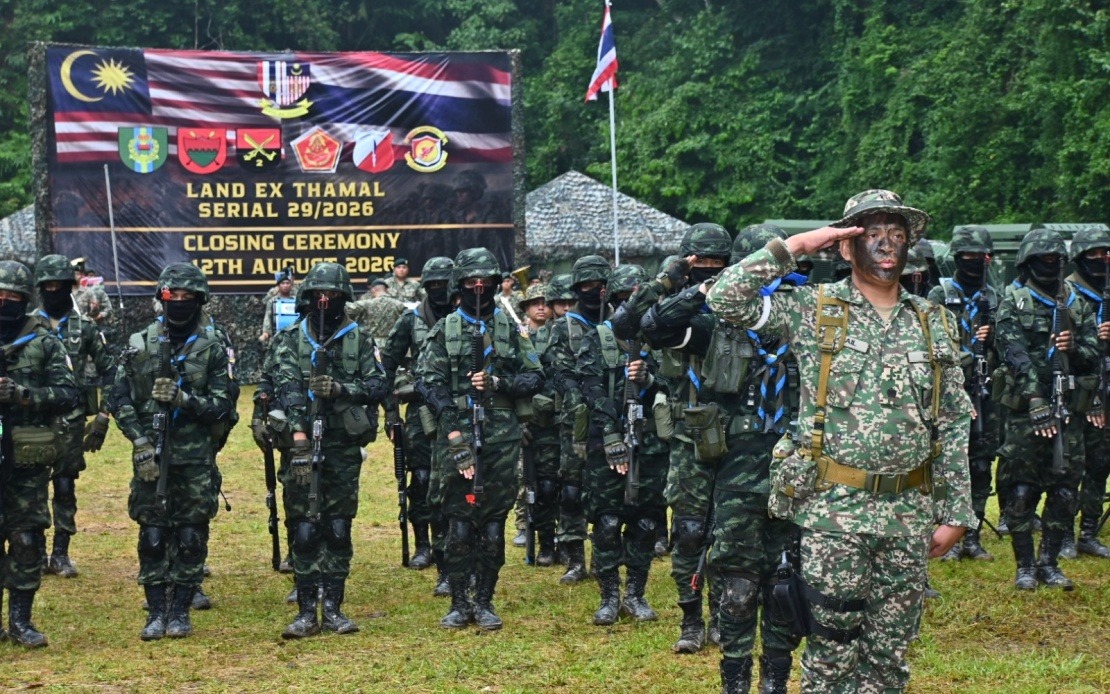
A significant military collaboration between Malaysia and Thailand is underway in northern Malaysia, where 252 soldiers from both nations are participating in an intensive training programme designed to sharpen tactical competencies and deepen defence partnerships. Headquartered in Gerik, the Exercise LAND THAMAL Series 29/2026 commenced on August 5 and brings together 197 personnel from the Malaysian Army (TDM) and 55 from the Royal Thai Army (RTA), reflecting the two countries' commitment to strengthening security cooperation in Southeast Asia.
The exercise operates across three distinct operational phases—Cross Training Exercise, Field Training Exercise, and Combined Military Civil Action—each designed to build complementary skill sets and operational understanding between the two forces. Through these structured components, participating troops are exposed to a comprehensive curriculum covering essential military functions including combat tactics, river and obstacle crossings, defensive fortifications, reconnaissance patrols, and coordinated assault operations. This multi-layered approach ensures soldiers gain practical experience across diverse scenarios they might encounter in border security or emergency response operations.
Central to the exercise's philosophy is the systematic exchange of tactical knowledge and operational methodologies. Rather than treating training as a one-way transfer, organisers have positioned the programme as a forum for mutual learning, where both armies can demonstrate their approaches to common challenges. This reciprocal model strengthens interoperability—the critical ability of military units from different nations to work seamlessly together—while simultaneously building personal relationships and institutional understanding between serving personnel. Such bonds prove invaluable when forces must coordinate during genuine security incidents or humanitarian crises.
The official inauguration occurred on August 5 at Gerik Airstrip, jointly overseen by Brigadier General Datuk Mohd Zaini Hashim, commanding officer of the 30th Malaysian Infantry Brigade, and Senior Colonel Taweeporn Kanatong, leading the 5th Infantry Brigade of the Thai Army. During the ceremony, Kanatong articulated the broader strategic rationale underpinning the exercise, emphasising that collaborative military training extends far beyond traditional combat readiness. Instead, it positions both nations to respond collectively to a widening spectrum of threats encompassing natural disasters, transnational security challenges, armed conflicts, and wider regional instability requiring coordinated responses.
For Malaysia specifically, the exercise carries particular significance given the country's extensive shared border with Thailand and the complex security dynamics that characterise the region. Joint training initiatives of this scale demonstrate both governments' recognition that border security and regional stability are inherently mutual challenges requiring integrated solutions. When Malaysian and Thai forces develop shared understanding of tactics, communication protocols, and command structures through exercises like LAND THAMAL, they create institutional capacity to respond more effectively to genuine crises, whether involving insurgent activity, trafficking networks, or natural disasters that demand rapid cross-border coordination.
Beyond strictly military dimensions, the exercise incorporates a civil-military component through the Jiwa Murni Programme, which organised community engagement activities at Sekolah Menengah Kebangsaan Sultan Idris Shah II in Gerik. This community-focused strand strengthens crucial military-civilian relationships and allows participating soldiers to demonstrate their commitment to local populations. Such initiatives cultivate goodwill, build trust in defence institutions, and reinforce the principle that armed forces serve broader societal functions beyond combat readiness—a particularly important message in border communities where perceptions of security forces significantly influence public confidence.
The 2nd Malaysian Infantry Division's statement characterised LAND THAMAL as a reflection of the robust professional relationship and mutual respect characterising Malaysia-Thailand defence ties. This institutional maturity distinguishes the relationship from less developed partnerships, where exercises might remain superficial or primarily symbolic. Instead, the structured curriculum and rotating leadership roles ensure personnel develop genuine operational competence working alongside their counterparts, translating into measurable improvements in joint capabilities should coordination become necessary during actual operations.
Regionally, Malaysian defence partnerships with Thailand represent a crucial stabilising element in Southeast Asia. Both nations face complex security environments involving maritime concerns, transnational crime, and evolving geopolitical competition. When Thailand and Malaysia demonstrate they can conduct sophisticated joint operations, train together systematically, and build institutional relationships around common security interests, this sends important signals to regional partners about the stability of bilateral relationships and the region's capacity for cooperative security arrangements. Such military-to-military relationships often provide diplomatic channels that prove invaluable during periods of political tension, offering continuity in high-level communication when civilian government contacts may cool.
The ongoing nature of the LAND THAMAL series—now in its 29th iteration planned through 2026—underscores the durability and importance both nations assign to this collaboration. Rather than episodic training events, the regular scheduling of such exercises creates predictability, allows for progressive skill development, and signals long-term commitment to bilateral defence cooperation. This consistency contrasts with more fragile partnerships prone to interruption during diplomatic difficulties, suggesting Malaysia and Thailand have established defence cooperation frameworks resilient enough to transcend short-term political variations.
The emphasis throughout official statements on strengthening mutual understanding and operational procedures reflects sophisticated thinking about military cooperation in contemporary contexts. Rather than portraying exercises primarily as demonstrations of combat prowess, Malaysian and Thai defence establishments frame LAND THAMAL as confidence-building, trust-generating, and capacity-enhancing. This approach aligns with modern security thinking emphasising that military cooperation serves deterrent functions—by making cooperation more attractive and conflict more costly—while simultaneously building institutional relationships that make coordinated crisis response more feasible when required.
For Malaysian military personnel, participation provides invaluable exposure to Thai Army practices, operational philosophies, and tactical innovations, fostering learning that enhances the Malaysian military's broader professional development. Conversely, Thai soldiers gain insights into Malaysian approaches and strengthen their capacity to coordinate with a key regional ally. This mutual education function, sustained across hundreds of personnel annually through such exercises, gradually raises overall military effectiveness and professionalism throughout both services.
Looking forward, the success of Exercise LAND THAMAL Series 29/2026 will likely reinforce both governments' commitment to continuing and potentially expanding bilateral defence cooperation frameworks. As regional security dynamics evolve—including maritime challenges, climate-related crises, and emerging transnational threats—the demonstrated ability of Malaysian and Thai militaries to work together cohesively becomes increasingly valuable. The exercise thus represents investment in institutional capacity and relationship-building that will generate security dividends extending well beyond the immediate training period, contributing substantively to regional peace and stability.

