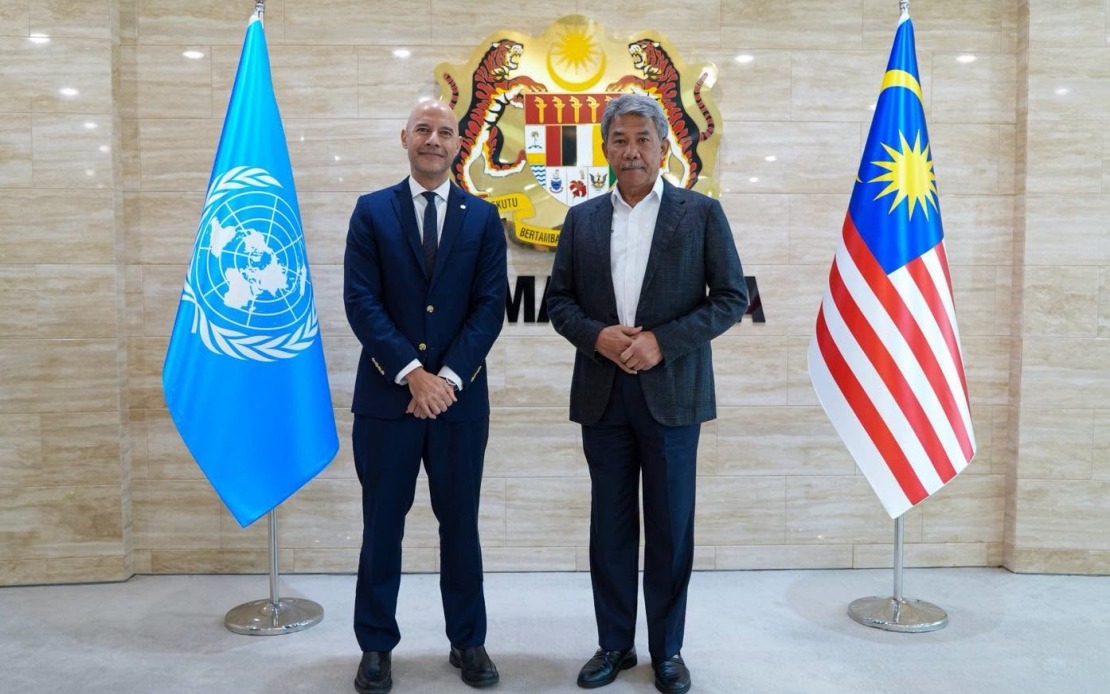
Foreign Minister Datuk Seri Mohamad Hasan received a courtesy visit from United Nations Resident Coordinator Nikolas Myint at Wisma Putra on Wednesday, signalling Malaysia's continued engagement with the UN system on matters of international cooperation and development. The meeting between the two officials provided a platform for substantive discussions regarding the trajectory of bilateral relations and the practical mechanisms through which Malaysia and the United Nations can deepen their partnership across multiple policy domains.
Myint, who was appointed to the position of UNRC for Malaysia, Singapore and Brunei by United Nations Secretary-General António Guterres on May 31, 2026, brings a multilateral development perspective to his new posting. The appointment of a single resident coordinator for three Southeast Asian nations reflects the UN's operational efficiency strategy in the region, though it also underscores the importance each country places on direct engagement with the organization's leadership. Myint's mandate encompasses coordinating UN agencies' operations across the three countries and serving as a key diplomatic liaison between national governments and the global body.
During their exchange, Mohamad articulated Malaysia's principled stance on the United Nations' role in tackling contemporary global challenges. The Foreign Minister emphasised that Malaysia recognizes the UN as an indispensable platform for multilateral problem-solving, whether addressing transnational security threats, climate change, public health emergencies, or sustainable development imperatives. This positioning reflects Malaysia's broader foreign policy orientation, which privileges international institutions as mechanisms for advancing national interests while contributing to regional and global stability.
The meeting also served as an opportunity to map out areas of practical cooperation between Malaysia's government apparatus and UN agencies operating within the country's borders. These agencies span diverse portfolios including development assistance, humanitarian affairs, environmental protection, gender equality, and technical capacity-building. By strengthening coordination channels with the new resident coordinator, Malaysia aims to ensure that UN programmes align more effectively with the nation's specific development priorities and that resources are allocated efficiently to address identified needs.
Malaysia's stated commitment to working closely with the UNRC and UN agencies reflects broader regional dynamics in Southeast Asia, where middle-income nations increasingly seek to leverage UN technical expertise and convening power to advance economic transformation and social progress. For Malaysia specifically, this engagement proves particularly valuable given the country's aspirations to achieve high-income status and address structural challenges in education, healthcare, environmental sustainability, and digital infrastructure.
The courtesy call also carries diplomatic significance beyond the bilateral Malaysia-UN relationship. As Singapore and Brunei share the same resident coordinator, developments in Malaysia's engagement with Myint may influence the broader coordination framework across the tri-nation arrangement. Enhanced Malaysian-UN cooperation could establish precedents or establish working practices that affect how the resident coordinator engages with the other two countries, particularly given Malaysia's larger economy and more extensive UN agency presence.
From a Southeast Asian perspective, Malaysia's reaffirmation of UN partnership arrives at a moment when regional countries face mounting pressures from geopolitical competition, transnational challenges, and the need to accelerate sustainable development progress. The ASEAN region collectively faces urgent imperatives around climate adaptation, pandemic preparedness, maritime security, and inclusive economic growth—all domains where UN technical agencies and normative frameworks provide critical support. Malaysia's proactive engagement signals that it intends to position itself as a constructive partner in these efforts rather than a passive recipient of UN programmes.
The Foreign Minister's emphasis on advancing cooperation "in line with the nation's development aspirations and global well-being" encapsulates a delicate balancing act that many developing nations navigate. Malaysia seeks to harness UN resources and expertise to advance domestic objectives while maintaining its diplomatic standing as a contributor to global problem-solving. This dual approach reflects Malaysia's self-perception as a responsible emerging power rather than a purely aid-dependent nation.
Looking forward, the substance of Malaysia-UN cooperation will likely concentrate on several key pillars. Climate action and environmental sustainability constitute one critical area, given Malaysia's vulnerability to sea-level rise and its rich biodiversity requiring international conservation frameworks. The country's commitment to achieving net-zero emissions by 2050 increasingly requires coordination with UN Environment Programme and related agencies. Additionally, Malaysia's aspirations in the digital economy and Fourth Industrial Revolution suggest potential for deeper collaboration with UN technology and innovation initiatives.
Education and human capital development represent another substantial frontier for expanded cooperation. Malaysia's efforts to upgrade vocational training systems, improve STEM education outcomes, and ensure educational equity across demographic groups align with UN Sustainable Development Goal priorities. The resident coordinator's office can facilitate knowledge transfer and best-practice sharing from other jurisdictions tackling similar challenges, thereby accelerating Malaysia's progress toward its education objectives.
Gender equality and women's economic participation, areas where Malaysia has made measurable progress but where significant gaps persist, also benefit from UN technical guidance and advocacy frameworks. The resident coordinator's office can amplify conversations around women's workforce participation, entrepreneurship support, and ending gender-based violence—issues that remain relevant across Malaysian society despite the country's relative development status.
The meeting between Mohamad and Myint thus represents more than a routine diplomatic courtesy. It marks an inflection point in Malaysia's engagement with the global UN system, suggesting the country's intention to deepen partnerships in an era of compounding global challenges. For Malaysian policymakers, investors, and civil society organizations, this recommitment to UN collaboration signals that the government views multilateral institutions not as constraints on sovereignty but as tools for advancing shared prosperity and security in an increasingly interdependent world.

