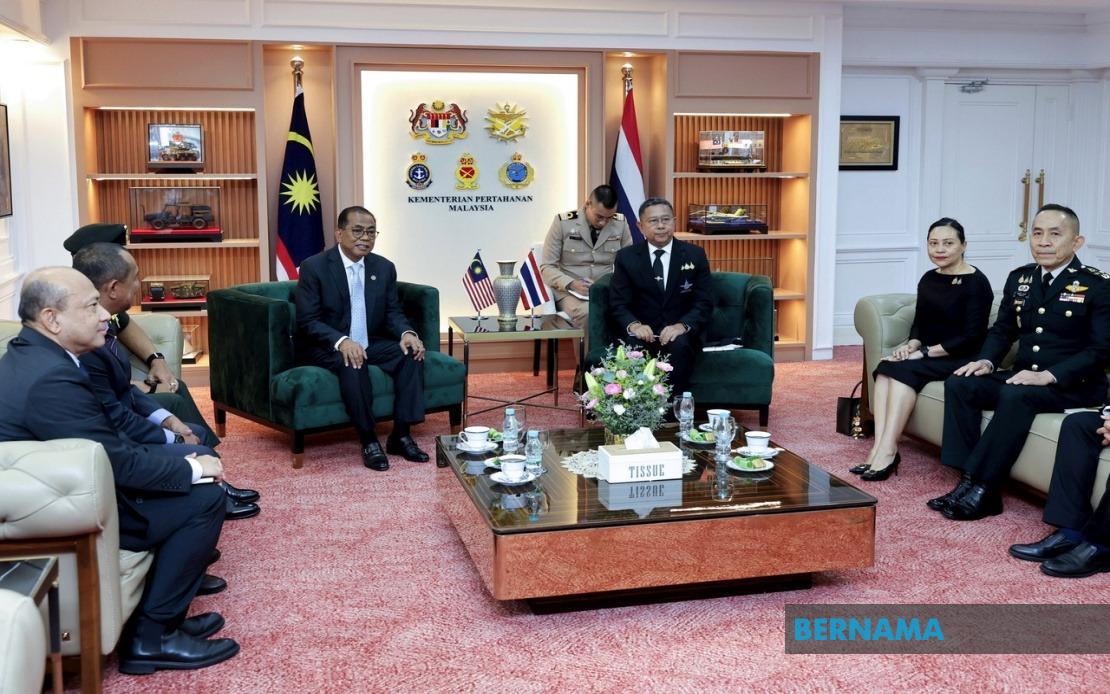
Malaysia has pledged to deepen its partnership with Thailand in pursuit of lasting peace and stability in the Thai southern border region, following the appointment of Thanut Suvarnananda as chief of the Royal Thai Government's Peace Dialogue Panel. Defence Minister Datuk Seri Mohamed Khaled Nordin conveyed Malaysia's formal welcome of the leadership transition during talks with visiting Thai Defence Minister Lieutenant General Adul Boonthumjaroen, signalling renewed momentum in a dialogue process that has long occupied the attention of both nations.
The appointment represents a strategic change in Bangkok's approach to one of Southeast Asia's most persistent security challenges. Mohamed Khaled expressed confidence that Thanut's elevation would catalyse progress on objectives both countries have worked toward for years. Malaysia's own commitment to the process remains anchored through Datuk Rabin Basir, who continues as the country's designated facilitator for the Southern Thailand Peace Dialogue. This dual leadership structure underscores how the region views the conflict as requiring sustained diplomatic engagement rather than military solutions alone.
Crucially, the Defence Minister drew a distinction between Malaysia's circumscribed role and Thailand's broader responsibilities. He emphasised that while Malaysia stands ready to facilitate dialogue between conflicting parties, the conduct of military operations and management of domestic security within southern Thailand remain exclusively within Bangkok's purview. This clarification holds particular significance for regional observers who sometimes misinterpret Malaysia's involvement as a deeper intervention in Thai internal affairs. The boundary reflects long-standing regional norms and the principle of national sovereignty that ASEAN members have traditionally upheld.
Beyond the peace dialogue framework, Malaysia and Thailand have identified smuggling and the unlawful movement of armed individuals across their shared border as pressing mutual concerns. Both defence ministers agreed to intensify collaborative efforts through the Malaysia-Thailand General Border Committee, an institutional mechanism that has evolved over decades to address security issues affecting both nations. This year's hosting of the 57th GBC Meeting will provide a platform for substantive discussions spanning multiple dimensions: tightening border security protocols, coordinating military deployments, fostering socio-economic development in peripheral areas, and preparing joint responses to natural disasters.
The breadth of the GBC agenda reflects a mature understanding that border stability depends on more than checkpoints and patrols. Peripheral regions often experience economic marginalisation, which can create recruitment pools for armed groups or criminal enterprises. By addressing development alongside security, Malaysia and Thailand signal recognition that sustainable peace requires addressing root causes of instability. The agenda's inclusion of disaster management acknowledges the shared vulnerability of border communities to typhoons and flooding, challenges that transcend political boundaries and demand coordinated responses.
Malaysia's support for Thailand's bilateral approach to its separate border dispute with Cambodia further demonstrates the kingdom's commitment to regional stability through dialogue. By endorsing Bangkok's preference for direct negotiations conducted in the spirit of the 'ASEAN Way'—a consensus-based approach emphasising non-interference and peaceful resolution—Malaysia reinforces norms that benefit all regional actors. The referral of the matter to the Philippines, as incoming 2026 ASEAN Chair, provides additional diplomatic channels should direct talks require external facilitation, though without compromising either nation's sovereignty.
Alignment ahead of the ASEAN Defence Ministers' Meeting and ADMM-Plus, scheduled for the Philippines, takes on heightened importance given current strategic uncertainties in the region. Malaysia and Thailand's coordination demonstrates that despite varying individual interests, Southeast Asian nations recognise shared stakes in maintaining rules-based order and preventing conflicts from destabilising the broader region. Such multilateral forums allow defence establishments to build personal relationships, clarify intentions, and prevent miscalculations that might otherwise escalate regional tensions.
A new Memorandum of Understanding, expected to be signed this year, signals Malaysian-Thai commitment to deepening defence cooperation beyond immediate border management. The agreement will encompass regional security architecture and collaborative development of indigenous defence capabilities. For Malaysia, whose defence industry has steadily matured, such partnerships create opportunities to integrate technological expertise and strengthen supply chains. Thailand similarly gains access to Malaysian innovations while demonstrating to ASEAN partners its commitment to collective security enhancement through institutional partnership rather than unilateral militarisation.
The southern Thailand conflict, spanning decades and claiming thousands of lives, remains a test case for regional conflict resolution mechanisms. Unlike interstate disputes that occasionally dominate headlines, this insurgency involves non-state actors, religious grievances, and historical communal tensions that defy simple diplomatic solutions. Yet Malaysia's sustained engagement—maintaining dialogue capacity even as military operations continue—reflects belief that eventual settlement requires inclusive negotiation. The new Peace Dialogue Panel chief's appointment suggests Bangkok remains committed to exploring political settlements, even as security operations persist.
For Malaysian policymakers, the stakes extend beyond humanitarian concern for a neighbouring population. Cross-border spillover effects—ranging from weapons trafficking to refugee movements—directly impact Malaysian security. Conversely, Malaysia's own experience managing religious and communal sensitivities within a diverse society positions it uniquely to offer insights valuable to Thai counterparts navigating their own pluralistic challenges. The relationship thus operates as a mutual learning exchange, with each nation's institutional knowledge and diplomatic experience contributing to regional problem-solving capacity that benefits all Southeast Asian states.

