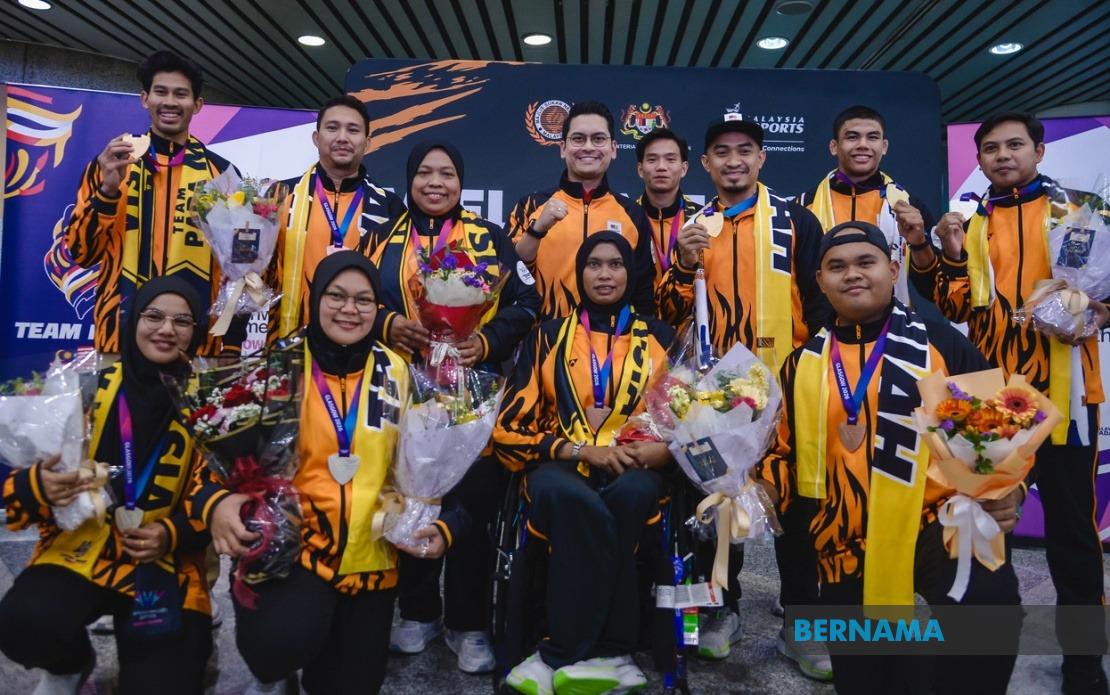
The Malaysian government has committed RM1.1 million in recognition of its athletes' success at the 2026 Glasgow Commonwealth Games, distributing the funds through the National Sports Incentive Scheme (SHAKAM) to honour the dedication and patriotic pride demonstrated by the medal-winning contingent. Youth and Sports Minister Dr. Mohammed Taufiq Johari unveiled the incentive structure during a welcoming ceremony for the Games medallists at Kuala Lumpur International Airport, framing the financial recognition as a tangible acknowledgment of the athletes' sacrifices and contributions to national pride. The allocation underscores the government's commitment to supporting elite athletic achievement while motivating future performers.
The reward structure mirrors a hierarchical approach that prioritizes gold medals, reflecting a strategic shift in how Malaysia measures sporting success. Winning athletes will receive RM80,000 for gold, RM40,000 for silver, and RM20,000 for bronze respectively. Athletes who achieve the additional distinction of setting a Games record in their gold medal event will qualify for a further RM10,000 supplement. This tiered system creates financial incentives that align with performance quality, distinguishing Malaysia's approach from flat-rate compensation models that treat all medal achievements equally.
The Games record bonus carries particular significance within Malaysia's emerging athletic philosophy. By offering supplementary rewards for record-breaking performances, the scheme encourages athletes to pursue not merely medal placement but excellence of the highest calibre. This mechanism incentivizes pushing beyond the baseline standard of winning, motivating competitors to view medal events as opportunities to establish benchmarks that may endure across future Commonwealth Games cycles. The incremental reward structure demonstrates sophisticated understanding of athletic motivation and the psychological drivers that push elite performers toward exceptional outcomes.
Dr. Mohammed Taufiq highlighted that the National Sports Council is currently exploring expansion of the SHAKAM funding envelope through corporate sponsorship arrangements. This signals recognition that government allocations alone may prove insufficient to sustain competitive incentive structures as Malaysia's medal ambitions escalate. Corporate partnerships would enable the scheme to grow organically with performance achievements, decoupling reward capacity from rigid government budgeting processes. For Malaysian businesses, such collaboration presents opportunities to gain association with national sporting success while contributing to athlete welfare.
Malaysia's Glasgow contingent delivered 16 medals overall—eight gold, three silver, and five bronze—surpassing the initial target of five gold medals by a significant margin. This performance represents one of the country's strongest showings since 2010, achieved despite fielding a comparatively smaller delegation than in previous Commonwealth Games editions. The efficiency of the medal haul—strong performance relative to team size—suggests improved targeting and preparation in sports selection and athlete development. Dr. Mohammed Taufiq attributed this success partly to institutional strategy evolution, specifically the adoption of colour-based medal targeting that directs organizational energy toward gold medal pursuit rather than aggregate medal accumulation.
The strategic implementation of gold-focused targets emerged from collaborative deliberations involving sports associations, coaching staffs, and athletes themselves. This consultative approach ensured that ambitious objectives reflected the realistic assessment of where Malaysian strength could generate medal opportunities, while remaining achievable within resource constraints. By anchoring institutional goals to specific medal colours rather than general podium placement, the ministry fundamentally reframed how success is measured and communicated throughout the sports system. Athletes reported that this focus provided motivational clarity rather than undue pressure, suggesting the targets were calibrated at appropriate challenge levels.
The shift toward colour-based targeting represents a calculated bet on psychological and organizational motivation. Rather than treating all medals equivalently, the system directs limited resources and coaching attention toward events where gold medal prospects appear viable. This represents a departure from traditional approaches that measure national success through total medal counts without qualitative distinction. By elevating gold medals as the primary institutional objective, Malaysia signals that its sporting ambitions have matured beyond merely achieving podium representation toward genuine competitive excellence within Commonwealth Games contexts. Dr. Mohammed Taufiq emphasized that this approach offers momentum toward a longer-term goal: securing Malaysia's first-ever Olympic gold medal.
The Glasgow performance carries particular significance for regional positioning within the Commonwealth framework. Southeast Asian nations increasingly view Commonwealth Games outcomes as barometers of athletic development and sporting infrastructure quality. Malaysia's strong Glasgow showing demonstrates that strategic investment, clarified institutional priorities, and evidence-based athlete selection can yield competitive returns even when operating with constrained delegations. The results may catalyze review of sporting priorities among other regional competitors, establishing new benchmarks for what Commonwealth Games participation and preparation should achieve.
Chef de Mission Datuk Awalan Abdul Aziz, concurrently President of the Malaysian Lawn Bowls Federation, provided specific context regarding lawn bowls results. The federation achieved two silver and two bronze medals at Glasgow, substantially exceeding the one silver and one bronze outcome at the Birmingham 2022 Commonwealth Games two cycles earlier. While Datuk Awalan noted that individual lawn bowls athletes harboured personal gold medal aspirations, these were managed as internal motivational targets rather than official federation objectives to prevent counterproductive performance anxiety. The measured approach to expectations-setting demonstrates mature sports leadership that distinguishes between aspirational athlete ambitions and formal institutional targets.
The lawn bowls performance illustrates how the colour-based targeting philosophy operates at sport-specific levels. Rather than imposing uniform gold medal mandates across all sporting disciplines regardless of realistic competitive position, the national framework permits individual sports associations to calibrate targets according to evidence-based assessments of medal probability. This flexibility enables more credible target-setting that motivates performance improvement while remaining grounded in technical analysis of competitive positioning. Sports where Australian or other dominant players command disproportionate advantages can pursue realistic silver or bronze targets without institutional failure designation, while sports where Malaysian competitive strength promises gold medal feasibility can concentrate resources accordingly.
The Commonwealth Games context differs meaningfully from Olympic competition in resource intensity and global attention. Stronger performances at these intermediate-level international events build athlete experience, develop coaching systems, and generate confidence that can translate into Olympic preparation frameworks. Malaysia's Glasgow success thus serves as development platform for emerging talent and a testing ground for strategic innovations in athletic preparation and institutional organization. The gold medal focus established at Commonwealth Games level provides clear progression pathway toward the longer-term Olympic objective that Dr. Mohammed Taufiq articulated as directional aspiration for Malaysian sport.
Financial recognition through SHAKAM extends beyond symbolic acknowledgment into material support for athletes whose careers often lack the commercial sponsorship prominence of sports in developed nations. For many Malaysian medal winners, the RM20,000 to RM80,000 payments represent significant income supplements relative to their earnings from competition and training. This recognition holds practical value for athletes managing extended careers without major endorsement contracts, supporting transition periods, injury recovery, and post-athletic planning. The scheme acknowledges that elite athletic performance requires sustained financial security, and that government incentives serve genuine athlete welfare functions beyond ceremonial recognition.
Moving forward, Malaysia's strategic framework for sporting achievement reflects growing sophistication in how nations approach competitive athletics within constrained resource environments. By concentrating institutional focus on demonstrably achievable gold medal objectives, employing transparent incentive structures, and building collaborative relationships with sports organizations and corporate partners, the framework creates multiplied motivation effects throughout the athletic system. The Glasgow results validate this approach while establishing baseline expectations for future Commonwealth Games performance. As the ministry continues refining SHAKAM through corporate funding expansion and ongoing strategy refinement, Malaysia positions itself to sustain performance momentum while steadily advancing toward the articulated Olympic gold medal objective that represents the ultimate measure of sporting development success.

