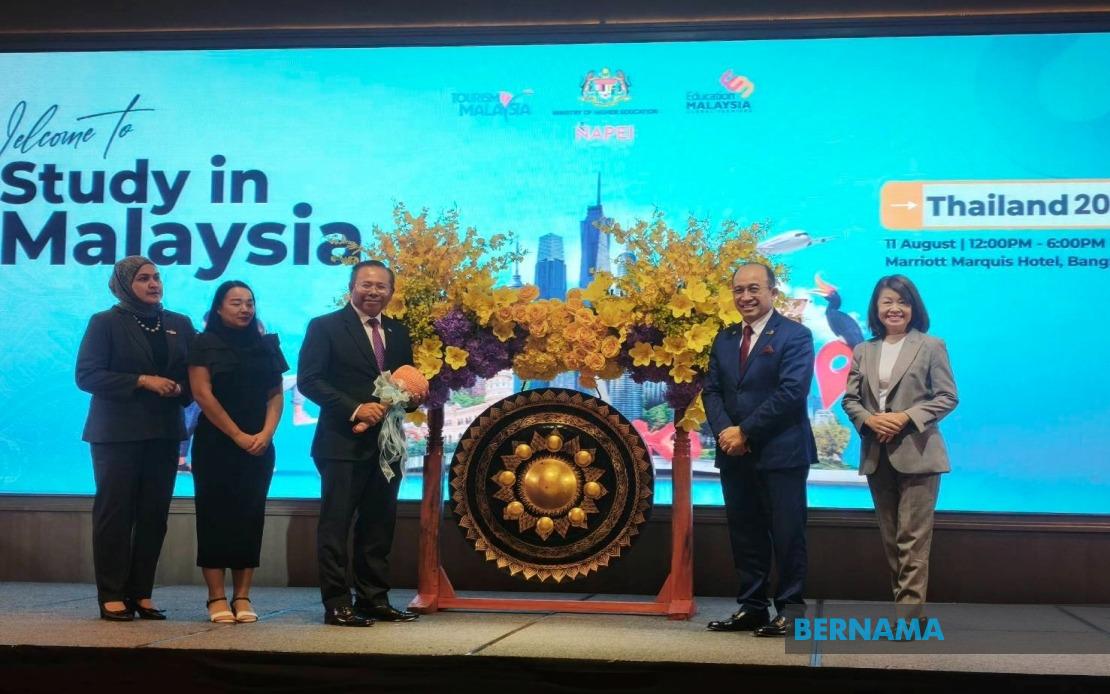
Malaysia is intensifying efforts to recruit Thai students into its higher education system, seeking to expand the current intake by more than one-fifth through a coordinated campaign that leverages cultural proximity, competitive pricing, and employment pathways unavailable in Thailand. The initiative represents a significant shift in Malaysia's international education strategy, moving beyond passive promotion to active engagement with Thailand's education agent network to systematically build student pipelines across the border.
Education Malaysia Global Services (EMGS), the government agency charged with internationalising the nation's universities, is anchoring this expansion through partnerships with Thailand's professional education consultancy sector. By engaging the Thai International Education Consultants Association (TIECA), an umbrella body representing 78 active education agents nationwide, EMGS is embedding itself within the institutional structures that influence Thai student decision-making. This approach recognises that education agents function as crucial intermediaries in Thailand's student mobility ecosystem, shaping perceptions of foreign universities and facilitating the logistical complexities of cross-border study.
Current enrolment figures provide the baseline for this ambition. EMGS data indicates that 634 Thai nationals were pursuing qualifications at Malaysian institutions during 2025, with the cohort evenly split between undergraduate and postgraduate levels. This population represents a modest but growing presence; Thai student numbers climbed from 300 in 2024 to 360 in 2025, translating to a 20 per cent year-on-year increase that suggests receptiveness to Malaysian education offerings. The agency's goal of securing an additional 20 per cent boost would push intake toward 430 to 440 students annually, substantially enlarging Thailand's contribution to Malaysia's international student body.
The geographic and economic case for studying in Malaysia carries particular weight for Thai students. Proximity to Thailand eliminates the expense and logistical burden associated with distant destinations, enabling family contact and reducing relocation costs. Malaysia's tuition fees undercut equivalent programmes in traditional destinations such as Australia, the United States, and the United Kingdom, making quality tertiary education accessible to middle-class Thai families for whom overseas study might otherwise remain aspirational. This affordability advantage becomes more pronounced when considered against Thailand's own private university sector, where institutional prestige and international accreditation often command comparable or higher fees.
Beyond the classroom, Malaysia's post-study employment landscape has emerged as a differentiating factor. The nation's Graduate Pass scheme permits international degree holders to work in Malaysia for one year following graduation, provided they secure employment in designated sectors. For Thai graduates, this transition pathway offers genuine labour market integration in a country with substantial service, technology, and professional services sectors. The opportunity to gainwork experience in an English-language business environment while maintaining geographic and cultural proximity to home country networks creates an incentive structure that competitors offering only departure dates struggle to replicate.
The recruitment campaign itself has taken on the character of a sustained roadshow penetrating Thailand's regional markets. Education fairs organised collaboratively by EMGS, Tourism Malaysia, and the National Association of Private Educational Institutions (NAPEI) visited Chiang Mai on August 9 and Bangkok on August 11, with a concluding event in Hat Yai on August 13. This tri-city itinerary reflects deliberate geographic segmentation, targeting northern Thailand's university-bound cohort in Chiang Mai, the capital's concentrated population of prospective students in Bangkok, and southern Thailand's cross-border population in Hat Yai. The sequencing and partnership structure signal coordination at ministerial level rather than ad-hoc promotional activity.
Malaysia's Ambassador to Thailand, Datuk Wan Zaidi Wan Abdullah, has articulated an additional policy initiative aimed at deepening Thai student attraction. The ambassador has proposed that Malaysian public and private universities establish dedicated scholarship programmes targeting Thai students, framing such schemes as catalysts for stimulating enrolment growth. Scholarships function as both direct financial incentives and symbolic affirmations of institutional commitment, signalling to prospective students and their families that Malaysian universities actively value Thai applicants. The ambassador's intervention suggests that recruitment expansion has gained traction at diplomatic levels, with educational exchange incorporated into bilateral relationship building.
This initiative unfolds within the broader context of Malaysia's positioning as a regional education hub. EMGS operates under the Ministry of Higher Education and bears responsibility for presenting Malaysia as an attractive destination for international talent and knowledge workers. By systematising Thai student recruitment and embedding it within formal diplomatic channels and professional networks, Malaysia is transitioning from opportunistic to strategic enrolment management. The approach acknowledges that Thai students represent a proximate, culturally compatible, and increasingly mobile demographic, particularly as digital technology enables seamless academic collaboration and part-time work arrangements across borders.
For Malaysia's university sector, Thai student growth carries institutional and commercial significance. International enrolment generates fee revenue, enhances campus diversity, and strengthens research collaboration networks. Thai students pursuing advanced degrees contribute to research activities and knowledge production in Malaysian institutions, while undergraduate cohorts provide stable tuition income. For the higher education sector, which has faced rationalisation pressures and funding constraints, international student recruitment functions as a revenue diversification mechanism that subsidises domestic provision and enables facility investment.
The coordination between EMGS and the Thai Embassy in Malaysia signals reciprocal commitment to deepening educational ties. Embassy involvement in student engagement activities legitimises Malaysian educational institutions within Thailand's diplomatic and official channels, removing potential concerns about credential recognition or institutional accreditation. Formal diplomatic backing transforms student recruitment from a purely commercial transaction into an element of bilateral relationship architecture, enhancing the perceived value and durability of the Malaysian education experience.
Thailand itself maintains demographic and economic characteristics conducive to student mobility. Rising incomes among urban middle-class Thai families have expanded the disposable income available for tertiary education abroad, while Thailand's own higher education capacity remains constrained relative to demand. Malaysian universities, positioned as accessible alternatives to saturated domestic institutions, capture demand that might otherwise flow to more distant destinations. The relative cost and proximity advantages become increasingly salient as Thai families evaluate competing options for children's educational futures.
Looking forward, the success of Malaysia's Thai recruitment initiative depends on sustained coordination between government agencies, universities, and private education agents. The formalisation of scholarship offerings and the expansion of post-study employment pathways will determine whether the 20 per cent enrolment increase target proves achievable or aspirational. For Thailand's students, Malaysia's recruitment drive offers expanded access to internationally recognised qualifications within geographic and economic parameters that render overseas education feasible for broader socioeconomic strata.

